On this page
Jump directly to the part you want to read.
“The key is not to prioritize what’s on your schedule, but to schedule your priorities.” — Stephen R. Covey
This quote captures the heart of effective time management. A busy schedule does not necessarily mean a meaningful day. When we allow every notification, meeting, request, and small task to determine where our time goes, our most important goals can easily get pushed aside. Real productivity begins when we consciously decide what matters and give those priorities a place in our day. Time management is therefore not about filling every empty hour or working endlessly. It is about protecting your attention, choosing meaningful work, and creating enough space for rest and life beyond work.
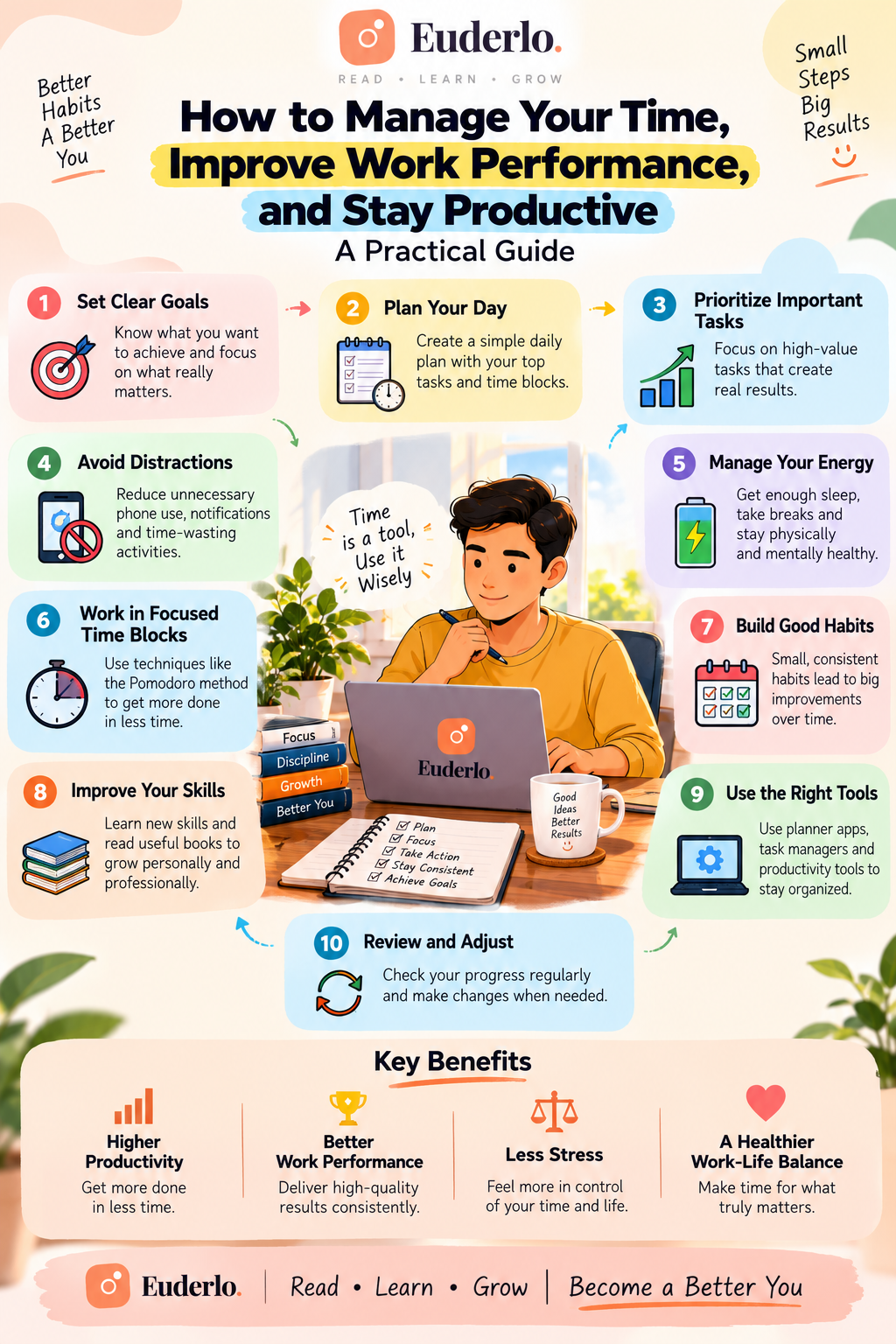
We all have the same 24 hours, but somehow we don't all experience those 24 hours in the same way. There are days when you finish your most important work, respond to people, learn something new, exercise, spend time with your family, and still feel that you had enough breathing room. Then there are days when you sit in front of your laptop for eight or ten hours and, when the day finally ends, you wonder where all that time went. I have experienced this difference myself, and I think most of us have. Sometimes the problem isn't that we don't work hard enough. The problem is that our time, attention, priorities, energy, and environment are not working together. This is where time management suggestions, practical tips for time management, effective methods for time management, and realistic productivity tips become useful. Time management is not about turning yourself into a machine that works every minute of the day. It is about learning how to decide what deserves your attention, when you should do it, what you should ignore, and how you can work without constantly feeling overwhelmed.
What Time Management Really Means
When people hear the words “time management,” they often imagine calendars, planners, alarms, to-do lists, productivity apps, and complicated schedules. But time itself cannot really be managed. We cannot create more hours, pause the clock, or save today's unused hour for tomorrow. What we can manage is our behavior during the time we have. We can decide what to prioritize, what to postpone, what to eliminate, and where to place our attention.
This distinction changed the way I think about productivity. Instead of asking, “How can I do more things today?” I prefer asking, “What are the few things that genuinely deserve my time today?” That question is much more powerful because doing more does not automatically mean accomplishing more.
You can spend an entire day replying to emails and still avoid the project that actually matters. You can attend five meetings and finish nothing meaningful. You can keep rearranging your task list without completing the task itself. You can watch dozens of productivity videos and still procrastinate on the work sitting directly in front of you.
That is why the best time management suggestions are not always about adding another technique. Sometimes the best technique is removing something.
Research supports the idea that time management is associated with meaningful outcomes. A large meta-analysis found that time management was moderately related to job performance, academic achievement, and well-being, while also being associated with lower distress. PubMed The lesson I take from this is not that a perfect schedule will solve our lives. Rather, having a greater sense of control over our time can support both performance and well-being.
Why We Struggle to Manage Time
If managing time were simply a matter of knowing what to do, none of us would struggle with it. The reality is more complicated because our attention is constantly being pulled in different directions.
Think about a normal working day. You may have email, WhatsApp messages, phone calls, meetings, notifications, social media, colleagues asking questions, clients needing answers, family responsibilities, unexpected problems, and your own thoughts competing for attention. Even when you are physically sitting at your desk, your mind may be somewhere else.
This is why one of the most important tips for time management is to understand that attention is limited.
We often say, “I don't have enough time,” when what we actually mean is, “I don't have enough uninterrupted attention.”
There is a major difference.
You may technically have three hours to complete an article, but if you check your phone every five minutes, answer messages throughout the process, switch between websites, and keep opening new tabs, those three hours are not three hours of focused work.
Our modern working environment makes this especially difficult. Digital communication can make us feel that we need to be constantly available. But availability and productivity are not the same thing.
Sometimes the most productive thing you can do is become temporarily unavailable.
Being Busy Is Not the Same as Being Productive
This is one of the most important ideas I want you to remember.
Busy means activity. Productive means progress.
You can be busy all day without moving closer to your most important goal.
Imagine that you want to start a website. You spend two hours choosing fonts, another hour changing colors, another hour checking competitors, and another hour organizing folders. You have been active for six hours, but perhaps the most important thing was actually writing the homepage content.
The same thing happens in offices. Someone may answer 60 emails but fail to complete an important report. A manager may attend meetings all day but make no meaningful decision. A student may reorganize notes for three hours without actually learning the material.
This is why I believe productivity tips should always begin with one question:
What outcome am I actually trying to create?
When the outcome becomes clear, many unnecessary activities become easier to identify.
The First Step: Decide What Matters
One of the simplest methods for time management is deciding your priorities before the day starts controlling you.
Don't wake up and immediately ask, “What should I do?”
Instead, decide beforehand.
What is the most important thing I need to accomplish today?
What would make today feel meaningful?
What task will create the greatest progress?
What deadline genuinely matters?
What can wait?
You don't need twenty priorities. If everything is a priority, nothing is.
I personally prefer thinking in terms of one major task and a few smaller supporting tasks. Your situation may be different, but the principle remains the same: give your best attention to the work that has the highest value.
This is especially important if you are building a career, freelancing, running a business, studying, or creating content. Your future is usually shaped by the important things you repeatedly make time for, not by the small tasks that constantly demand immediate attention.
The Top 3 Ways to Improve Work Performance
If someone asked me for the top 3 ways to improve work performance, I would start with three things: clarity, focused execution, and feedback.
The first is clarity. You need to know what success looks like. A vague task such as “work on the project” gives your brain too many possible directions. A specific task such as “finish the homepage design before 2 PM” gives you a clear starting point.
The second is focused execution. Once you know what matters, give it your attention. Put away unnecessary distractions, reduce notifications, close irrelevant tabs, and create a period during which you focus on one meaningful task.
The third is feedback. Look at your results. Did you finish what you planned? What interrupted you? What took longer than expected? What could you do differently tomorrow?
These top 3 ways to improve work performance create a simple cycle: decide what matters, focus on it, review what happened, and improve your system.
You don't need to become perfect. You need to become slightly better at organizing your effort.
3 Top Ways to Improve Work Performance Without Working Longer
The 3 top ways to improve work performance are not necessarily about increasing your working hours.
The first is to improve your focus. If you can complete meaningful work with fewer interruptions, you may accomplish more without extending your day.
The second is to remove unnecessary work. Ask whether a meeting is actually needed, whether a repetitive task can be automated, whether every email needs an immediate answer, and whether you are spending time on activities that create little value.
The third is to improve your skills. If you can learn to perform a task more efficiently, your productivity can improve without requiring more hours.
This is something I strongly believe in: sometimes the best productivity strategy is becoming better at what you already do.
A writer who improves research skills can write faster. A developer who understands reusable systems can build faster. A salesperson who improves communication can have better conversations. A manager who learns delegation can stop trying to do everything personally.
Working harder has limits. Improving your capability can change the limit.
Time Blocking: Give Important Work a Place
One of the most practical methods for time management is time blocking.
The idea is simple: instead of keeping every task inside one giant to-do list, give important activities specific periods of your day.
For example, you might decide that the first two hours of your morning are for deep work. After that, you process messages. Later, you handle meetings. In the afternoon, you complete administrative work and review your progress.
The exact schedule doesn't matter as much as the principle.
Important work needs protected time.
If you don't protect it, less important work will often consume it.
A calendar can become more powerful than a simple task list because it forces you to acknowledge that your time is limited. If your list contains fifteen tasks but your calendar realistically provides six productive hours, you have to make a decision.
That decision is useful.
It forces prioritization.
Why Small Tasks Can Destroy Your Day
Small tasks are dangerous because they feel easy.
Answering one email feels easy.
Checking one notification feels easy.
Opening Instagram for five minutes feels easy.
Reading one message feels easy.
Looking at one YouTube video feels easy.
The problem is not always the individual activity. The problem is what happens when dozens of small activities interrupt the larger task you were trying to complete.
A day can disappear through tiny interruptions.
This is why one of my favorite tips for time management is to batch similar tasks together.
Instead of checking email every few minutes, check it during designated periods.
Instead of responding to messages throughout your deep-work session, create a communication window.
Instead of repeatedly switching between small administrative tasks and creative work, group similar activities.
Batching reduces unnecessary switching.
Stop Trying to Multitask
We often praise people for multitasking, but many tasks that appear to happen simultaneously are actually rapid switches between activities.
You write a sentence.
You check a notification.
You return to the sentence.
You open an email.
You return to the document.
You check your phone.
You return again.
Your body may still be sitting in one place, but your attention has travelled repeatedly.
For demanding work, this can make concentration much harder.
Try something different.
Choose one meaningful task.
Set a realistic period.
Remove distractions.
Work.
Then take a break.
You don't have to focus for five hours without stopping. You simply need to create periods when your attention isn't being constantly divided.
The 80/20 Principle and Better Priorities
The Pareto principle, commonly known as the 80/20 rule, is often discussed in productivity because it encourages us to look for disproportionate results.
The exact 80/20 relationship should not be treated as a universal mathematical law for every personal situation. But the underlying question is useful:
Which activities create the greatest results?
Perhaps 20% of your clients create most of your revenue.
Perhaps a few types of content bring most of your website traffic.
Perhaps one skill creates most of your professional value.
Perhaps a few distractions consume most of your lost time.
The point is not to force everything into an 80/20 formula.
The point is to look for leverage.
When you find the activities that matter most, protect them.
Productivity Tips for People Who Procrastinate
Procrastination is often misunderstood as laziness.
Sometimes it is not.
Sometimes we procrastinate because a task feels unclear, difficult, boring, emotionally uncomfortable, or too large.
If you tell yourself, “I need to write 4,000 words,” your brain may feel resistance.
Instead, say, “I will write the introduction.”
Once you begin, the next step often becomes easier.
Break large tasks into visible actions.
Don't write “build website.”
Write “create database.”
Then “create homepage.”
Then “write hero section.”
Then “build navigation.”
Then “test mobile layout.”
A large goal becomes a sequence of smaller actions.
This is one of the most useful productivity tips I have learned: make starting easier than avoiding the task.
Your Environment Influences Your Productivity
We often blame ourselves when our environment is constantly encouraging distraction.
If your phone is beside your keyboard, you will probably look at it more.
If social media is open in another browser tab, you may click it.
If your workspace is chaotic, it may create additional friction.
If the tools you need are difficult to access, starting becomes harder.
This is why good productivity isn't only about willpower.
Design your environment so that the behavior you want becomes easier.
Keep important files accessible.
Prepare tomorrow's workspace today.
Remove unnecessary notifications.
Put distracting apps away.
Keep your most important task visible.
Your environment can either support your intentions or fight against them.
Work Performance Is Also About Skills
Sometimes we think we have a time-management problem when we actually have a skill problem.
Imagine that a task takes you three hours because you don't know how to do it efficiently. You might believe that you need better time management, but what you actually need is better knowledge.
This is why learning is such an important part of productivity.
Improve your writing.
Improve your communication.
Learn technology.
Learn data analysis.
Learn project management.
Improve your research skills.
Learn negotiation.
Develop leadership skills.
Improve your ability to use the software already available to you.
The more competent you become, the easier certain tasks become.
Books for Soft Skills
If you are looking for books for soft skills, don't limit your search to books with “soft skills” in the title.
Look for books about communication, emotional intelligence, negotiation, leadership, psychology, relationships, decision-making, listening, confidence, and human behavior.
Reading about these subjects can change the way you understand people and yourself.
But there is something I want to emphasize: reading is not the same as developing a skill.
You can read ten books about communication and still communicate poorly.
You can read about leadership and still avoid responsibility.
You can read about negotiation and still be afraid to ask for what you want.
The real transformation happens when you take an idea from a book and practice it in your life.
This is also why I created Euderlo around books, learning, and personal growth. I don't want reading to stop at information. I want the ideas we discover to become useful in our everyday lives.
If you enjoy learning through books, you can also explore Euderlo's Atomic Habits summary, which connects repeated behavior with identity, systems, environment, and personal change. Atomic Habits — Euderlo
Remote Work Tips for Staying Focused
Remote work can be incredibly convenient.
You don't have to commute.
You can often create a more comfortable environment.
You may have greater flexibility.
You can sometimes structure your day around your personal responsibilities.
But remote work also removes some of the natural boundaries that exist in an office.
Your bed may be ten steps away from your laptop.
Your family may be nearby.
Your phone may be beside you.
Household responsibilities may interrupt your day.
There may be no physical signal telling you when work begins or ends.
This is why one of the most practical remote work tips is to create a consistent start and finish to your working day.
It doesn't have to be complicated.
Get ready.
Prepare your workspace.
Review your priorities.
Start your first important task.
At the end of the day, review what you completed, write down what needs attention tomorrow, close your work applications, and physically leave your workspace if possible.
Create a beginning and an ending.
Work From Home Tips That Actually Help
Some of the most useful work from home tips are surprisingly basic.
Don't work from your bed if you can avoid it.
Create a dedicated workspace.
Keep your desk reasonably organized.
Use headphones when appropriate.
Communicate your availability to people around you.
Take real breaks.
Move away from the screen.
Don't eat every meal while working.
Create a shutdown routine.
And most importantly, don't assume that working from home means you need to be online all day.
Research on working from home doesn't show one universal result. A systematic review of 37 studies found that outcomes varied substantially depending on the circumstances and type of work-from-home arrangement. PubMed Another systematic review of 20 peer-reviewed studies found mixed effects on employee performance and well-being. PubMed Central (PMC)
That makes sense to me because people don't work under identical conditions.
Your job matters.
Your personality matters.
Your home environment matters.
Your workload matters.
Your level of autonomy matters.
Your communication with your team matters.
Your ability to separate work from personal life matters.
So don't ask whether remote work is automatically productive.
Ask what conditions make remote work productive for you?
Remote Work Needs Boundaries
One of the biggest problems with remote work is that work can expand into every part of life.
You answer an email at 9 PM.
You check Slack while eating.
You open your laptop on Sunday.
You respond to a client while watching television.
Eventually, you are physically at home but psychologically still at work.
This is why boundaries matter.
If you can, establish working hours.
Communicate when you are available.
Turn off unnecessary notifications after work.
Create a separate work area.
Don't feel guilty about finishing your workday.
A productive workday needs an ending.
Meetings and Communication
Another area where we can improve work performance is communication.
Not every conversation needs a meeting.
Not every email needs ten paragraphs.
Not every message requires an immediate response.
Before scheduling a meeting, ask yourself:
What decision needs to be made?
Who needs to participate?
Could this be communicated clearly in writing?
What should people prepare beforehand?
What outcome should exist when the meeting ends?
Meetings without a clear purpose can consume the time that people need for actual work.
Good communication is therefore a productivity skill.
Learn to write clearly.
Learn to listen.
Learn to ask better questions.
Learn to explain problems.
Learn to provide useful feedback.
Learn to disagree respectfully.
These abilities can improve both relationships and work performance.
Management Software: Useful Tool or Another Distraction?
Technology can help us manage tasks, projects, deadlines, teams, communication, documents, and workflows.
But there is a trap.
We sometimes spend more time managing our productivity system than actually doing productive work.
We download a new app.
Create categories.
Choose labels.
Add colors.
Move tasks around.
Build dashboards.
Change templates.
Then discover that the original task is still unfinished.
If you are searching for tip management software, first clarify what you mean by management software and what problem you need it to solve. If you are actually looking for task-management or time-management software, focus on simple capabilities: tasks, deadlines, reminders, collaboration, ownership, reporting, integrations, and ease of use.
The best productivity tool is not necessarily the one with the most features. It is the one that makes your work clearer.
Don't Let Software Become Your Boss
A management system should serve you.
It should help you remember.
It should help you prioritize.
It should help you collaborate.
It should help you see progress.
It should reduce mental load.
If it creates more work than it removes, reconsider it.
Before choosing software, ask:
What problem am I solving?
Who will use it?
What information needs to be tracked?
What can be automated?
What needs human judgment?
Can my team understand it quickly?
Will people actually maintain it?
These questions are much more useful than simply asking which software is “the best.”
Time Management and Stress
Poor time management can create a feeling of constantly being behind.
You may finish one task and immediately worry about another.
You may go to sleep thinking about unfinished work.
You may start your morning already feeling late.
This is where planning can create psychological relief.
When your tasks are written down and prioritized, your brain doesn't have to continuously remember everything.
You can say:
“This is important, but it is scheduled for tomorrow.”
That simple decision can reduce mental noise.
Research on employee time-management behavior has also found associations with positive outcomes including job satisfaction and job performance, alongside lower stress and burnout. PubMed
But there is an important warning here: time management should reduce stress, not become another source of stress.
If your productivity system makes you feel guilty every time you fail to follow it perfectly, simplify it.
Rest Is Part of Productivity
I think this is one of the most misunderstood ideas in modern productivity culture.
Some people believe that every free minute should be optimized.
Learn something.
Work.
Exercise.
Read.
Network.
Build a business.
Create content.
Study.
Repeat.
But human beings need recovery.
You cannot expect yourself to operate at maximum concentration indefinitely.
Rest is not necessarily wasted time.
Sleep matters.
Movement matters.
Relationships matter.
Leisure matters.
Quiet matters.
Sometimes doing nothing for a while gives your mind the space it needs.
The goal of productivity is not to eliminate rest. It is to make meaningful work possible without destroying the rest of your life.
Learn to Say No
Every time you say yes to something, you are spending some of your limited time.
Yes to a meeting.
Yes to a project.
Yes to a request.
Yes to a call.
Yes to another commitment.
Eventually, your calendar becomes crowded.
Learning to say no is therefore one of the most powerful but underrated time management suggestions.
You don't always need to say “no” permanently.
You can say:
“Not right now.”
“I don't have capacity this week.”
“Can we do this next week?”
“Could you send me the details first?”
“Is this urgent?”
“Which of my current priorities should I move to make room for this?”
That final question can be particularly powerful in professional situations.
It reminds people that your time is not unlimited.
The Weekly Review
A daily schedule helps you decide what to do.
A weekly review helps you understand how you actually spend your life.
Once a week, take some time to look back.
What did I accomplish?
What didn't I accomplish?
Why?
Where did my time go?
What distracted me?
Which meetings were useful?
Which tasks created real progress?
What should I stop doing?
What should I delegate?
What should I automate?
What skill should I develop?
This is one of the best methods for time management because it transforms your experience into information.
You stop guessing.
You start observing.
And when you observe your behavior, you can change it.
A Simple Productivity System You Can Start Tomorrow
If everything I have written so far feels like too much, don't try to implement everything.
Start tomorrow with five simple actions.
First, write down your most important task.
Second, give it a protected block of time.
Third, put your phone away while doing it.
Fourth, process messages later instead of constantly switching.
Fifth, spend five minutes at the end of the day deciding what matters tomorrow.
That's it.
Don't build a complicated productivity machine.
Build something you can actually repeat.
After a week, review it.
Maybe you discover that mornings work better.
Maybe afternoons are better for meetings.
Maybe you need shorter focus blocks.
Maybe your phone is the biggest distraction.
Maybe your biggest problem isn't time at all; it is unclear priorities.
Adjust.
The Real Meaning of Productivity
I don't think productivity means doing more and more until every empty minute disappears.
For me, productivity means using your limited time intentionally so that your actions are connected to the life and career you actually want to build.
If you are a student, productivity might mean learning deeply rather than studying endlessly.
If you are a writer, it might mean producing meaningful work rather than constantly checking statistics.
If you are a developer, it might mean solving important problems rather than writing unnecessary code.
If you are an entrepreneur, it might mean focusing on customers and value rather than staying busy with small administrative tasks.
If you work from home, it might mean finishing your work effectively and then genuinely disconnecting.
Your definition of productivity can change according to your responsibilities.
There is no single perfect system.
My Final Advice
If you remember only a few things from this article, remember these.
You don't need to manage every minute. You need to manage your priorities.
You don't need to work longer. You need to work with greater clarity.
You don't need another productivity app if your priorities are unclear.
You don't need to eliminate every distraction. You need to protect important work from unnecessary distractions.
You don't need to copy someone else's schedule. Build a system around your real life.
And don't become obsessed with productivity.
We are not machines.
We have good days and bad days.
Sometimes you will finish everything.
Sometimes you won't.
Sometimes you will focus for three hours.
Sometimes you will struggle to focus for thirty minutes.
That doesn't mean your system has failed.
Look at the bigger picture.
Are you becoming more organized?
Are you learning?
Are you improving your skills?
Are you accomplishing meaningful work?
Are you protecting your health and relationships?
Are you becoming more intentional with your time?
If the answer is gradually becoming yes, you are moving in the right direction.
The top 3 ways to improve work performance ultimately come down to knowing what matters, giving it focused attention, and learning from your results. The 3 top ways to improve work performance are not magic tricks. They are habits of clarity, execution, communication, learning, and reflection.
And if you are still looking for the perfect tip for time management, perhaps the most useful one is this:
Stop trying to fit your entire life into your schedule. Decide what matters most, give it your attention, and allow everything else to take its appropriate place.
We don't get unlimited time.
We get today.
And what we repeatedly do with today gradually becomes our work, our skills, our relationships, our habits, and eventually, our life.
Frequently Asked Questions About Time Management
What are the best time management suggestions for improving productivity?
The best time management suggestions include setting clear priorities, planning your day, using time blocking, reducing distractions, avoiding unnecessary multitasking, and reviewing your progress. Instead of trying to complete everything, focus on the tasks that create the greatest value.
What is the best tip for time management?
One of the most effective tips for time management is to identify your most important task before starting your day. Give that task a specific time block and complete it before less important activities take your attention.
What are the most effective methods for time management?
Popular methods for time management include time blocking, the Pomodoro Technique, task batching, prioritization, the Eisenhower Matrix, and weekly planning. The best method depends on your work style, responsibilities, and the type of work you need to complete.
What are the top 3 ways to improve work performance?
The top 3 ways to improve work performance are setting clear priorities, protecting focused working time, and regularly reviewing your results. You can also improve your performance by developing communication, problem-solving, teamwork, and other important soft skills.
What are the best productivity tips for students and employees?
Useful productivity tips include creating a realistic daily plan, breaking large tasks into smaller steps, limiting phone notifications, taking meaningful breaks, and focusing on one important task at a time. Consistency is usually more valuable than trying to work intensely for a short period and then becoming exhausted.
What are the best books for soft skills?
Some useful books for soft skills include How to Win Friends and Influence People by Dale Carnegie, The 7 Habits of Highly Effective People by Stephen R. Covey, Atomic Habits by James Clear, and Mindset by Carol S. Dweck. However, reading alone is not enough; the real benefit comes from applying the ideas to your communication, relationships, work, and everyday decisions.
What are the best remote work tips for staying productive?
Effective remote work tips include establishing fixed working hours, creating a dedicated workspace, communicating expectations clearly, scheduling focused work periods, and taking regular breaks. It is also important to create boundaries between your professional responsibilities and personal life.
What are the best work from home tips for avoiding distractions?
The most practical work from home tips include keeping your phone away during focused work, creating a dedicated workspace, turning off unnecessary notifications, communicating your working hours to others, and planning your day before you begin. A consistent routine can make working from home much easier and more productive.
What is time management software and how can it help?
Time management software can help you organize tasks, deadlines, schedules, projects, and working hours in one place. These tools can make it easier to understand where your time goes and keep important responsibilities organized, but software should support good time-management habits rather than replace them.
How can I improve my time management and productivity every day?
Start small by choosing your three most important tasks, assigning time to them, removing unnecessary distractions, and reviewing your progress at the end of the day. Over time, consistent planning, focused work, and regular reflection can help you manage your time better and become more productive without making your daily schedule unnecessarily complicated.
Main Takeaway
The biggest lesson is that productivity is not about doing everything; it is about doing what matters with greater clarity and intention. We cannot control how many hours exist in a day, but we can decide where our attention, energy, and effort go. Start by identifying your most important priorities, protecting focused time, reducing unnecessary interruptions, and reviewing your results regularly. The top 3 ways to improve work performance are clarity, focused execution, and continuous feedback. If you work remotely, create boundaries that separate professional responsibilities from personal life. If you want to develop professionally, invest in communication, critical thinking, leadership, and other soft skills alongside technical abilities. Use productivity software and digital tools to support your system, not replace it. Most importantly, don't confuse being busy with being productive. You don't need to work longer hours to create better results. You need to become more intentional about how you use the hours you already have. Good time management should ultimately give you greater control, meaningful progress, and a healthier relationship with work.
A little context before you go
This article was written to provide practical, realistic, and actionable guidance on time management, productivity, work performance, remote work, and professional development. The goal is not to encourage people to work longer hours, but to help readers use their limited time, attention, and energy more intentionally.
The article combines practical productivity strategies with ideas from behavioral psychology, workplace research, and everyday experience. Topics such as prioritization, time blocking, multitasking, procrastination, soft skills, remote work, and productivity tools are explained in a way that can be applied by employees, students, freelancers, entrepreneurs, and work-from-home professionals.
Some recommendations are general strategies rather than universal rules. The most effective time-management method can differ from person to person, depending on their responsibilities, working environment, personality, and goals. Readers should adapt these techniques rather than trying to follow every productivity system at once.
Research and external resources have been referenced where appropriate to provide additional context. Readers should consult the original research or authoritative sources when making important professional or personal decisions.
Where these ideas come from
Sources are listed here when an article uses books, studies, official information, research, or other external material.