On this page
Jump directly to the part you want to read.
"We don't become mentally strong when life finally becomes easy; we become stronger every time we choose to keep going while life is difficult. You will have days when you question yourself, moments when fear feels louder than courage, and situations you cannot control. But you don't have to have everything figured out today. We can learn from what hurt us, grow through what challenged us, and begin again after every setback. Your strength isn't measured by how little you feel, but by how wisely you respond to what you feel. So when life feels heavy, remember this: you don't need to win every battle today. You only need to take the next step, and we can build strength from there."
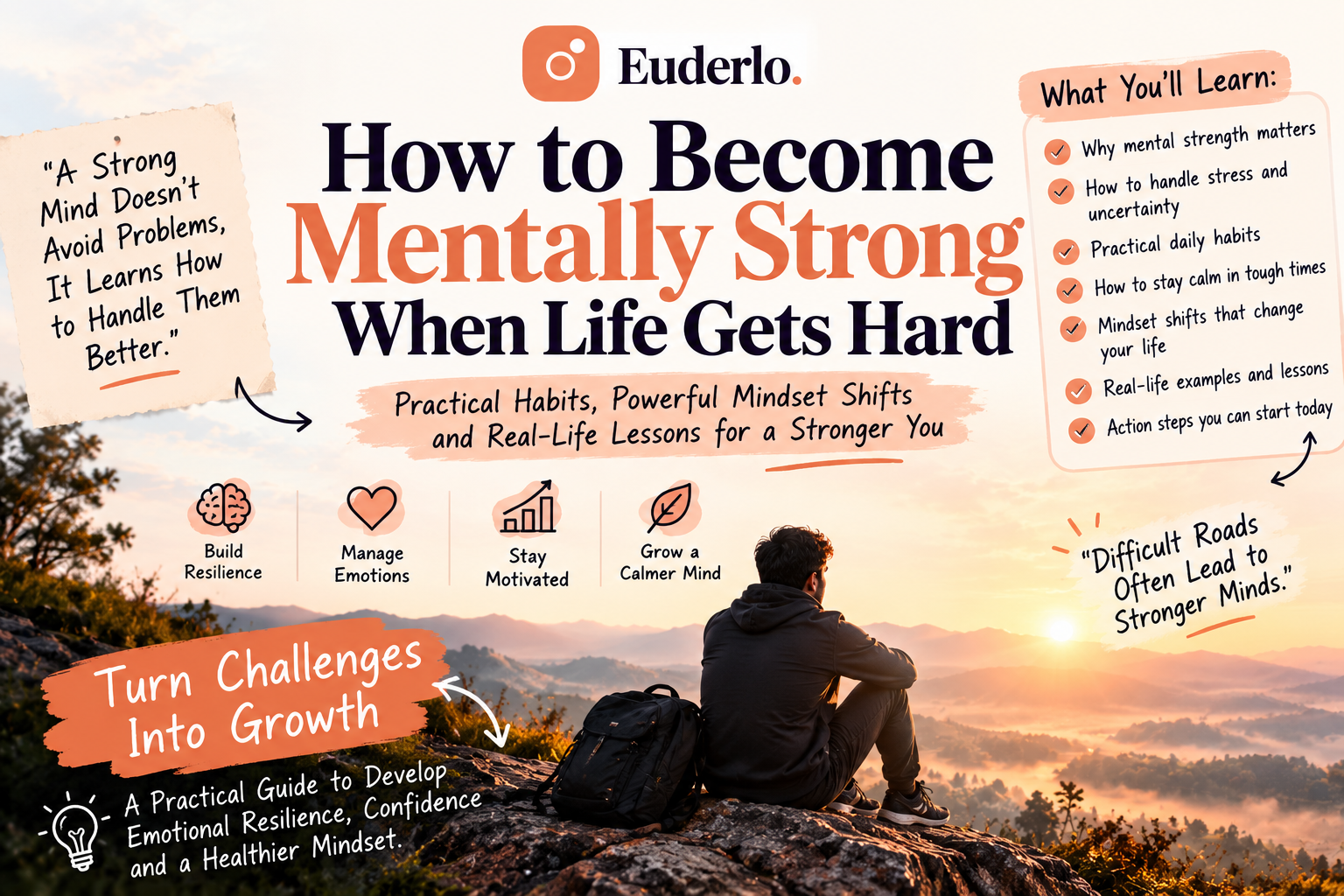
There comes a point in life when we realize that being physically strong is only one part of becoming a strong person. You can work out every morning, build a successful career, earn good money and look confident in front of everyone, yet still feel completely exhausted when you are alone with your thoughts. You can smile at people while carrying anxiety inside you, continue working while feeling emotionally drained, and tell everyone that you are fine when, honestly, you are not. This is why learning how to become mentally strong is not simply another self-improvement goal. It is one of the most important skills we can develop if we want to handle failure, rejection, uncertainty, pressure, disappointment and the unexpected parts of life without losing ourselves in the process.
When I think about mental strength, I don't think about someone who never cries, never feels afraid and never gets hurt. I think about someone who can feel all of those things and still find a way to move forward. A mentally strong person can be disappointed without becoming bitter, afraid without allowing fear to make every decision, hurt without spending years trying to hurt someone back, and uncertain without assuming that everything will end badly. Mental strength is not about becoming emotionless. It is about becoming aware enough to understand your emotions without allowing every emotion to control your behavior. Psychology often describes this ability through the broader idea of resilience: the process of adapting to difficult experiences with psychological, emotional and behavioral flexibility. The American Psychological Association's explanation of resilience makes an important point here: the skills and resources associated with resilience can be cultivated and practiced. That means mental strength is not reserved for people who were simply “born strong.” We can build it.
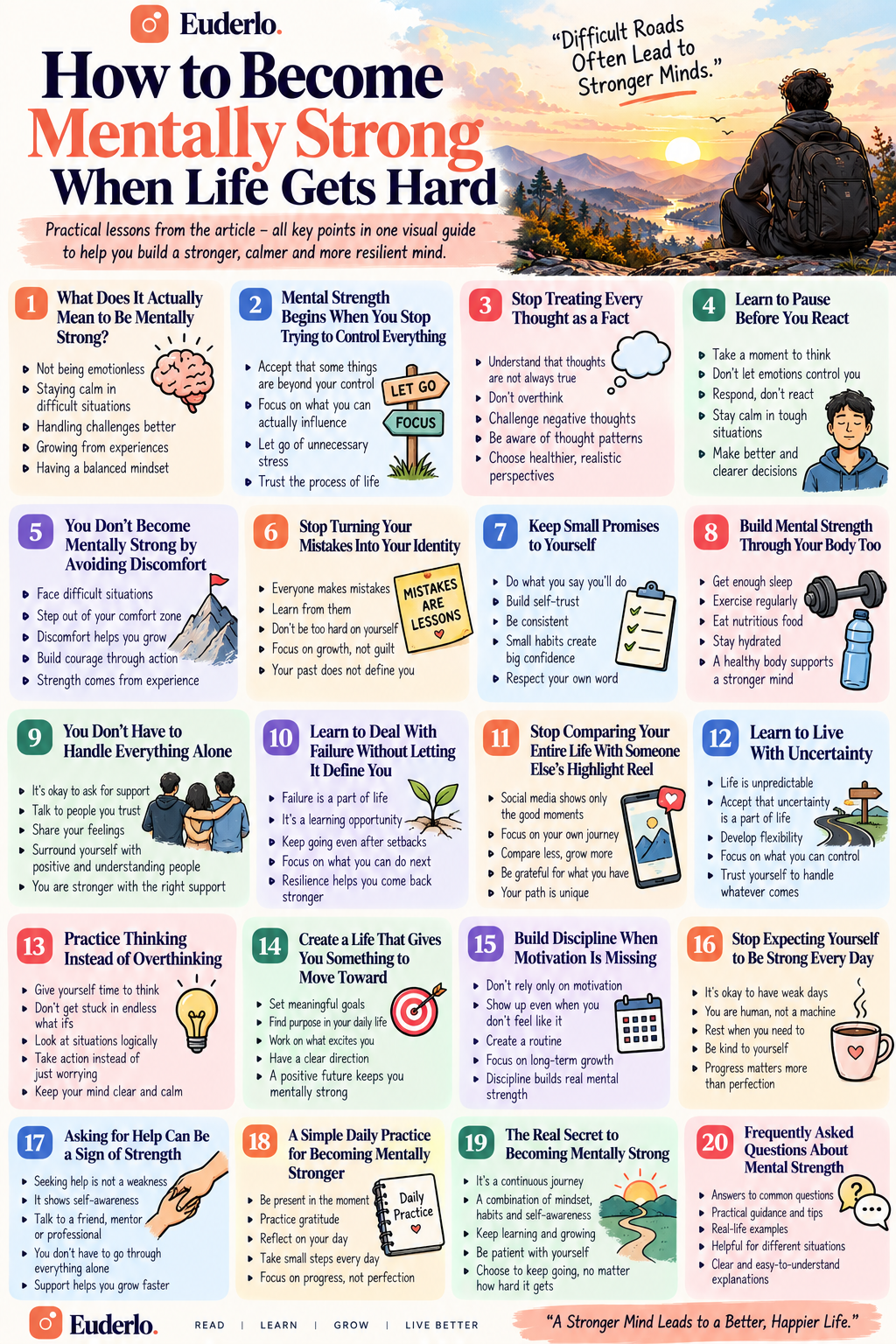
What Does It Actually Mean to Be Mentally Strong?
The phrase “mental strength” is used everywhere today, but it is often misunderstood. Social media sometimes makes mental strength look like becoming cold, ignoring everyone, never explaining yourself, never showing emotion and walking away from every relationship without looking back. That may look powerful in a short video, but real psychological strength is much more complicated and much more human. A mentally strong person does not necessarily have fewer emotions. They may simply have a healthier relationship with those emotions. They can recognize anger without immediately sending an aggressive message. They can experience sadness without deciding that their entire life is meaningless. They can feel anxious without treating every anxious thought as a prediction of the future. They can admit that something hurt them without allowing that pain to become their entire identity.
This distinction matters because there is a huge difference between emotional control and emotional suppression. Suppression says, “I am not allowed to feel this.” Emotional awareness says, “I feel this, and I want to understand why.” The second approach is far more useful because emotions contain information, even though they do not always provide accurate instructions. Feeling jealous does not necessarily mean someone has done something wrong. Feeling afraid does not necessarily mean you are in danger. Feeling rejected does not necessarily mean you are unworthy. Feeling angry does not automatically mean you should react. The stronger response is to create a small space between the emotion and the action. In that space, you get the opportunity to choose what happens next.
This is one of the foundations of emotional intelligence and self-awareness. The more clearly we understand our internal patterns, the less likely we are to become prisoners of them. Sometimes the biggest change in our life begins with something incredibly simple: noticing what we are doing while we are doing it.
Mental Strength Begins When You Stop Trying to Control Everything
One of the biggest reasons people feel mentally exhausted is that they spend enormous amounts of energy trying to control things that were never completely under their control. We want people to understand us. We want relationships to last. We want our plans to work. We want our careers to progress on schedule. We want everyone to treat us fairly. We want our future to be predictable. We want our mistakes to disappear. But life does not make that agreement with us.
You can work hard and still be rejected. You can love someone sincerely and still lose them. You can make a careful plan and still encounter something you never expected. You can do your best at work and still face circumstances that have nothing to do with your effort. You can explain yourself perfectly and still be misunderstood.
Mental strength begins when we learn to distinguish between what belongs to our responsibility and what does not. The question is no longer, “How can I make everything happen the way I want?” Instead, it becomes, “What is actually within my control right now?” That question can completely change the way we deal with stress. The APA's guidance on dealing with uncertainty similarly emphasizes accepting that uncertainty exists while directing attention toward what we can control.
Imagine that you applied for a job and didn't get selected. You cannot control the interviewer's final decision. You cannot control who else applied. You cannot rewrite the past interview. But you can control whether you learn from the experience, improve your skills, update your résumé, apply somewhere else and prepare differently next time. The mentally exhausting question is, “Why didn't they choose me?” The mentally stronger question is, “What can I do now?”
That doesn't mean we should never feel disappointed. Disappointment is normal. It simply means we don't have to build a permanent home inside it.
Stop Treating Every Thought as a Fact
One of the most important lessons I have learned about becoming mentally strong is that a thought can feel incredibly real without necessarily being true. Our minds are constantly interpreting events. Sometimes those interpretations are useful. Sometimes they are influenced by fear, insecurity, previous experiences or exhaustion.
You receive no reply from someone you care about and immediately think, “They don't care about me anymore.” You make one mistake at work and think, “Everyone probably thinks I'm incompetent.” You see another person's success and suddenly think, “I'm falling behind in life.” You experience a difficult month and conclude, “Nothing ever works for me.”
Notice what happened in each situation. Something happened in reality, and then the mind created a story around it.
The fact is that someone hasn't replied. The story is that they don't care. The fact is that you made a mistake. The story is that everyone thinks you are incapable. The fact is that another person succeeded. The story is that you are behind. The fact is that you had a difficult month. The story is that your entire future will be difficult.
Mental strength doesn't mean forcing yourself to think positively. It means learning to think accurately. Instead of asking, “How can I convince myself that everything is great?” ask, “What do I actually know?” and “What am I assuming?”
That difference can protect you from hours of unnecessary overthinking.
Learn to Pause Before You React
There are moments when a few seconds of silence can save us from weeks of regret. Someone says something that hurts you, and your first instinct is to respond immediately. Someone sends an angry message, and you type an even angrier reply. Someone rejects you, and you want to prove that they made a mistake. Someone criticizes you, and your mind immediately starts preparing a defense.
We have all done this.
But reacting immediately gives the emotion control over the decision. Pausing gives you control back.
The next time you feel a powerful emotional reaction, don't ask yourself, “What do I feel like doing?” Ask, “What response will I respect tomorrow?”
That question is surprisingly powerful. Sometimes the answer will be to speak. Sometimes it will be to walk away. Sometimes it will be to apologize. Sometimes it will be to set a boundary. Sometimes it will be to wait until you are calm enough to understand what you actually want to say.
The goal isn't to become passive. It is to become deliberate.
You Don't Become Mentally Strong by Avoiding Discomfort
We naturally want to escape uncomfortable feelings. When we are bored, we reach for our phones. When we are anxious, we look for distraction. When a conversation becomes difficult, we avoid it. When a task feels overwhelming, we postpone it. When loneliness appears, we immediately search for someone's attention. When we fail, sometimes we stop trying because quitting feels less painful than failing again.
The problem is that constant avoidance teaches us that discomfort is something we cannot handle.
Mental strength grows when we gradually discover that discomfort is survivable.
You can sit with an uncomfortable thought without immediately acting on it. You can finish a difficult task without checking your phone every few minutes. You can have a difficult conversation respectfully. You can go to the gym when motivation is low. You can spend an evening alone without assuming that loneliness means something is wrong with you. You can receive criticism without immediately defending yourself.
This does not mean we should deliberately make life painful. It means we should stop interpreting every uncomfortable moment as something that must immediately disappear.
The WHO's current stress guidance emphasizes practical coping strategies, regular routines, sleep, physical activity and connection with other people as ways of managing stress.
Sometimes the strongest sentence you can tell yourself is simply: “This feels uncomfortable, but I can handle the next few minutes.”
Stop Turning Your Mistakes Into Your Identity
One of the easiest ways to weaken your confidence is to turn individual events into permanent statements about who you are.
“I failed” becomes “I am a failure.”
“I made a bad decision” becomes “I always ruin everything.”
“This relationship ended” becomes “Nobody will ever love me.”
“I procrastinated today” becomes “I'm lazy.”
“I lost money” becomes “I'll never be successful.”
These statements sound similar, but psychologically they are completely different. The first describes something that happened. The second attacks your identity.
When we define ourselves by our mistakes, we make improvement harder because we start believing that the problem is permanent. But behavior can change. Skills can improve. Decisions can be corrected. Knowledge can increase. Relationships can be understood differently. Habits can be rebuilt.
Instead of saying, “I am terrible at this,” try saying, “I haven't learned how to do this well yet.”
That one word—yet—keeps the door open.
If you're working on personal growth, Euderlo's guide on becoming the best version of yourself explores this same idea from a broader perspective: personal development is not about becoming perfect; it is about deliberately improving the person you are becoming.
Keep Small Promises to Yourself
There is another part of mental strength that doesn't receive enough attention: self-trust.
We often want confidence before we take action. But confidence frequently grows after we repeatedly prove to ourselves that we can rely on ourselves.
Tell yourself you will walk for twenty minutes, and then walk. Tell yourself you will read ten pages, and read them. Tell yourself you will spend thirty minutes working without checking social media, and protect those thirty minutes. Tell yourself you will wake up at a certain time, and make a genuine effort to do it.
These may look like ordinary habits, but psychologically they send a powerful message: “When I make a promise to myself, I try to keep it.”
You don't need to begin with a dramatic transformation. In fact, dramatic promises often collapse because they require too much effort to sustain. Start small enough that you can repeat the behavior. Then allow repetition to create identity.
This is one reason the ideas discussed in Euderlo's article on self-improvement habits are useful: meaningful change often becomes easier when we turn vague ambitions into small behaviors that can actually be repeated.
Build Mental Strength Through Your Body Too
We sometimes talk about the mind as if it exists separately from the body, but our physical condition can influence how we experience and respond to stress. Poor sleep, inactivity, constant stimulation and an unhealthy routine can make ordinary problems feel harder to manage.
The World Health Organization's guidance on self-care currently includes healthy eating, physical activity, sufficient sleep and connection with others among important self-care practices.
This doesn't mean that exercise or sleep magically solve every psychological problem. They don't. But they are foundations that can support your ability to function well.
Think about how different a problem feels after you have slept badly for several nights compared with how you feel after being rested. Think about how much easier it can be to clear your head after a walk. Think about how difficult it becomes to concentrate when your body is exhausted.
Harvard Health similarly highlights exercise, healthy eating and sufficient sleep as ways to improve the body's ability to deal with stress, noting that sleep deprivation can affect memory, attention, decision-making and learning.
So if you want to know how to build mental strength, don't ignore the boring fundamentals. Sleep. Move. Eat reasonably well. Rest. Spend time outside. Take care of your body. Mental strength isn't only built while sitting and thinking about your problems.
You Don't Have to Handle Everything Alone
There is a strange idea that strong people don't need anyone. I don't believe that.
Some of the strongest people I know are not the people who insist that they can handle everything alone. They are the people who know when to reach out.
Human beings are social creatures. Good relationships can provide emotional support, perspective, practical help and a sense that we don't have to carry every burden privately. Research reviewing social support and resilience has found substantial evidence connecting supportive relationships with better psychological and physical outcomes under stress.
The important part is choosing the right people.
You don't need twenty people who know everything about you. You may simply need one or two people with whom you can speak honestly. Someone who can listen without turning your vulnerability into gossip. Someone who can tell you when you are wrong without humiliating you. Someone who can remind you who you are when you temporarily forget.
But mental strength also requires boundaries. You can love people without allowing them to repeatedly disrespect you. You can forgive someone without returning to the same unhealthy pattern. You can care about someone while accepting that you cannot control their choices.
Connection gives us strength. Boundaries help us protect that strength.
Learn to Deal With Failure Without Letting It Define You
Failure can make us question everything.
You work on something for months and it doesn't work. You prepare for an interview and don't get the job. You start a business and lose money. You study hard and receive a disappointing result. You trust someone and the relationship ends badly.
The pain is real.
But failure doesn't automatically tell you who you are.
One of the healthiest ways to process failure is to become curious about it. Instead of only asking, “Why did this happen to me?” ask, “What can this experience teach me?”
What did I misunderstand? What was within my control? What wasn't? Which decision would I make differently? What skill was missing? Did I rush? Did I ignore information? Did I expect something unrealistic? Was the failure actually a failure, or was it simply an outcome I didn't want?
Sometimes the answer will be uncomfortable. Maybe we really did make a poor decision. But accepting that truth is more useful than protecting our ego.
A mentally strong person doesn't need every experience to prove that they were right.
They need experiences to help them become wiser.
Stop Comparing Your Entire Life With Someone Else's Highlight Reel
Comparison becomes particularly destructive when we compare our complete life with someone else's carefully selected moments.
You see someone's new car but don't see their financial obligations. You see someone's successful company but don't see the businesses that failed before it. You see someone's relationship photographs but don't know what happens when the camera is off. You see someone traveling while you are working through a difficult financial period. You see someone achieving a goal at twenty-five and suddenly believe you have wasted your life.
But you are comparing information you know with information you don't.
Social media has made this easier and harder at the same time. We have more access to other people's lives than any previous generation, but much of what we see is curated.
Mental strength means returning your attention to your own life.
Ask yourself, “What am I building?” “What matters to me?” “What did I learn this year?” “What have I improved?” “What should I focus on next?”
You don't need someone else's timeline to decide whether your life has value.
Learn to Live With Uncertainty
A large part of anxiety comes from wanting certainty about a future that cannot provide it.
Will this relationship last?
Will I succeed?
Will I get the job?
Will my business work?
Will my finances improve?
Will everything be okay?
We want answers now.
But life often gives us probabilities, possibilities and unknowns instead.
The goal isn't to become comfortable with every uncertainty overnight. It is to develop the ability to continue living while some questions remain unanswered. The APA's guidance on uncertainty similarly recommends accepting that uncertainty is part of life and redirecting attention toward areas where action is possible.
Sometimes you don't need to know what happens six months from now. You need to know what you can do today.
That shift can make an enormous difference.
Practice Thinking Instead of Overthinking
Thinking helps us solve problems.
Overthinking often keeps us trapped inside them.
The difference is movement.
Healthy thinking eventually leads to a decision, experiment, conversation or action. Overthinking repeatedly circles the same question without producing anything new.
You think about the conversation again.
Then again.
Then imagine what you should have said.
Then imagine what they might have meant.
Then imagine what could happen next.
Suddenly, an event that lasted ten minutes has occupied your mind for six hours.
When you notice this happening, ask yourself: “Is there something I can actually do about this right now?”
If yes, identify the action.
If no, acknowledge that the thought cannot currently be solved and return your attention to something meaningful.
This is not about forcing your mind to be silent. Minds think. That's what they do. The skill is learning that you don't have to follow every thought wherever it goes.
Recent WHO psychological self-help guidance includes techniques that involve noticing difficult thoughts and feelings without automatically letting them control your behavior, alongside grounding and values-based action.
Create a Life That Gives You Something to Move Toward
It becomes easier to endure difficult periods when your life contains things that genuinely matter to you.
Purpose doesn't have to sound grand.
Maybe you want to become financially independent.
Maybe you want to build a company.
Maybe you want to write books.
Maybe you want to become a better parent.
Maybe you want to help people.
Maybe you want to become healthier.
Maybe you want to learn.
Maybe you simply want to create a peaceful life that feels authentic.
Purpose gives effort a direction.
This is one reason books about meaning continue to matter. Viktor Frankl's Man's Search for Meaning, for example, explores the relationship between meaning, suffering and the human ability to choose one's attitude toward circumstances. If you're interested in this subject, you can explore the broader ideas behind the book through Euderlo's book summaries.
The important point isn't that suffering is automatically valuable. It isn't. Some experiences are simply painful and unfair. The point is that having something meaningful to move toward can influence how we respond when life becomes difficult.
Build Discipline When Motivation Is Missing
Motivation feels great when it arrives, but it is not reliable enough to build an entire life around.
Some days you will wake up inspired. Other days you will want to do absolutely nothing.
If you only work when you feel motivated, your progress will constantly depend on your mood.
Mental strength means learning to take useful action even when motivation is imperfect.
This doesn't mean forcing yourself to be productive every minute. Rest matters. Recovery matters. Life isn't a productivity competition.
It means understanding the difference between “I genuinely need rest” and “I am avoiding this because it feels uncomfortable.”
Sometimes you need a full night's sleep.
Sometimes you need a holiday.
And sometimes you simply need to start the task you've been avoiding for three weeks.
Learning that difference takes self-awareness.
Stop Expecting Yourself to Be Strong Every Day
This might sound contradictory, but becoming mentally strong also means accepting that you will sometimes feel weak.
There will be days when you don't feel confident.
There will be mornings when getting out of bed feels difficult.
There will be moments when you question decisions you once felt certain about.
There will be periods when you need more support.
None of that automatically means you have failed at becoming mentally strong.
The WHO's current definition of mental health describes mental health as a state of well-being that helps people cope with life's stresses, realize their abilities, learn and work, and contribute to their communities. It also emphasizes that mental health exists on a continuum and is influenced by individual, family, community and structural factors.
In other words, being mentally healthy doesn't mean being happy every day.
It means having the capacity and support to navigate life.
Sometimes strength looks like working hard.
Sometimes strength looks like resting.
Sometimes strength looks like setting a boundary.
Sometimes strength looks like saying, “I need help.”
Asking for Help Can Be a Sign of Strength
We need to talk about this because self-improvement content sometimes creates another problem: it makes people believe that if they were mentally strong enough, they would be able to solve everything themselves.
That's not true.
There are experiences that are too heavy to carry alone.
If persistent anxiety, depression, trauma, grief, overwhelming stress or other psychological difficulties are significantly affecting your ability to sleep, work, study, maintain relationships or manage everyday life, speaking with a qualified mental health professional can be an important step. WHO currently recognizes evidence-based psychological self-help as one part of a broader mental-health support system, while also emphasizing the importance of professional care when it is needed.
Asking for help does not mean you are weak.
It means you recognize that your well-being matters enough to receive support.
A Simple Daily Practice for Becoming Mentally Stronger
You don't need a complicated routine to start building mental strength. At the end of each day, take five or ten minutes and ask yourself what happened today, what you felt, what was actually under your control, what you handled better than you would have handled it in the past, and what one thing you want to do differently tomorrow. You don't have to write an essay. A few honest sentences are enough.
Over time, this practice can reveal patterns that are difficult to see when we are simply moving from one day to another. You may discover that you become more irritable when you don't sleep enough. You may notice that certain people consistently trigger anxiety. You may realize that social media makes you compare yourself more than you thought. You may notice that exercise helps you think more clearly. You may realize that some of your biggest problems are not caused by the situation itself but by the story you repeatedly tell yourself about it.
Self-awareness doesn't solve everything.
But it gives you a starting point.
The Real Secret to Becoming Mentally Strong
After everything we've discussed, I think the simplest way to understand mental strength is this: you don't need to control everything that happens to you; you need to gradually become better at deciding what you do next.
Life will still hurt.
People will disappoint you.
Plans will fail.
Money problems will appear.
Relationships will change.
You will make mistakes.
You will sometimes feel lost.
You will occasionally question whether you are moving in the right direction.
Becoming mentally strong does not remove these experiences.
It changes the way you meet them.
Instead of immediately reacting, you learn to pause. Instead of assuming the worst, you learn to examine the evidence. Instead of turning mistakes into an identity, you learn from them. Instead of trying to control everyone around you, you focus on your own choices. Instead of running from every uncomfortable emotion, you learn to sit with some of them. Instead of believing that asking for help is weakness, you recognize support as part of being human. Instead of waiting for motivation, you learn to take small actions consistently. Instead of comparing your life with everyone else's, you return to your own path.
And perhaps the most important thing is this: you don't have to become harder to become stronger.
You can remain kind.
You can remain sensitive.
You can care deeply.
You can love people.
You can cry.
You can be disappointed.
You can admit that something hurts.
You can ask for help.
And you can still be mentally strong.
For me, that is a much more meaningful definition of strength than simply becoming someone who doesn't care.
I don't want to become so strong that nothing affects me. I want to become strong enough that difficult things can affect me without completely destroying me.
That kind of strength is built quietly.
It is built when you don't send the message you will regret tomorrow. It is built when you get back to your routine after losing it. It is built when you admit that you were wrong. It is built when you keep a promise to yourself. It is built when you choose a difficult but healthy conversation instead of avoidance. It is built when you fail and decide to learn rather than disappear. It is built when you take care of your body while your mind is struggling. It is built when you ask someone for help instead of pretending everything is fine.
None of these moments look dramatic.
But they matter.
Because every time you respond to difficulty with a little more awareness, patience and courage, you are teaching yourself something important:
“I can handle difficult moments.”
“I can learn.”
“I can change.”
“I can begin again.”
And sometimes becoming mentally strong doesn't begin with changing your entire life.
It begins with taking the next right step.
Not the next hundred steps.
Just the next one.
Frequently Asked Questions About Mental Strength
1. How can I become mentally strong?
You can begin by learning to manage your reactions, accepting what you cannot control, building healthy routines, maintaining supportive relationships, challenging unrealistic thoughts and learning from setbacks. Mental strength develops through repeated practice rather than one sudden transformation. The APA specifically notes that the resources and skills associated with resilience can be cultivated and practiced.
2. How do I become mentally strong during difficult times?
Start by narrowing your attention to what you can control today. Maintain basic routines, sleep adequately, stay physically active, talk to someone you trust and break large problems into smaller actions. You do not have to solve your entire future while you are in the middle of a difficult moment.
3. Can you become mentally strong after failure?
Yes. Failure can become an opportunity to examine your decisions, identify missing skills and change your approach. The important distinction is between learning from failure and turning failure into an identity. “I failed at something” is very different from “I am a failure.”
4. How can I become mentally strong and stop overthinking?
Start by separating facts from assumptions. Ask yourself what actually happened, what you are imagining, whether you can do anything about it and what the next useful action is. If there is no action available, deliberately redirect your attention rather than repeatedly replaying the same thought.
5. Does being mentally strong mean controlling your emotions?
Not exactly. Mental strength is not about eliminating emotions. It is about developing the ability to experience emotions without automatically allowing them to dictate your behavior. You can be angry and still choose not to act aggressively. You can be afraid and still take a sensible step forward.
6. What habits make you mentally stronger?
Consistent sleep, regular physical activity, healthy eating, meaningful social connection, realistic self-talk, journaling, mindfulness, setting boundaries, learning from mistakes and maintaining small commitments can all support resilience and mental well-being. WHO currently includes sleep, physical activity, healthy eating and connection among important self-care practices.
7. Why do I feel mentally weak even when my life looks fine?
External circumstances don't completely determine internal experience. You can have a job, money, relationships or other things that appear positive and still experience stress, loneliness, anxiety or emotional exhaustion. Mental health exists on a continuum and is influenced by many individual and environmental factors.
8. Can exercise really help mental strength?
Exercise is not a universal treatment for psychological difficulties, but regular physical activity can support mood, stress management, sleep and overall well-being. Harvard Health and WHO both include physical activity among practices that can support healthier stress management and self-care.
9. Is asking for help a sign of mental weakness?
No. Support from trusted people can be an important part of resilience, and professional mental-health support can be appropriate when difficulties become persistent or interfere with daily functioning. Research on social support has found important links between supportive relationships and resilience under stress.
10. What is the most important thing to remember about becoming mentally strong?
Remember that mental strength is a process, not a personality label. You don't need to become fearless, emotionless or perfect. You need to become better at responding to reality: accepting what you cannot control, taking action where you can, learning from experience, caring for yourself and beginning again when necessary.
Main Takeaway
Mental strength isn't about becoming emotionless or pretending that nothing hurts you. It's about learning how to face difficult moments without allowing them to completely control you. We all experience failure, rejection, stress, uncertainty, disappointment, and days when we simply don't feel like ourselves. What matters is how we respond. You can become mentally stronger by focusing on what you can control, pausing before reacting, challenging negative thoughts, keeping small promises to yourself, taking care of your body, building supportive relationships, setting healthy boundaries, and learning from your mistakes instead of letting them define you. You don't have to change your entire life overnight. Start with one small decision, one healthier response, or one promise you can keep today. Over time, these small choices build self-trust, emotional resilience, confidence, and discipline. We cannot control everything life brings our way, but we can become better at choosing what we do next—and sometimes, that is where real mental strength begins.
This article is for anyone who wants to become mentally stronger and handle life's challenges with greater confidence and clarity. It can be especially useful for: People dealing with stress, pressure, or uncertainty who want to develop healthier ways.
A little context before you go
At Euderlo, we believe becoming mentally strong is not about becoming emotionless, perfect, or unaffected by the difficult parts of life. We all experience fear, disappointment, rejection, stress, uncertainty, and moments when we question ourselves. What matters is how we learn to respond to those experiences. This article was created to offer practical, thoughtful, and realistic guidance for anyone who wants to build mental strength, emotional resilience, self-confidence, and a healthier mindset.
We have focused on ideas that you can actually apply to everyday life rather than promising overnight transformation. Mental strength develops gradually through the choices we make, the habits we practice, the way we understand our emotions, and how we respond when things don't go according to plan. Our goal is not to tell you to ignore your feelings or simply “think positive,” but to encourage you to understand yourself more clearly and make more intentional decisions.
The psychological and health-related information referenced in this article is based on established sources and is presented for general education and personal development. It should not replace professional mental-health advice, diagnosis, or treatment. If you are experiencing persistent emotional or psychological difficulties that interfere with your daily life, consider speaking with a qualified mental-health professional.
At Euderlo, our hope is simple: that you leave this article feeling a little clearer, a little stronger, and ready to take your next step.
Where these ideas come from
Sources are listed here when an article uses books, studies, official information, research, or other external material.
- 01 https://www.apa.org/topics/resilience?
- 02 https://www.apa.org/topics/resilience/building-your-resilience?
- 03 https://www.who.int/news-room/questions-and-answers/item/stress?
- 04 https://www.who.int/news-room/fact-sheets/detail/self-care-health-interventions?
- 05 https://www.who.int/en/news-room/fact-sheets/detail/mental-health-strengthening-our-response?
- 06 https://www.health.harvard.edu/mind-and-mood/ramp-up-your-resilience?
- 07 https://pmc.ncbi.nlm.nih.gov/articles/PMC2921311/?