Learning how to improve focus and concentration is not about forcing yourself to work harder or eliminating every thought from your mind. It is about understanding your habits, managing distractions, and creating an environment that supports better attention. Whether you want to improve productivity, complete important tasks, or discover how to increase concentration in studies, small changes can make a meaningful difference.
In this guide, we will explore practical ways to improve focus, strengthen your attention span, and develop healthier daily routines. You will also learn how to concentrate on studies without unnecessary distractions and how to increase focus and concentration through simple, sustainable habits that fit your everyday life.
On this page
Jump directly to the part you want to read.
“Your life begins to change when you stop giving your attention to everything around you and start giving your best attention to what truly matters. Focus is not about doing a thousand things perfectly; it is about choosing one meaningful thing and giving it your time, energy, and patience. Every time you resist a distraction, you strengthen your discipline. Every time you return to your goal after losing concentration, you build resilience. Remember, your attention is one of your most valuable resources. Where you direct it today shapes what you learn, what you create, and who you become tomorrow.”
Have you ever sat down to study, read a book, or finish an important task, only to realize that your mind has wandered somewhere else? You read the same paragraph three times without understanding it, reach for your phone without thinking, or spend twenty minutes planning what you should do instead of actually doing it. If this sounds familiar, you are not alone. Many of us struggle to give our full attention to the things that matter, especially when distractions are always within reach.
Learning how to improve focus is not simply about forcing yourself to work harder. It is about understanding how your attention works, identifying what interrupts it, and building habits that make concentration easier. When we learn how to manage distractions, organize our environment, take care of our health, and approach difficult tasks differently, we can make meaningful progress without depending entirely on motivation.
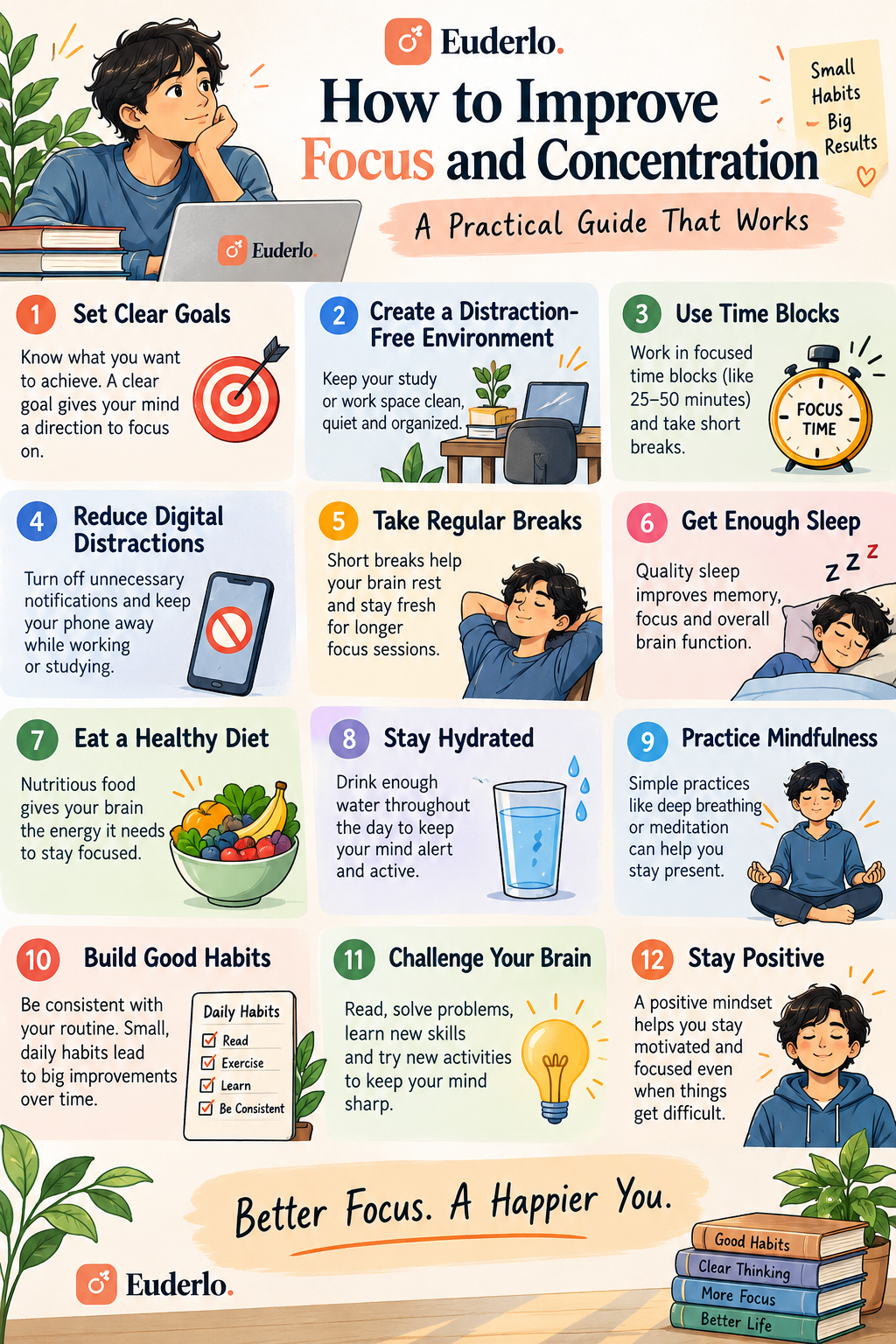
If you have been searching for how to increase concentration, how to improve focus and concentration, or how to increase concentration while studying, this guide will help you develop a practical approach. We will explore 15 strategies you can use in everyday life, from setting clear goals and managing screen time to practicing mindfulness and improving your study techniques.
You do not need to change your entire life overnight. You only need to understand what is preventing you from focusing and start making changes that you can maintain. As we will see, better concentration is often less about doing more and more about learning to give your attention to one meaningful thing at a time.
Understand What Focus and Concentration Really Mean
We often use the words focus and concentration as if they mean exactly the same thing. Although they are closely connected, understanding the distinction can help us improve both.
Focus means directing your attention toward a particular task, subject, or goal. When you sit down to write an assignment and decide to work on that assignment instead of checking messages, you are choosing where your attention should go.
Concentration is the ability to maintain that attention for a period of time. You might begin reading a chapter with complete focus, but if your mind repeatedly wanders after every few sentences, maintaining concentration becomes difficult.
Think of attention as a flashlight. You can point it toward one object, but you must also keep it there long enough to see the details. Focus helps you choose the object; concentration helps you continue paying attention to it.
Both abilities matter in everyday life. A student needs focus to begin studying mathematics and concentration to work through a challenging problem. A writer needs focus to choose an idea and concentration to develop it into a complete article. An employee needs focus to identify a priority and concentration to finish the work accurately.
The goal is not to eliminate every unrelated thought. Our minds naturally wander, and unexpected interruptions are part of life. The real goal is to notice when attention moves away from the task and learn how to bring it back.
We should also avoid assuming that a person who struggles to concentrate is lazy or undisciplined. Attention is affected by several factors, including sleep, stress, the environment, motivation, task difficulty, and individual circumstances. Recognizing these influences gives us a better starting point than criticizing ourselves.
Identify Why You Struggle to Concentrate
Before learning how to increase focus and concentration, take a moment to understand why you lose attention in the first place. The same concentration problem can have different causes for different people, so the most useful solution depends on what is happening in your daily life.
Digital distractions and constant notifications
Your phone may be one of the biggest obstacles to your concentration. A notification appears, you check it for a few seconds, and suddenly you are reading a message, watching a video, or scrolling through social media. Even when you return to work, you may find it difficult to remember exactly where you stopped.
The American Psychological Association explains that switching between tasks can create costs in time and efficiency, particularly when the tasks are complex. Its overview of multitasking and switching costs discusses why frequently moving between activities can interfere with performance.
The problem is not that technology is always harmful. We need our phones and computers for learning, communication, and work. The problem is allowing every notification, message, and interesting thought to interrupt whatever we are trying to accomplish.
Stress, overthinking, and mental overload
Sometimes your surroundings are quiet, your phone is away, and you still cannot concentrate. The reason may be that your mind is occupied with worries about money, relationships, career decisions, family responsibilities, or unfinished tasks.
When you keep thinking about what might happen tomorrow, it becomes harder to give your attention to what you need to do today. You might open a textbook, but your mind keeps returning to a conversation or a problem you have not resolved.
In such situations, simply telling yourself to focus may not help. You may first need to reduce the mental pressure you are carrying. Writing down your worries, identifying what you can control, and breaking an overwhelming task into smaller actions can make it easier to begin.
If overthinking is a recurring problem, you can also read Euderlo's guide on how to stop overthinking.
Poor sleep and low energy
Sleep is another important part of concentration. When you are tired, reading, remembering information, making decisions, and staying alert may become more difficult.
The US Centers for Disease Control and Prevention states that most adults need at least seven hours of sleep each night. Its guidance on sleep and health also recommends keeping a regular sleep schedule.
If you regularly sleep too little, no productivity technique can fully compensate for the lack of rest. Instead of blaming yourself for losing focus, examine whether your daily schedule gives your body enough time to recover.
Unclear goals and procrastination
Another common reason for poor concentration is not knowing exactly what to do next. You may write "study," "work on my project," or "improve my skills" on your to-do list, but these descriptions are too broad to guide your immediate actions.
When a task feels large or confusing, delaying it can feel easier than beginning. You might start cleaning your desk, checking messages, or planning your entire week because these activities provide a temporary sense of progress.
The solution is to make your next action specific. Instead of "study science," write "read the next three pages and answer five questions." Instead of "write an article," write "draft the introduction and first heading."
If you frequently delay important work, explore Euderlo's essay on why we procrastinate and how to stop delaying the life we want.
When concentration problems deserve attention
Occasional distraction is normal. However, if concentration difficulties are persistent, have recently become much worse, or interfere significantly with work, education, relationships, or daily responsibilities, consider speaking with a qualified healthcare professional. Sleep problems, stress, anxiety, medication effects, and other health-related factors can contribute to attention difficulties.
You do not need to diagnose yourself or assume that something is seriously wrong. The important thing is to seek appropriate support when ordinary adjustments are not enough.
How to Improve Focus: Start With One Clear Task
One of the most practical answers to how to improve focus and concentration is to stop trying to accomplish everything at once.
Imagine that you sit down to study. You have your textbook open, your laptop running, several browser tabs available, messages arriving, and a mental list of everything you still need to do. Even if you remain at your desk for two hours, your attention may be divided between many different things.
Instead, begin by choosing one meaningful task.
Ask yourself: "What is the one thing I want to complete during this session?" Your answer should describe an action or outcome that you can recognize when it is finished.
For example, if you are preparing for an examination, your goal might be to understand one chapter and solve ten related questions. If you are writing an article, your goal might be to complete the introduction and two main sections. If you are learning a new skill, your goal might be to complete one lesson and practice the technique it teaches.
Once you have chosen your task, identify the first physical action required to begin. Open the relevant book, write the first sentence, solve the first question, or launch the specific program you need.
This approach removes unnecessary decisions. You do not have to keep asking yourself what you should do next because you have already decided before the session begins.
Another useful strategy is to keep a separate list for unrelated thoughts. Suppose you suddenly remember that you need to reply to an email, buy something, or call a friend. Instead of acting on that thought immediately, write it down and return to your current task. You can deal with it later if it is genuinely important.
The principle is simple: give one task your attention before giving another task your attention. We cannot control every thought that enters our minds, but we can become more deliberate about which thoughts receive our time and action.
Create an Environment That Supports Concentration
Your surroundings can either make concentration easier or force you to resist distractions repeatedly. Rather than relying entirely on willpower, design your environment to support the behavior you want.
Keep your workspace simple
Choose a place where you can work with reasonable comfort and minimal interruption. You do not need an expensive desk or a perfect study room. A clean table, a comfortable chair, sufficient lighting, and the materials required for your task are often enough to get started.
Remove objects that regularly distract you. If you are studying from a textbook, keep unrelated books, entertainment devices, and unnecessary stationery out of your immediate workspace.
Before beginning, make sure that you have water, notebooks, chargers, and other essentials nearby. This reduces the need to get up repeatedly because you forgot something.
Put your phone out of reach
Silencing your phone is helpful, but placing it somewhere you cannot casually reach may be even more useful if you tend to check it automatically. You could leave it in another room, put it inside a bag, or give it to a family member for a short study session.
If you need your phone for educational purposes, activate focus mode, silence unnecessary notifications, and open only the application you need.
You can also set specific times to check messages. Instead of responding to every notification immediately, check them during planned breaks or after completing an important task.
Reduce noise and interruptions
Some people work best in silence, while others prefer gentle background sounds. Experiment with your environment rather than assuming that one arrangement suits everyone.
If family members or roommates frequently interrupt you, explain when you need uninterrupted time and how long you expect to be occupied. Even a clearly communicated 25-minute period can make a difference.
Prepare before you begin
A simple preparation routine can signal that it is time to work. Arrange your materials, write down your goal, silence unnecessary notifications, and sit down in the same workspace when possible.
This connects your environment with the behavior you want to repeat. Euderlo's article on how to build good habits explores how changing your surroundings and making useful actions easier can support consistent routines.
You do not have to create a perfect environment. You need one that removes enough friction for you to begin and continue your work.
Use Time-Blocking and the Pomodoro Technique
If you are wondering how to increase concentration without exhausting yourself, experiment with structured work sessions.
The Pomodoro Technique is a popular method that divides work into focused intervals separated by short breaks. A common starting pattern is 25 minutes of work followed by five minutes of rest. After several rounds, you can take a longer break.
The exact timing is not a scientific rule that everyone must follow. It is simply a practical framework that helps you begin, remain aware of time, and avoid working indefinitely without rest.
Start by selecting a task and setting a timer for 25 minutes. During that period, work on the selected task rather than switching between unrelated activities. If a distraction appears, note it and return to what you were doing.
When the timer ends, take a short break. Stand up, stretch, drink water, or look away from your screen. If you are studying, avoid automatically spending the entire break watching short videos, because doing so may make it harder to return to your work.
After the break, begin another session if you have enough energy and time.
Some tasks require more than 25 minutes to reach a useful stopping point. If you are writing, solving a difficult problem, or deeply engaged in a project, you may prefer a 40- or 50-minute interval. If you are exhausted, new to focused work, or studying a particularly difficult subject, shorter intervals may be more manageable.
Time-blocking complements this technique. Instead of keeping your entire day in your head, assign approximate periods to important activities. You might reserve the morning for demanding work, the afternoon for meetings or routine tasks, and the evening for revision or reading.
Remember that the purpose of a schedule is to guide your attention, not to make you feel guilty whenever life changes your plans. Use it as a flexible structure that helps you protect time for what matters.
Train Your Attention With Mindfulness
Mindfulness is the practice of paying attention to the present moment without immediately judging or reacting to every thought that appears. It can be useful when your mind keeps jumping between worries, memories, plans, and the task in front of you.
You do not need to sit cross-legged for an hour or learn complicated meditation techniques. Start with a few minutes of simple attention practice.
Sit comfortably and bring your attention to your breathing. Notice the air entering and leaving your body. After a while, you may begin thinking about something else. You might remember a pending task, wonder what someone thinks of you, or start planning what you will eat later.
When you notice this, gently return your attention to your breathing. Do not criticize yourself for getting distracted. The moment you notice that your attention has wandered is the moment you can practice bringing it back.
You can use the same principle while reading, studying, listening to someone, or completing a task. When you realize that you have been thinking about something unrelated, acknowledge it and return to what you were doing.
Research on mindfulness has explored its possible benefits for stress, sleep, and mental well-being. The US National Center for Complementary and Integrative Health provides an overview of the evidence in its guide to meditation and mindfulness. The findings vary by outcome, so mindfulness should not be presented as a guaranteed solution for every concentration problem.
The practical lesson is that you can learn to respond to distractions more deliberately. Instead of following every thought, you can notice it and choose whether it deserves your attention.
Try two to five minutes of mindful breathing before a study session for a week. If it feels helpful, continue and gradually adjust the duration. If it makes you uncomfortable, stop or try a different relaxation technique.
Improve Focus Through Sleep, Exercise, and Nutrition
We often search for a special technique to improve concentration while overlooking the everyday habits that influence our energy and alertness. You cannot expect to concentrate consistently if you regularly sleep too little, rarely move your body, or work for long periods without taking care of basic needs.
Build a consistent sleep routine
Sleep supports normal daytime functioning, learning, and memory. Most adults need at least seven hours of sleep each night, although individual needs vary. Teenagers generally require more.
Try to go to bed and wake up at reasonably consistent times. Reduce stimulating activities before bedtime, make your sleeping environment comfortable, and avoid allowing late-night scrolling to repeatedly shorten your sleep.
If you study late every night and wake up exhausted, consider whether your schedule is helping you learn or simply increasing the number of hours you spend with a book open. More study time does not necessarily mean better learning when fatigue makes it difficult to understand and retain information.
Move your body regularly
Physical activity supports general health and can contribute to mental well-being. The World Health Organization discusses the benefits of regular movement in its physical activity guidance.
You do not need an elaborate exercise routine to begin. A walk, a short stretching session, cycling, dancing, or a workout you enjoy can help you incorporate movement into your day.
If you have been sitting for several hours, try standing up and walking briefly before returning to work. Pay attention to how you feel afterward and choose a routine that fits your abilities and schedule.
Eat balanced meals and drink enough water
Your body needs adequate nutrition to function well. Aim for balanced meals that include appropriate sources of protein, whole grains, vegetables, fruit, and other foods that suit your dietary needs.
For example, an Indian student might choose dal with roti and vegetables, rice with rajma, curd with a balanced meal, or fruit and nuts as a snack. These are ordinary food choices, not special concentration treatments. No single food can guarantee better focus.
Stay hydrated, particularly when working for long periods or in hot weather. If you regularly skip meals and then struggle with hunger or low energy while studying, planning your meals may help.
Be cautious about products that promise extraordinary mental performance. Supplements, energy drinks, and excessive caffeine are not substitutes for adequate sleep, balanced nutrition, or professional advice when needed. Caffeine can also interfere with sleep, especially when consumed later in the day.
The aim is not to follow a perfect health routine. It is to give your body the conditions it needs to support your daily activities.
How to Increase Concentration in Studies
If you are a student searching for how to increase concentration in studies, you may believe that you need to sit at your desk for longer hours. But effective studying involves more than the amount of time you spend looking at a textbook. You also need methods that help you understand, retrieve, and apply information.
Set a clear study objective
Before beginning, decide what you want to accomplish. Instead of writing "study history," choose a specific goal such as understanding one topic, making a timeline of important events, or answering ten questions without looking at your notes.
Clear objectives make it easier to recognize progress. They also give your attention somewhere definite to go.
Use active recall instead of only rereading
One of the most useful ways to improve concentration in study is to make learning active. After reading a section, close the book and explain the main idea in your own words. Write down what you remember, solve a question, or test yourself using flashcards.
Researchers John Dunlosky and colleagues reviewed a range of learning techniques in a widely cited paper published in Psychological Science in the Public Interest. Their review identified practice testing and distributed practice as particularly useful techniques across a range of learning situations.
You can read the research through Improving Students' Learning With Effective Learning Techniques.
The practical implication is that repeatedly looking at information is not always the best way to learn it. Testing yourself helps you identify what you can actually remember and what you still need to understand.
Divide difficult chapters into manageable parts
A long chapter can feel overwhelming when you approach it as one enormous task. Break it into smaller sections and work through them in a sensible order.
Read one subsection, identify its main idea, and answer a few questions. Then move to the next subsection. If a concept is difficult, slow down and find another explanation instead of repeatedly reading the same paragraph without understanding it.
Use spaced repetition
Rather than trying to memorize everything in one sitting, revisit important information over multiple days. For example, review a concept on the day you learn it, test yourself the next day, and return to it several days later.
A 2021 meta-analysis by Donoghue and Hattie examined 242 studies involving 169,179 participants and found strong support for practice testing and distributed practice among the learning techniques it evaluated. You can read the findings in A Meta-Analysis of Ten Learning Techniques.
These techniques do not eliminate the need for focused effort, but they can make your study sessions more purposeful.
Keep one subject or task in front of you
If you are solving mathematics questions, avoid switching between mathematics, social media, and unrelated videos every few minutes. Finish a manageable set of questions before moving to another activity.
You can still study different subjects during the same day. The point is to reduce unnecessary switching within each focused session.
Create a distraction notebook
Keep a small notebook beside you. Whenever you remember something unrelated, write it down and return to your studies. During your break, review the list and decide which items genuinely require action.
This technique is especially useful if your mind frequently reminds you about unfinished chores, messages, or future plans.
Measure learning rather than hours
At the end of a study session, ask yourself what you can now explain or solve that you could not do before. Count completed problems, accurately recalled concepts, or topics you understand well.
Three focused sessions that help you understand a difficult topic may be more valuable than several hours spent rereading it without testing your knowledge.
For more ideas on creating a consistent learning routine, explore Euderlo's article on how to develop good study habits.
How to Focus and Study When Your Mind Keeps Wandering
You may understand every technique described above and still find that your mind wanders when you open your books. The solution is not to expect yourself to have complete control over every thought. Instead, develop a reliable response for the moments when concentration breaks.
First, identify what usually distracts you. Do you start worrying about the examination? Do you feel bored when a subject becomes difficult? Do you remember unrelated tasks? Or do you automatically reach for your phone whenever studying becomes uncomfortable?
Understanding your pattern helps you choose a practical response.
If you are worried about an examination, write down the specific concern and decide what action you can take. If the chapter feels too difficult, reduce the task to one concept or one question. If you are bored, switch to an active learning method, such as solving practice questions or explaining the topic aloud.
When your attention wanders, use a simple reset. Pause briefly, take a comfortable breath, look at your study objective, and return to the next action. You do not need to restart the entire session because you became distracted for a moment.
You can also use a technique called mental parking. Suppose you remember that you need to pay a bill or reply to an important message. Write it down so that you can deal with it later. If the matter is genuinely urgent, handle it appropriately; otherwise, return to your current task.
Another helpful approach is to lower the barrier to starting. Tell yourself that you will work on the subject for just five minutes. During that time, read one page, solve one question, or write a short explanation. Once you begin, you may find it easier to continue.
Most importantly, do not interpret every lapse in attention as a personal failure. Concentration is not a permanent state that you either possess or lack. It fluctuates with the task, your environment, your energy, and your circumstances.
If you want to know how to get concentration on studies, begin by making the next study action smaller, clearer, and easier to start. Then practice returning to it whenever your mind wanders.
Develop a Daily Routine for Better Focus
A daily routine helps you reduce the number of decisions you need to make before beginning important work. You do not have to copy another person's schedule. Build one around your responsibilities, energy levels, and available time.
In the morning, identify one or two priorities. If possible, avoid beginning the day with an extended period of social media scrolling. Instead, prepare for the most important activity you want to complete.
During your most alert hours, schedule demanding work or study. Begin with a clear objective, work in manageable intervals, and take breaks when necessary. If you have classes, a job, or family responsibilities, adapt your focused sessions to the time you actually have.
Later in the day, review what you completed and identify what remains unfinished. Move outstanding tasks to a realistic schedule rather than keeping them in your mind throughout the evening.
Before bed, prepare the materials you will need the next day. Decide when you will begin studying or working, set out your notebook, and choose the first task. This makes it easier to start without spending the next morning deciding what to do.
The routine should also include time for meals, movement, relaxation, and sleep. A schedule that leaves no room for rest may look productive on paper but become difficult to maintain.
You can make the process easier by connecting a new behavior to something you already do. For example, after breakfast, you might study for 25 minutes. After returning home, you might take a short walk and then begin your first work session.
Euderlo's guide to building good habits that last explains how small, repeatable actions can become part of your routine.
The most useful routine is not the one that looks impressive. It is the one you can realistically follow on ordinary days, including days when motivation is low.
A Practical 7-Day Focus Improvement Plan
You do not need to apply every strategy at once. Use the following seven-day plan to identify what helps you concentrate and begin building a more consistent routine.
Day 1: Observe your current habits. Complete one ordinary study or work session and notice when your attention wanders. Record the main distractions, your approximate working time, and anything that made concentration easier or harder. Do not judge your performance; collect information.
Day 2: Prepare your environment. Clear your workspace, keep necessary materials nearby, and silence unnecessary notifications. Place your phone out of reach if it distracts you. Complete at least one focused session and note whether the changes helped.
Day 3: Practice focused intervals. Try two 25-minute sessions with a five-minute break between them, adjusting the timing if necessary. Choose a specific objective for each session and measure what you actually complete.
Day 4: Make learning active. If you are studying, replace some rereading with practice questions, flashcards, or explanations in your own words. If you are working, finish with a short review of what you accomplished and what remains.
Day 5: Add movement and mindfulness. Take a short walk or stretch during a break. If you find it comfortable, practice a few minutes of mindful breathing before beginning your next session.
Day 6: Combine your most useful techniques. Choose a clear task, prepare your environment, work for a manageable interval, and take an intentional break. Try to follow a consistent starting time.
Day 7: Review and adjust. Look back at your notes. Which distractions appeared most often? Which changes made it easier to begin? Did shorter or longer sessions work better? Use the answers to create a routine for the following week.
Seven days is enough to begin observing patterns, but it is not a guarantee that your concentration will be permanently transformed. Continue practicing the methods that help you and adjust those that do not.
Common Mistakes That Make Concentration Harder
Even when you understand how to improve focus, certain habits can work against your efforts.
One mistake is expecting instant results. You may have spent months developing a routine of checking your phone whenever you feel bored. Replacing that behavior can take repeated practice. A difficult first session does not mean the approach cannot help you.
Another mistake is multitasking during demanding work. Switching repeatedly between messages, study material, and unrelated tasks can interrupt your progress. Complete one manageable piece of work before deliberately moving to the next.
A third mistake is studying for long hours without proper rest. Sitting at your desk for four hours does not automatically mean you have learned more than someone who studied for two focused hours. Track your understanding and results instead of treating time alone as proof of productivity.
You may also be making concentration harder by waiting for motivation. Motivation changes from day to day. A clear first action and a small commitment can help you begin even when you do not feel particularly enthusiastic.
Finally, avoid ignoring persistent concentration problems. Productivity methods can help with ordinary distractions, but they are not a substitute for professional assessment when difficulties are severe, new, or interfering with everyday life.
Remember that the goal is not to become a person who never gets distracted. It is to become someone who can recognize distraction, understand its causes, and return to meaningful work more deliberately.
Conclusion: Build Focus One Habit at a Time
Learning how to improve focus and concentration begins with understanding that your attention is influenced by more than willpower. Your environment, sleep, stress, daily routines, and approach to difficult tasks all play a role in how easily you can concentrate.
You do not need to become perfectly disciplined overnight. Start with one change that addresses your biggest obstacle. Put your phone away during study sessions, choose a clearer task, practice active recall, take a short walk, or establish a more consistent sleep schedule.
Then observe what happens and adjust your approach. If a technique helps, continue practicing it. If it does not suit your circumstances, try something else. Meaningful progress comes from learning what works for you and repeating those behaviors consistently.
If you are a student, remember that effective learning is not measured only by how many hours you spend at a desk. It is measured by what you understand, remember, and can apply. If you are working toward a personal or professional goal, the same principle applies: deliberate attention makes it easier to move from intention to action.
We live in a world where distractions are easy to find and attention is constantly being requested. You cannot control every interruption, but you can become more intentional about where your time and energy go.
Choose one task. Give it your attention. Return when you get distracted. Repeat tomorrow.
That is a practical place to begin building better focus, stronger concentration, and a more deliberate way of living.
Frequently Asked Questions About Focus and Concentration
How can I improve focus quickly?
Choose one task, remove the most obvious distractions, and work on a small, clearly defined action for a short period. If you are tired, hungry, or overwhelmed, address that need as well. A quick reset can help you begin, although it cannot guarantee perfect concentration.
How can I increase concentration while studying?
Prepare a quiet study space, define a specific learning goal, and use active recall or practice questions rather than relying entirely on rereading. Work in manageable sessions, take appropriate breaks, and revisit important material over several days.
How can I improve concentration in study when my mind keeps wandering?
Notice when your attention moves away from the task without criticizing yourself. Write down unrelated thoughts, identify what is distracting you, and return to the next small study action. If a subject feels overwhelming, break it into smaller sections.
Why do I lose focus after a few minutes of studying?
Possible reasons include digital distractions, insufficient sleep, stress, boredom, unclear goals, or a task that is too difficult or too easy. Observe when the problem occurs and experiment with one change at a time. Persistent difficulties may deserve professional attention.
How can I concentrate on studies without my phone?
Silence unnecessary notifications, enable focus mode, and keep your phone in another room or inside a bag. If you need it for learning, open only the required resource and set a specific time to check messages.
How long should I study before taking a break?
There is no single interval that works for everyone. Twenty-five minutes of work followed by five minutes of rest is one possible starting point. Adjust your sessions according to your task, energy, and ability to maintain attention.
Can meditation improve concentration?
Mindfulness practice may help some people become more aware of their thoughts and practice returning attention to the present moment. Research findings vary, however, and meditation should not be treated as a guaranteed cure for concentration difficulties.
What foods help concentration?
Balanced meals, adequate nutrition, and hydration support general health and normal functioning. Include a variety of foods that suit your needs rather than relying on one supposedly magical food or supplement. If you experience persistent fatigue or other symptoms, seek appropriate medical advice.
How can I focus on studying when I have no motivation?
Start with a small action that feels manageable. Open your textbook, read one page, or solve one question. You do not have to feel motivated before beginning; sometimes a clear and achievable first step is enough to get started.
How can I improve focus for long hours?
Prioritize adequate sleep, plan focused work sessions, take appropriate breaks, and reduce unnecessary task switching. Increase your working intervals gradually instead of forcing yourself into long sessions that leave you exhausted.
When should I seek help for concentration problems?
Consider consulting a qualified healthcare professional if concentration problems persist, worsen, begin suddenly, or significantly affect your education, work, or everyday life. Professional advice can help identify possible contributing factors and appropriate next steps.
Main Takeaway
Improving focus and concentration starts with understanding that attention is a skill you can strengthen through consistent practice. If you want to learn how to improve focus, begin by choosing one clear task, removing unnecessary distractions, and working in manageable time intervals. Avoid multitasking, keep your phone away during important activities, and create a comfortable environment that helps you concentrate.
If you are wondering how to increase concentration in studies, use active recall, practice questions, and spaced repetition instead of relying only on rereading your notes. Getting enough sleep, exercising regularly, eating balanced meals, and staying hydrated can also support your overall mental performance. Mindfulness and short breaks may help you manage distractions and return your attention to the task at hand.
Remember, learning how to improve focus and concentration does not require changing everything overnight. Start with one practical habit, observe your progress, and build a routine that works for you. Consistency, patience, and realistic goals can help you develop better concentration over time.
This article is for students, professionals, entrepreneurs, and anyone who struggles with distractions or lack of concentration.
A little context before you go
This article explores practical, research-informed ways to improve focus and concentration in everyday life. It combines actionable advice on managing distractions, developing effective study habits, improving sleep, practicing mindfulness, and building consistent routines. The content is designed for students, professionals, and anyone seeking better concentration and productivity. Scientific studies and reputable health resources are included to support key recommendations, while examples make the techniques easier to apply. Readers are encouraged to experiment with different strategies, track their progress, and develop sustainable habits rather than expect instant results. This article is for educational purposes and does not replace professional medical advice.
Where these ideas come from
Sources are listed here when an article uses books, studies, official information, research, or other external material.
- 01 https://www.apa.org/topics/research/multitasking
- 02 https://www.cdc.gov/heart-disease/about/sleep-and-heart-health.html
- 03 https://www.nccih.nih.gov/health/tips/8-things-to-know-about-meditation-and-mindfulness
- 04 https://www.who.int/news-room/fact-sheets/detail/physical-activity
- 05 https://journals.sagepub.com/doi/10.1177/1529100612453266