On this page
Jump directly to the part you want to read.
“Your habits may feel small when you repeat them today, but over time they become the quiet force shaping your character, your choices, your confidence, and ultimately the life you live. Every action you repeat is a vote for the person you are becoming.”
— Euderlo
We all want to improve ourselves, but most of us don't really struggle with knowing what to do. We already know we should exercise, read more, sleep better, save money, stop procrastinating, spend less time on our phones, and take better care of our minds. The difficult part is turning that knowledge into something we actually do every day. We start with motivation, create an ambitious routine, follow it for a few days, miss one day, and eventually return to our old patterns. If you've experienced this, you're not alone. Self-improvement isn't difficult because we don't know enough. It's difficult because changing repeated behavior takes patience, awareness, and consistency.
The good news is that you don't have to completely transform your life overnight. You don't need to wake up at 5 AM, read 100 books a year, exercise for two hours every day, or follow an impossibly strict routine. Real personal growth is usually much quieter than that. It happens when you make a slightly better decision today, repeat it tomorrow, and continue doing it long after the initial motivation disappears. Over time, those ordinary decisions become habits, and those habits begin shaping the person you become.
Research supports the importance of several behaviors discussed in this article. Studies on goal setting, progress monitoring, implementation intentions, physical activity, sleep, gratitude, and mindfulness suggest that specific and repeatable behaviors can support meaningful changes in behavior and well-being. For example, research on goal setting has found a positive, although modest, relationship between setting goals and behavior change, while research on progress monitoring suggests that regularly tracking your progress can improve goal attainment.
So, if you're searching for self-improvement habits that actually work, wondering how to improve yourself every day, or trying to figure out how to become a better version of yourself, don't start by trying to change everything. Start with a few habits that make your life better and that you can realistically continue.
Why the Best Self-Improvement Habits Are Usually Boring
The best self-improvement habits often look surprisingly ordinary. Reading a few pages, going for a walk, going to bed on time, writing down your priorities, putting your phone away while working, saving some money, or keeping a small promise to yourself doesn't feel like a dramatic transformation. There is nothing particularly exciting about doing the same useful thing again tomorrow. But that is precisely where much of personal growth happens.
We often look for a breakthrough when what we really need is repetition. One workout won't transform your health. One book won't transform your thinking. One productive day won't make you disciplined. But repeating useful actions for months can gradually change your abilities, decisions, confidence, and routines. That's why effective self-improvement habits may feel boring at first: their power comes less from intensity and more from what happens when ordinary actions accumulate over time.
Start Your Day Before You Start Your Phone
Think about the first few minutes after you wake up. For many of us, the phone is the first thing we reach for. We check messages, open social media, look at notifications, read the news, and suddenly our attention belongs to everyone except ourselves. Before we've even decided what kind of day we want to have, dozens of other people's thoughts and priorities have already entered our minds.
Try something different. Give yourself a little time before checking your phone. Drink some water, stretch, open the curtains, sit quietly, write in a journal, or simply think about what matters today. You don't need a complicated morning routine. The purpose is to begin your day intentionally instead of immediately reacting to whatever appears on your screen. One of the simplest daily self-improvement habits is learning to decide where your attention goes before the world decides for you.
“When you arise in the morning, think of what a privilege it is to be alive—to think, to enjoy, to love.”
— Marcus Aurelius, Meditations
Decide What You Actually Want to Improve
"I want to improve my life" sounds good, but it isn't specific enough. What does improvement actually mean to you? Maybe you want to become healthier, earn more money, build confidence, improve your relationships, develop a career, learn a valuable skill, become more disciplined, or simply feel more peaceful.
Take some time to write those things down. When you know what you're working toward, everyday decisions become easier. Instead of asking yourself what you should do whenever you have free time, you can ask a much better question: "Does this move me closer to the person I want to become?" That question can become a powerful filter for your time, attention, money, relationships, and habits.
“Knowing yourself is the beginning of all wisdom.”
— Aristotle
Turn Your Goals Into Specific Actions
A goal gives you direction, but an action gives you somewhere to start. Saying "I want to get fit" is a goal. Saying "I'll walk for 30 minutes after work on Monday, Wednesday, and Friday" gives that goal a structure. Saying "I want to read more" is an intention. Saying "I'll read ten pages before bed" gives you something you can actually do.
This is why vague goals often fail. We tell ourselves that we'll exercise more, save more, learn more, or become more productive, but we never decide exactly when and how those things will happen. Research into implementation intentions has found that specific "if-then" plans can help people translate intentions into behavior. Instead of saying, "I'll stop procrastinating," try saying, "If I feel like avoiding my work, I'll spend five minutes on the first part of the task before doing anything else."
“A goal is a dream with a deadline.”
— Napoleon Hill
Read Every Day
You don't need to read 50 or 100 books every year. You can start with ten pages a day. What matters is developing a relationship with learning. Read about psychology, philosophy, business, history, science, money, relationships, creativity, biographies, or subjects you know almost nothing about.
And don't read only to collect information. Read to change the way you think. A good book should occasionally challenge your assumptions and make you reconsider something you thought you understood. When we read deeply, we aren't simply filling our minds with facts; we're exposing ourselves to different ways of seeing the world. That makes reading one of the most valuable habits for personal growth.
“Today a reader, tomorrow a leader.”
— Margaret Fuller
Write Down Your Thoughts
There are thoughts we carry around for days without really understanding them. We know we're stressed, but we don't know why. We know we're unhappy, but we can't explain what is missing. We know we're avoiding something, but we don't want to admit what it is.
Writing can create some distance between you and those thoughts. You don't need to become a professional writer or follow a complicated journaling method. Take five or ten minutes and ask yourself: What am I feeling? What am I worried about? What am I avoiding? What went well today? What did I learn? What do I want to change? You may be surprised by how much clearer your thoughts become when you see them written down.
“Writing is thinking on paper.”
— William Zinsser
Move Your Body Regularly
You don't need to become obsessed with fitness to take care of your body. You simply need to move consistently. Walk, cycle, swim, run, stretch, play a sport, or do strength training. Find something you can realistically continue doing.
The World Health Organization recommends that adults get 150–300 minutes of moderate-intensity aerobic physical activity each week, or an equivalent amount of vigorous activity, along with muscle-strengthening activities on at least two days per week. You don't have to achieve the perfect routine immediately. If you're currently inactive, starting with regular walks and gradually increasing your activity can be a much more realistic approach.
Exercise isn't only about looking better. Taking care of your physical health can support your overall well-being and make it easier to show up for the other parts of your life.
“Take care of your body. It’s the only place you have to live.”
— Jim Rohn
Protect Your Sleep
We often treat sleep as something we can sacrifice whenever life gets busy. We work late, scroll through our phones, watch another episode, answer messages, and then wonder why we're exhausted the next morning.
Sleep deserves to be treated as part of your health rather than as leftover time. The CDC says adults aged 18–60 generally need at least seven hours of sleep per night. Try to maintain a reasonably consistent sleep schedule, create a comfortable sleeping environment, and give yourself time to wind down before bed. You can have the best productivity system in the world, but if you're constantly exhausted, using it becomes much harder.
“Sleep is the best meditation.”
— Dalai Lama
Plan Tomorrow Before You Go to Bed
One of the easiest ways to make your life feel more organized is to spend five minutes planning the next day. You don't need to write down twenty tasks. Choose the few things that genuinely matter.
Write down the most important task, one personal priority, and one small task you've been avoiding. When you wake up, you won't have to spend the first hour wondering what you should do. You already have a direction. Planning your day doesn't guarantee that everything will go according to plan, but it reduces unnecessary decision-making and gives your attention somewhere useful to go.
“By failing to prepare, you are preparing to fail.”
— Benjamin Franklin
Make Difficult Tasks Smaller
We often procrastinate because a task feels too large. "I need to write the entire article" sounds overwhelming. "I'll write the introduction" sounds manageable. "I need to clean the whole house" feels exhausting. "I'll clean my desk for five minutes" feels possible.
When you're stuck, make the first step smaller. You don't have to finish the entire task immediately. You simply have to begin. Once you start, you may find that the task isn't as difficult as your mind made it seem. One of the most practical self-improvement habits for productivity is learning that starting small is still starting.
“Great things are done by a series of small things brought together.”
— Vincent van Gogh
Track Your Progress
If you want to improve something, give yourself a way to see whether you're actually improving. Track your workouts, reading, spending, study time, writing, sleep, screen time, or another behavior that matters to you.
Research on progress monitoring has found that monitoring can improve goal attainment on average. The purpose isn't to punish yourself when you miss a day. It's to create awareness. When you can see what you're actually doing instead of relying on what you think you're doing, you can make better decisions.
“What gets measured gets managed.”
— Peter Drucker
Make Your Environment Help You
Sometimes we think we lack discipline when the real problem is that our environment constantly encourages the opposite behavior. If your phone is beside you while you're working, you'll probably check it. If your workout clothes are buried in a cupboard, exercising requires another decision. If your book is hidden while your phone is always within reach, you already know which one you're more likely to pick up.
Make good habits easier. Put your book somewhere visible. Keep your exercise clothes ready. Turn off unnecessary notifications. Remove distracting apps from your home screen. Small changes in your environment can reduce the amount of willpower required to do the things you actually want to do.
“You are the average of the five people you spend the most time with.”
— Jim Rohn
Replace Bad Habits Instead of Only Fighting Them
If you want to stop checking social media every few minutes, simply telling yourself "Don't check your phone" may not be enough. Instead, decide what you'll do when the urge appears. Maybe you'll take a breath, stand up, drink some water, or work for another five minutes.
The goal isn't only to remove a bad habit. It's to create a better response to the trigger that normally produces it. When we replace a behavior with something useful, the change can become easier to maintain.
“We first make our habits, and then our habits make us.”
— John Dryden
Learn Something Valuable Every Day
Personal development isn't only about mindset. It is also about becoming more capable. Spend 15 or 30 minutes learning something that could improve your future. You might study communication, writing, sales, technology, marketing, finance, design, public speaking, leadership, or artificial intelligence.
You don't need to become an expert quickly. Give yourself a year. Imagine what happens when you spend even a small amount of time developing one useful skill every day for twelve months. The result may be far greater than you expect.
“Live as if you were to die tomorrow. Learn as if you were to live forever.”
— Mahatma Gandhi
Protect Your Attention
Your attention is one of your most valuable resources, yet we often give it away without thinking. Notifications, short videos, unnecessary conversations, emails, social media, and constant multitasking can fragment your attention throughout the day.
Try giving yourself periods of uninterrupted work. Put your phone away, close irrelevant tabs, turn off unnecessary notifications, and focus on one meaningful task. You don't need to work for eight uninterrupted hours. Even a focused 30–60 minute session can be valuable when compared with an hour spent constantly switching between tasks.
“It is not enough to be busy; so are the ants. The question is: What are we busy about?”
— Henry David Thoreau
Spend Time Alone
Being alone and being lonely aren't the same thing. Sometimes we need time without constant entertainment so that we can hear our own thoughts.
Go for a walk without headphones. Sit somewhere quietly. Have a cup of tea without opening your phone. Write in your journal. Think about your life.
Ask yourself, "Am I happy with the direction I'm going? What am I avoiding? What do I really want? Am I living according to my own values or someone else's expectations?" You don't always find clarity by consuming more information. Sometimes you find it by becoming quiet enough to think.
“Be able to be alone. Lose not the advantage of solitude.”
— Thomas Browne
Practice Gratitude
Gratitude doesn't mean pretending everything is perfect. You can have problems and still appreciate what is good. You can want more from life and still be grateful for what you already have.
Try writing down three things you're genuinely grateful for at the end of the day. They don't have to be extraordinary. A good conversation, a meal, your health, a friend, a peaceful morning, an opportunity, or simply having another day can be enough.
Research published in 2025 found that gratitude interventions were associated with a small improvement in well-being across studies involving more than 24,800 participants from 28 countries. Gratitude isn't a cure for life's problems, but it can influence what we choose to notice.
“Acknowledging the good that you already have in your life is the foundation for all abundance.”
— Eckhart Tolle
Learn to Pause Before You React
One of the biggest signs of personal growth is learning that you don't have to respond immediately to every emotion. Someone says something that hurts you, you become angry, and your first instinct is to reply. Before you do, pause.
Take a breath. Ask yourself whether the response you're about to give will actually improve the situation or simply release your anger. Emotional maturity doesn't mean never becoming angry or upset. It means creating enough space between what happens and what you do next to make a better decision.
“When angry, count to ten before you speak. If very angry, count to one hundred.”
— Thomas Jefferson
Learn to Say No
Every yes has a cost. When you say yes to something unnecessary, you're often saying no to something else—your time, your health, your work, your family, your goals, or your rest.
You don't have to attend everything. You don't have to answer every request immediately. You don't have to explain every boundary in detail. Sometimes "I can't commit to that right now" is enough.
Learning to say no isn't about becoming selfish. It's about understanding that your time and energy are limited and should be spent intentionally.
“The difference between successful people and really successful people is that really successful people say no to almost everything.”
— Warren Buffett
Have the Difficult Conversation
There may be a conversation you've been avoiding because you don't know how it will go. Maybe you need to apologize, establish a boundary, tell someone how you feel, or address a misunderstanding.
Avoiding difficult conversations can create more anxiety than having them. Speak honestly, but don't use honesty as an excuse to be cruel. Listen as carefully as you speak. Sometimes becoming a better person means learning how to communicate when things are uncomfortable.
“Honest communication is built on truth and integrity and upon respect of the one for the other.”
— Benjamin E. Mays
Stop Comparing Your Timeline With Someone Else's
Someone will always be ahead of you in something. Someone will earn more money, build a successful career earlier, travel more, become healthier, get married sooner, or achieve something you've been trying to achieve.
But you are comparing your complete life with a small part of someone else's. Instead of asking, "Am I ahead of them?" ask, "Am I moving in the direction I want to go?" Compare yourself with who you were six months ago. That comparison can tell you much more about your actual growth.
“Comparison is the thief of joy.”
— Theodore Roosevelt
Become More Intentional With Money
Self-improvement isn't complete if we ignore financial habits. Start paying attention to where your money goes. Track your expenses. Separate needs from wants. Build savings. Learn basic financial concepts. Think before making unnecessary purchases.
Money doesn't automatically create happiness, but financial instability can limit your choices and create avoidable stress. Learning to manage your money is therefore part of becoming more responsible and independent.
“Beware of little expenses. A small leak will sink a great ship.”
— Benjamin Franklin
Take Responsibility for What You Can Control
Not everything that happens to you is your fault. Life can be unfair, people can hurt you, and circumstances can sometimes make things extremely difficult. But even when you can't control what happened, you can ask, "What can I do now?"
That question moves your attention toward action. Taking responsibility doesn't mean blaming yourself for everything. It means recognizing where your influence begins and using that influence instead of waiting for everything around you to change.
“The greatest glory in living lies not in never falling, but in rising every time we fall.”
— Nelson Mandela
Learn From Your Mistakes
Everyone makes mistakes. The important question is what happens afterward.
When something goes wrong, don't only ask, "Why did this happen to me?" Ask, "What can this teach me?" What did you overlook? What assumption was wrong? What would you do differently next time?
A mistake that teaches you something can become valuable information. A mistake you refuse to examine can become a pattern.
“Anyone who has never made a mistake has never tried anything new.”
— Albert Einstein
Choose Your Environment Carefully
The people around you influence what feels normal. If everyone around you constantly complains, complaining can become normal. If the people around you are learning, creating, exercising, taking responsibility, and trying new things, those behaviors may begin to feel normal too.
This doesn't mean you should abandon people simply because they're struggling. It means you should become aware of the influence your closest relationships have on you. Ask yourself who brings out the best version of you and spend more time around people who encourage healthy growth.
“Tell me who your friends are, and I will tell you who you are.”
— Miguel de Cervantes
Change the Way You Speak to Yourself
Imagine your closest friend made a mistake. Would you tell them they're useless and will never succeed? Probably not. Yet many of us speak to ourselves in ways we would never speak to someone we love.
Instead of saying, "I'm terrible at this," try saying, "I'm still learning this." Instead of "I always fail," try, "This attempt didn't work."
That's not fake positivity. It's a more accurate way of describing the situation. One mistake doesn't define you, and one difficult period doesn't have to become your identity.
“Whether you think you can, or you think you can’t—you’re right.”
— Henry Ford
Do Something That Makes You Uncomfortable
Growth often requires constructive discomfort. Apply for the job. Publish your writing. Speak in front of people. Ask the question. Start the project. Go to the gym. Learn something difficult.
You don't have to wait until you feel confident. Sometimes confidence comes after action. Every time you do something difficult and discover that you can handle it, you build evidence that you are capable of more than you previously believed.
“Do one thing every day that scares you.”
— Eleanor Roosevelt
Review Your Life Every Week
Give yourself 20 minutes at the end of every week to reflect. What went well? What went badly? What did you learn? Where did you waste time? What should you stop doing? What should you continue? What matters next week? This creates a simple feedback loop: you act, observe, learn, adjust, and act again. Personal growth becomes much easier when you're willing to regularly look at your behavior instead of simply hoping things will improve.
“The unexamined life is not worth living.”
— Socrates
Stop Trying to Transform Overnight
This might be the most important lesson in the entire article. We often become excited about self-improvement and decide to change everything at once. We want to wake up early, exercise every day, read 50 pages, meditate, learn a skill, start a business, save money, stop using social media, eat perfectly, and become completely disciplined.
Then we miss one day and feel like we've failed. Don't do that to yourself. Choose two or three good habits for self-improvement and make them sustainable. A simple routine you follow for a year is far more valuable than an extreme routine you abandon after a week.
“The journey of a thousand miles begins with one step.”
— Lao Tzu
Keep the Promises You Make to Yourself
Every time you make a promise to yourself and keep it, you create evidence that you can trust yourself. You don't need to make enormous promises.
Don't say, "I'll exercise for two hours every day." Say, "I'll walk for 20 minutes today." Don't say, "I'll read an entire book this week." Say, "I'll read five pages tonight."
Then keep the promise. Self-confidence isn't created only by telling yourself that you're capable. It grows when your actions repeatedly give you evidence that you can rely on yourself.
“We are what we repeatedly do. Excellence, then, is not an act, but a habit.”
— Aristotle
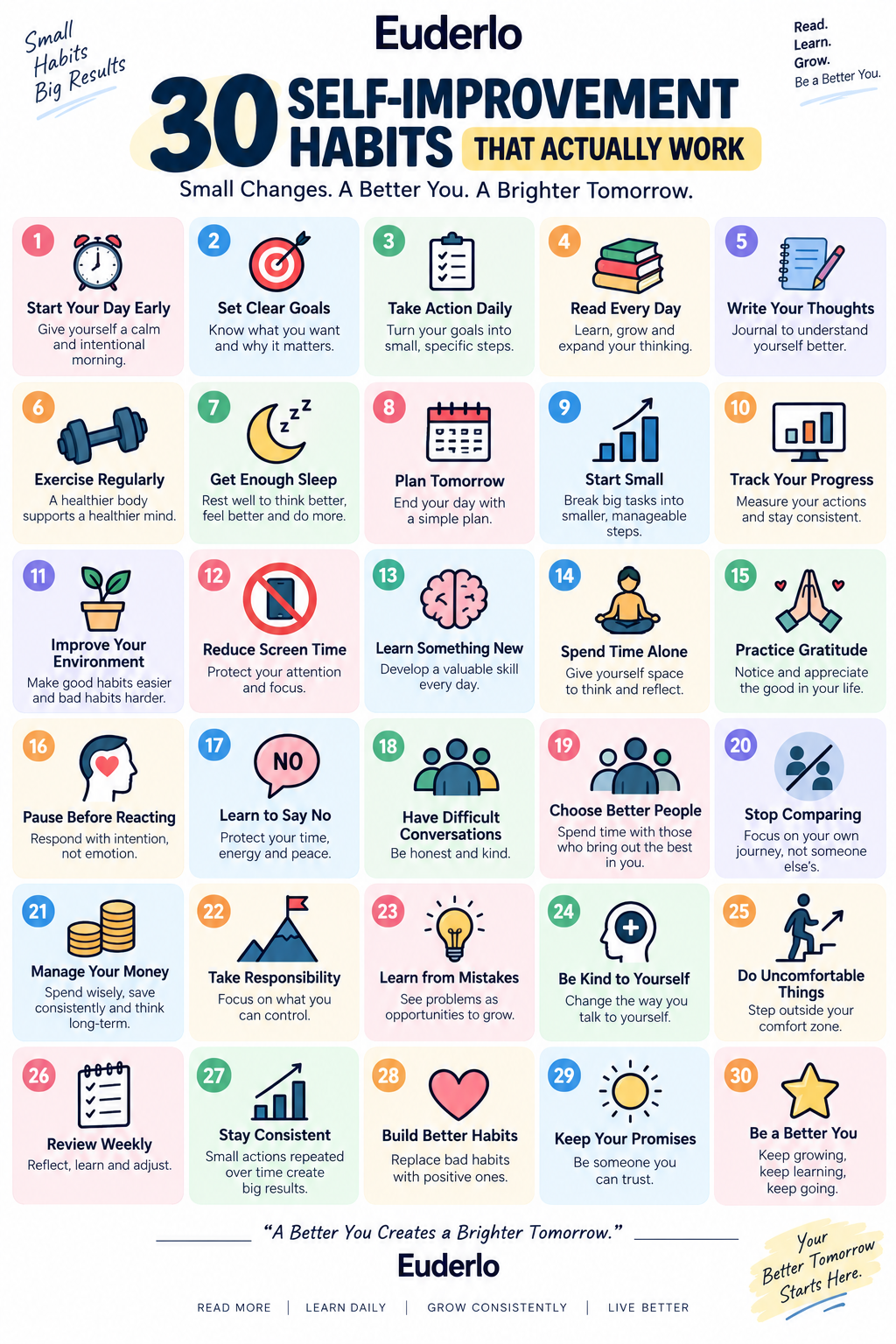
You Don't Need All 30 Habits
After reading this, you may feel like starting all 30 habits tomorrow. I wouldn't recommend it. Choose three habits that matter most to you right now. Maybe you decide to read ten pages every night, exercise three times a week, and plan tomorrow before going to bed.
Give those habits time to become normal. Then add another. Self-improvement isn't about creating the most impressive routine. It's about building a life you can actually maintain.
“Success is the sum of small efforts, repeated day in and day out.”
— Robert Collier
A Better Way to Think About Personal Growth
We often ask, "How can I change my life?" But perhaps a better question is, "What can I repeat?"
- You don't become disciplined because you decided to be disciplined once. You become disciplined by repeatedly doing what you said you would do.
- You don't become confident because you read one motivational quote. You become more confident when you repeatedly face situations that make you uncomfortable and discover that you can handle them.
- You don't become healthier because you had one perfect workout. You become healthier because you continue taking care of your body.
- You don't become wiser because you read one great book. You become wiser when you learn, reflect, make mistakes, and apply what you've learned. That is the real foundation of personal growth.
How to Choose the Best Habits for Self-Improvement
The best habits for self-improvement aren't necessarily the habits that look impressive or are recommended by everyone on the internet. The right habits are the ones that solve a problem you actually have and fit realistically into your life. If you're constantly tired, improving your sleep may matter more than creating an elaborate morning routine. If you struggle with procrastination, learning another productivity technique may not help as much as making your difficult tasks easier to start. And if you feel distracted all day, protecting your attention may be more valuable than adding another goal to your schedule.
Before choosing a new habit, ask yourself three simple questions: What do I want to improve? What is currently getting in my way? And what small action could make that situation better? This changes self-improvement from collecting habits into solving problems. You don't need twenty new habits. You need a few meaningful behaviors that you can repeat consistently. The most useful self-improvement habits are therefore personal, practical, and sustainable rather than simply popular.
The Best Self-Improvement Habits Depend on What You Want to Change
There is no single list of best self-improvement habits that works equally well for everyone. Your priorities determine which habits deserve your attention. Someone trying to become healthier may need to focus on movement, nutrition, and sleep, while someone struggling with procrastination may benefit more from planning, reducing distractions, and breaking difficult tasks into smaller actions. Someone trying to advance their career may need to spend more time learning valuable skills, improving communication, and protecting focused work.
This is why personal development should begin with an honest look at your current life. Instead of copying another person's routine, identify the area where a small improvement could create the biggest difference. Your self-improvement habits should support the person you are trying to become and the life you are actually trying to build. A habit becomes much easier to maintain when you understand why it matters to you.
How to Build a Self-Improvement Routine You Can Actually Maintain
Building a routine around self-improvement habits doesn't require changing your entire life on Monday morning. In fact, starting with too much can make consistency harder. Choose one or two habits that matter, make them small enough to complete even on a difficult day, and connect them to a part of your existing routine. You might read a few pages after dinner, write tomorrow's priorities before bed, walk after work, or spend a short period learning a useful skill each day.
Give yourself time to make the behavior feel normal before adding more. If you miss a day, don't turn that missed day into a reason to abandon the entire routine. Simply return to it. The goal isn't to build a perfect schedule that works only when everything goes according to plan. The goal is to create self-improvement habits that can survive busy days, low motivation, unexpected problems, and imperfect weeks. A routine you can continue for months is more valuable than an impressive routine you can maintain for only a few days.
Conclusion
The best self-improvement habits are usually not dramatic. They're ordinary things that we repeat long enough for them to become part of who we are.
Read a few pages. Move your body. Sleep properly. Plan tomorrow. Learn something useful. Protect your attention. Spend time with good people. Manage your money. Say no when you need to. Have difficult conversations. Learn from your mistakes. Keep your promises.
None of these actions looks life-changing when you do it once. But your life isn't created by one day. It's created by thousands of ordinary days.
So instead of asking yourself, "How can I completely change my life?", ask a smaller and more useful question: "What is one thing I can do today that my future self will thank me for?"
Then do it. Tomorrow, do it again. That's how self-improvement becomes real—not through perfection, but through consistent, intentional action. You don't need to become someone else. You simply need to keep becoming a better version of yourself.
Frequently Asked Questions
What are the best self-improvement habits?
The most useful self-improvement habits are those you can consistently maintain. Reading, exercising, getting enough sleep, setting specific goals, tracking progress, journaling, learning valuable skills, protecting your attention, managing money, practicing gratitude, and reviewing your progress can all become useful parts of a personal development routine.
How can I improve myself every day?
Start small. Choose one or two behaviors that genuinely matter to you and repeat them consistently. You could read ten pages, exercise for 20 minutes, learn a skill, plan your day, journal, or reduce unnecessary screen time. The goal isn't to have a perfect day; it's to make better decisions consistently.
How do I become a better version of myself?
Start by understanding what you want to improve. Then turn those goals into specific actions. Work gradually on your health, mindset, discipline, relationships, career, finances, and personal values. Becoming a better version of yourself is a long-term process rather than a one-time transformation.
How long does it take to build a habit?
There is no universal number of days that applies to every person and every habit. Habit formation depends on the behavior, person, environment, repetition, and consistency. Instead of worrying about a specific number, focus on making the behavior easy enough to repeat regularly.
How can I become more disciplined?
Make your goals specific, reduce distractions, start with small commitments, create an environment that supports your desired behavior, and track your progress. Most importantly, stop relying entirely on motivation. Build systems that make it easier to do what you have already decided matters.
How can I stop procrastinating?
Break the task into a small first action, decide exactly when you'll begin, remove distractions, and use an if-then plan when you anticipate resistance. You don't need to finish everything immediately. You only need to make starting easier.
Main Takeaway
Real self-improvement isn't about changing your entire life overnight. It's about making small, intentional choices and repeating them until they become part of who you are. Build habits that improve your health, discipline, mindset, productivity, relationships, and confidence, but don't try to change everything at once. Start with a few habits you can genuinely maintain, track your progress, learn from your mistakes, and keep the promises you make to yourself. Over time, those small daily actions can create meaningful personal growth and help you become the person you want to be.
Everyone
A little context before you go
Euderlo articles are prepared with a focus on clarity, useful ideas, thoughtful structure, and practical value. Read the ideas, question what does not fit your experience, and use what genuinely helps you.
Where these ideas come from
Sources are listed here when an article uses books, studies, official information, research, or other external material.
No external sources were listed for this article.
No tags were added to this article.