We become better when we choose to read instead of endlessly scroll, exercise instead of always making excuses, learn instead of assuming we already know enough, save instead of spending impulsively, communicate instead of avoiding difficult conversations, and begin again after we fail. In this guide, we will explore how to become the best version of yourself in a practical and realistic way—from building self-discipline and better habits to improving your health, mindset, relationships, career, finances, emotional strength, and sense of purpose. You don't need to change your entire life today. You just need to take the next meaningful step.
On this page
Jump directly to the part you want to read.
Have you ever looked at your life and thought, “I know I can become more than I am today”?
Maybe you want to become more confident. Maybe you want to get healthier, make more money, build meaningful relationships, develop discipline, read more books, stop procrastinating, find your purpose, or simply feel more at peace with yourself.
I think most of us have experienced that feeling.
We see someone living the kind of life we want, and something inside us says, I could do that too.
Then Monday arrives.
We wake up late. We check our phone. We postpone the workout. We tell ourselves we'll start tomorrow. We spend hours scrolling, compare our lives with someone else's highlight reel, and go to bed promising ourselves that tomorrow will be different.
And then tomorrow looks surprisingly similar to yesterday.
But becoming the best version of yourself does not require you to completely reinvent your personality overnight.
It starts much smaller.
It starts with the decisions you make when nobody is watching.
It starts with what you do with one ordinary morning.
It starts with the book you choose to read instead of another hour of mindless scrolling.
It starts with going for a walk when you don't feel motivated.
It starts with saying no to something that takes you away from the person you want to become.
Most importantly, becoming your best self is not about becoming perfect.
It is about becoming more intentional.
In this guide, I want us to look at personal growth differently—not as a competition with other people, but as a lifelong process of becoming stronger, wiser, healthier, more capable, and more authentic.
What Does It Really Mean to Become the Best Version of Yourself?
When people search for “how to become the best version of yourself,” they often imagine a perfect life.
A perfect body.
A perfect career.
A perfect relationship.
A perfect bank balance.
A perfect morning routine.
A perfect mind that never feels anxious, distracted, disappointed, or confused.
But real personal development doesn't work that way.
The best version of you is not a person who never struggles.
It is the version of you who knows how to respond to struggle.
You will still have difficult days.
You will still make mistakes.
You will sometimes lose motivation.
You will sometimes make the wrong decision.
You will occasionally fall back into old habits.
And that's okay.
Growth doesn't mean never falling.
Growth means learning how to get back up.
For me, one of the most important mindset shifts is this:
Don't ask, “How can I become perfect?”
Ask:
“How can I become 1% better today?”
That question is much more useful.
Because when we focus on becoming perfect, the size of the goal can overwhelm us.
When we focus on improving one small thing, we can actually take action.
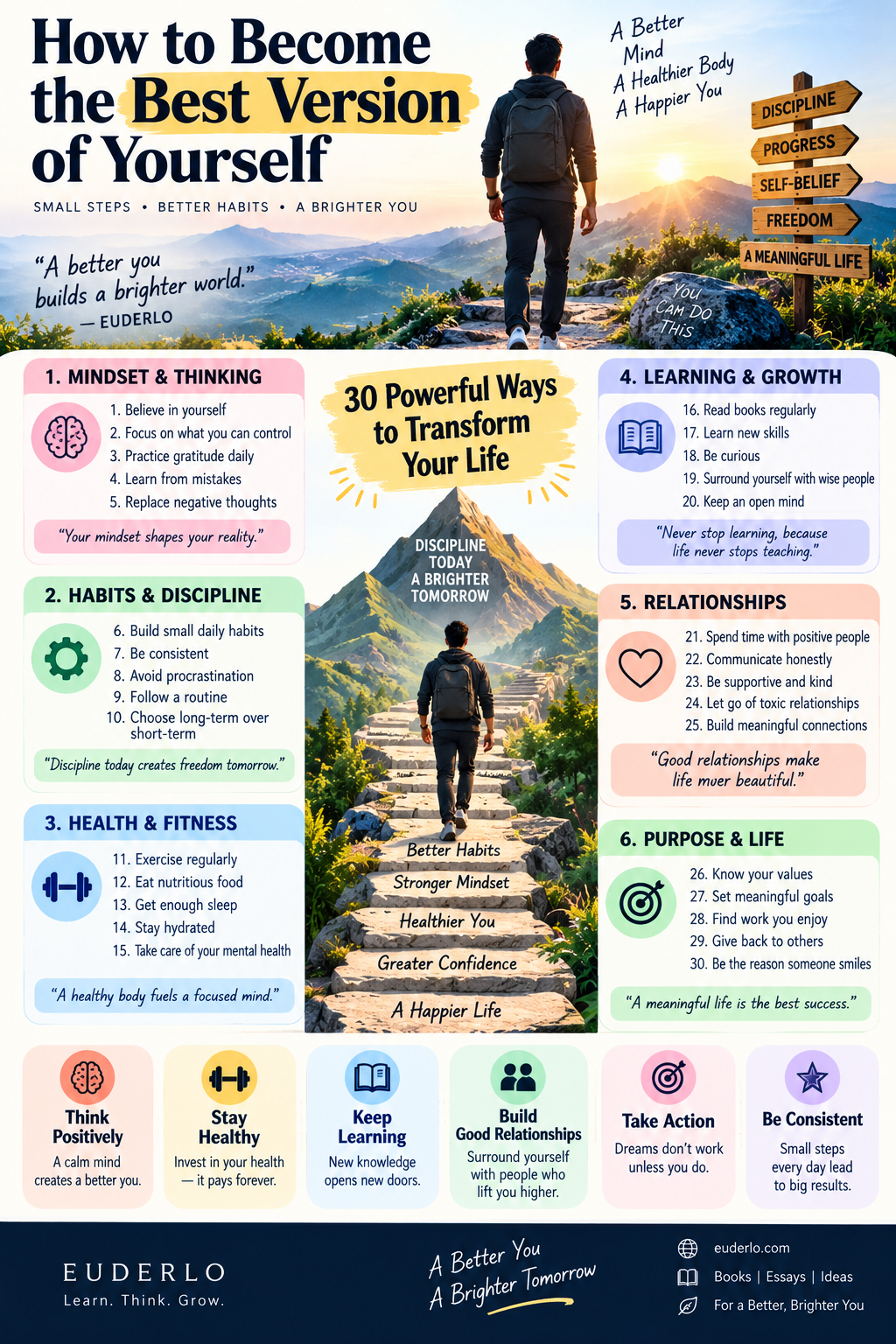
1. Decide Who You Want to Become
Before changing your habits, you need to understand the person you are trying to build.
Ask yourself:
Who do I want to become?
Not:
“What do I want to have?”
Instead:
“Who do I want to be?”
There is a major difference.
You may want more money.
But what kind of person earns and manages that money responsibly?
You may want a strong body.
What kind of person consistently takes care of their health?
You may want to become successful.
What qualities would that successful version of you have?
Perhaps discipline.
Patience.
Courage.
Curiosity.
Humility.
Communication skills.
Emotional control.
Consistency.
Integrity.
When we define our desired identity, our daily decisions become easier.
Instead of saying:
“I need to exercise.”
You say:
“I am someone who takes care of my body.”
Instead of:
“I need to read.”
You say:
“I am a person who learns every day.”
Instead of:
“I need to save money.”
You say:
“I am someone who manages money responsibly.”
The goal isn't to pretend you've already mastered something.
The goal is to repeatedly behave like the person you want to become.
2. Stop Comparing Your Life With Everyone Else's
One of the fastest ways to lose your peace is to measure your life against someone else's.
Someone is earning more.
Someone is travelling more.
Someone got married earlier.
Someone bought a house.
Someone built a business.
Someone became famous.
Someone has millions of followers.
And suddenly, your own progress looks insignificant.
But comparison often hides something important:
You are comparing your behind-the-scenes with somebody else's highlights.
You don't know the full story.
You don't know what they sacrificed.
You don't know what problems they face privately.
You don't know their starting point.
And you don't know whether their definition of success is even compatible with yours.
Instead of asking:
“Why am I behind?”
Try asking:
“Am I moving in the direction I want?”
That question brings your attention back to your own life.
Your competition is not the person on Instagram.
Your competition is yesterday's version of you.
3. Build Self-Awareness Before You Try to Change Yourself
Personal growth begins with self-awareness.
You cannot change what you refuse to notice.
Take some time and honestly examine your life.
Ask yourself:
What am I doing well?
What am I avoiding?
What habits are helping me?
What habits are hurting me?
Where am I wasting time?
What am I afraid of?
What do I keep postponing?
What kind of people influence me?
What makes me feel alive?
What consistently drains me?
What do I want my life to look like five years from now?
What would I regret not doing?
Don't answer these questions to impress yourself.
Answer them honestly.
Sometimes the most powerful personal development exercise is simply sitting alone with a notebook and telling yourself the truth.
We often know what needs to change.
The difficult part is admitting it.
4. Create Goals That Actually Matter to You
Goals give direction to your effort.
But not every goal deserves your energy.
You can have dozens of goals and still feel lost.
Instead, choose a few important areas of life.
For example:
Health
I want to become stronger, healthier, and more energetic.
Career
I want to develop valuable skills and increase my income.
Mind
I want to read, learn, think deeply, and improve my knowledge.
Relationships
I want to become a better friend, family member, and partner.
Finances
I want to spend responsibly, save consistently, and build long-term financial stability.
Inner life
I want to become calmer, more self-aware, and less controlled by fear.
Then turn those areas into specific goals.
Instead of:
“I want to get healthy.”
Try:
“I will exercise three or four times each week and improve my everyday diet.”
Instead of:
“I want to read more.”
Try:
“I will read 10 pages every night.”
Small, measurable actions give vague ambitions somewhere to go.
5. Build Discipline Instead of Waiting for Motivation
This is one of the most important lessons in self-improvement.
Motivation is useful, but it is unreliable.
Some mornings you will wake up excited.
Other mornings you will want to stay in bed.
If your entire life depends on motivation, your progress will always fluctuate.
Discipline gives you something more stable.
Discipline means doing what matters even when you don't particularly feel like doing it.
That doesn't mean forcing yourself to work endlessly.
It means learning to keep promises you make to yourself.
If you decide to read ten pages, read ten pages.
If you decide to exercise, show up.
If you decide to study for one hour, put your phone away and study.
If you decide to sleep earlier, protect your bedtime.
Every time you keep a promise to yourself, you build self-trust.
And self-trust is powerful.
You begin to think:
“When I say I'm going to do something, I actually do it.”
That changes your identity.
6. Start With Small Habits
Many people fail at self-improvement because they try to change everything simultaneously.
They decide:
“I'll wake up at 5 AM, meditate for an hour, exercise for two hours, read 50 pages, learn coding, start a business, eat perfectly, quit social media, and become financially independent.”
It sounds impressive.
It usually lasts three days.
Instead, start small.
Read five pages.
Walk for 15 minutes.
Meditate for five minutes.
Write three sentences in your journal.
Put your phone away for 30 minutes.
Drink water when you wake up.
Prepare tomorrow's priorities before sleeping.
Small actions may look insignificant, but they are easier to repeat.
And repetition matters.
Research on habit formation has shown that automaticity develops gradually and varies substantially between behaviors and individuals. There is no universal “21-day rule” that magically creates a habit.
So don't become obsessed with how quickly a habit becomes automatic.
Focus on repeating the behavior.
7. Design Your Environment to Help You
Willpower isn't everything.
Your environment matters.
If your phone is beside you while you're trying to study, distraction is one tap away.
If your running shoes are hidden in a cupboard, exercising requires another decision.
If your books are visible beside your bed, reading becomes easier.
If unhealthy snacks are always available, resisting them becomes harder.
So make good behavior easier and unwanted behavior harder.
Put your book on your pillow.
Keep your workout clothes ready.
Turn off unnecessary notifications.
Move distracting apps away from your home screen.
Keep your phone outside your bedroom if that works for you.
Prepare healthy food in advance.
Your environment silently influences hundreds of decisions.
Instead of constantly asking yourself to have more willpower, build an environment that supports the person you want to become.
8. Take Care of Your Body
You cannot separate personal growth from physical health.
Your body is the foundation through which you experience everything else.
When you feel physically exhausted, it becomes harder to concentrate, exercise, learn, work, communicate, and regulate your emotions.
You don't need to become a professional athlete.
You need to move.
The World Health Organization recommends that adults get 150–300 minutes of moderate-intensity aerobic activity per week, or the equivalent amount of vigorous activity, and perform muscle-strengthening activities involving major muscle groups on at least two days each week.
That could mean:
Walking.
Cycling.
Swimming.
Running.
Dancing.
Playing a sport.
Strength training.
Even everyday movement counts.
The important point is that physical activity doesn't have to look impressive on social media to benefit you.
Your goal is not to build a body that receives likes.
Your goal is to build a body that supports your life.
9. Treat Sleep as a Priority, Not a Luxury
We often glorify exhaustion.
We say things like:
“I only slept four hours because I was working hard.”
But lack of sleep isn't a badge of ambition.
Sleep is part of performance.
The CDC recommends that adults aged 18–60 get at least seven hours of sleep per night. Adequate sleep supports health and emotional well-being.
Sleep also affects concentration, memory, mood, and everyday functioning.
If you consistently sacrifice sleep for entertainment, scrolling, or unnecessary work, you're borrowing energy from tomorrow.
Try creating a simple nighttime routine.
Dim the lights.
Reduce stimulating activities.
Put your phone away.
Prepare your clothes for tomorrow.
Write down unfinished thoughts.
Read something calming.
Go to bed at a consistent time when possible.
You don't need a perfect routine.
You need a routine you can repeat.
10. Learn to Control Your Attention
Your attention is one of your most valuable resources.
Where your attention goes, your life gradually follows.
If you spend hours consuming outrage, comparison, gossip, and short-form entertainment, your mind becomes accustomed to constant stimulation.
If you spend time reading, creating, learning, exercising, thinking, and having meaningful conversations, your mental environment changes.
Ask yourself:
What am I allowing into my mind every day?
Your phone can be a tool.
It can also become a place where your attention disappears.
Try creating periods of uninterrupted focus.
Start with 25 minutes.
Put your phone away.
Choose one task.
Work only on that task.
Take a short break.
Then repeat.
You don't need to become a productivity machine.
You need to become the person who can choose where their attention goes.
11. Read Books That Challenge the Way You Think
If you want to become your best self, become a lifelong learner.
Books allow us to borrow decades of experience from people we may never meet.
A good book can change a decision.
A great book can change a worldview.
Read across different subjects:
Psychology
Philosophy
History
Business
Science
Biography
Spirituality
Economics
Communication
Leadership
Personal development
Creativity
Don't only read books that agree with you.
Read books that challenge you.
And don't measure reading by the number of books you finish.
Measure it by the ideas you apply.
After finishing a chapter, ask:
“What will I do differently because I read this?”
That question transforms reading from entertainment into personal development.
12. Develop Skills That Increase Your Value
Personal growth isn't only about mindset.
It is also about capability.
Learn skills that help you create value.
Depending on your interests and career, these could include:
Writing
Communication
Public speaking
Sales
Marketing
Coding
Data analysis
Design
Leadership
Negotiation
Financial literacy
AI literacy
Project management
Research
Critical thinking
You don't need to learn everything.
Choose one valuable skill and become genuinely good at it.
Then combine it with another.
For example:
Writing + Marketing.
Coding + AI.
Design + Business.
Communication + Sales.
Research + Content Creation.
The combination of skills can become much more valuable than trying to master every possible subject.
13. Learn to Manage Money
You cannot build a stable life while completely ignoring your finances.
Money isn't everything.
But financial stress can affect many parts of life.
Start with the basics.
Know what you earn.
Know what you spend.
Know what you owe.
Build an emergency buffer when possible.
Avoid unnecessary high-cost debt.
Learn about saving, investing, taxes, insurance, and compound growth.
Most importantly, don't use money to prove your worth.
A bigger phone doesn't necessarily mean a better life.
A luxury purchase doesn't automatically create financial freedom.
Financial maturity means understanding the difference between what you can buy and what you can actually afford.
Your goal should not simply be to look wealthy.
Your goal should be to become financially resilient.
14. Stop Trying to Impress Everyone
At some point, personal growth requires learning to disappoint people.
Not intentionally.
Not disrespectfully.
But honestly.
You cannot build your life around everyone's expectations.
Someone will think you're working too much.
Someone will think you're not working enough.
Someone will think your career is strange.
Someone will think you should get married.
Someone will think you should stay single.
Someone will think you should move abroad.
Someone will think you should stay home.
If you attempt to satisfy every opinion, you will eventually lose your own.
Learn to ask:
“Does this decision reflect my values?”
You can listen to advice without surrendering your judgment.
15. Choose Your Friends Carefully
The people around us influence our thinking, behavior, expectations, and emotional environment.
That doesn't mean you should abandon everyone who isn't ambitious.
It means you should pay attention to what your relationships repeatedly bring into your life.
Do your friendships encourage growth?
Can you talk honestly?
Can you celebrate each other's progress?
Can you disagree without disrespect?
Do you feel safe being yourself?
Do you encourage each other?
Human beings need connection.
The U.S. Surgeon General's advisory on social connection notes that relationships and social connection play important roles in health and well-being, and recommends investing time in consistent, high-quality engagement with others.
So becoming your best self doesn't mean becoming isolated.
Growth and connection can exist together.
16. Become Better at Communication
You can be intelligent and still struggle in life if you cannot communicate.
Learn to:
Listen without immediately interrupting.
Ask better questions.
Explain your thoughts clearly.
Disagree respectfully.
Say what you mean.
Admit when you're wrong.
Give sincere appreciation.
Set boundaries without aggression.
Apologize when necessary.
Communication is not about winning every conversation.
Sometimes communication means understanding someone even when you disagree.
One of the simplest improvements you can make is to listen more carefully.
Don't prepare your next sentence while the other person is speaking.
Actually listen.
17. Learn Emotional Intelligence
Being emotionally strong doesn't mean suppressing emotions.
It means understanding them.
You can feel anger without becoming cruel.
You can feel fear without allowing fear to make every decision.
You can feel sadness without believing that your entire life is hopeless.
You can feel jealousy without acting destructively.
When an emotion appears, pause.
Ask:
What am I feeling?
Then:
Why might I be feeling this?
Then:
What response would help rather than hurt me?
That small pause between emotion and action can change relationships, careers, and entire lives.
18. Stop Running From Failure
Failure hurts.
Let's not pretend otherwise.
When something we deeply care about doesn't work, disappointment can be intense.
But failure can also provide information.
A failed business can teach you about customers.
A failed interview can teach you what to improve.
A failed relationship can reveal patterns you didn't notice.
A rejected application can show you where you need stronger skills.
A missed opportunity can teach you to prepare differently next time.
The question isn't:
“How do I make sure I never fail?”
The better question is:
“How do I become someone who can learn from failure?”
You don't need to romanticize failure.
Learn from it.
Adjust.
Try again.
19. Practice Self-Respect, Not Self-Hatred
Self-improvement can become unhealthy when we constantly attack ourselves.
“I am lazy.”
“I am behind.”
“I am not good enough.”
“I wasted my life.”
“I should have achieved more.”
This type of internal dialogue rarely creates sustainable growth.
You can acknowledge your mistakes without turning them into your identity.
Instead of:
“I'm a failure.”
Say:
“This didn't work. What can I learn?”
Instead of:
“I'm lazy.”
Ask:
“What is making it difficult for me to take action?”
Instead of:
“I'm behind everyone.”
Ask:
“What is the next meaningful step for me?”
There is a difference between accountability and self-destruction.
We need accountability.
We don't need to hate ourselves into becoming better people.
20. Find Something Bigger Than Immediate Pleasure
A meaningful life usually requires some ability to delay immediate gratification.
The phone offers instant entertainment.
Shopping offers instant excitement.
Junk food offers instant pleasure.
Social media offers instant validation.
But many meaningful things take time.
Fitness.
Education.
Relationships.
Career development.
Business.
Writing.
Financial stability.
Mastery.
Purpose.
You may not see the reward today.
That doesn't mean the work is pointless.
A tree doesn't become tall because someone pulls on its branches.
It grows through consistent nourishment over time.
Our lives are similar.
21. Discover Your Values
Ask yourself:
What actually matters to me?
Not what impresses people.
Not what social media tells you should matter.
Not what your neighbors think matters.
What matters to you?
Maybe it is:
Freedom.
Family.
Creativity.
Knowledge.
Adventure.
Security.
Service.
Faith.
Love.
Excellence.
Independence.
Community.
Once you understand your values, decisions become clearer.
If freedom is important to you, you may prioritize flexibility.
If family is important, you may protect time for them.
If learning is important, you may invest in books and education.
If creativity is important, you may create even when nobody is watching.
Your values become an internal compass.
22. Make Time for Silence
We live in a world filled with noise.
Notifications.
Videos.
Music.
News.
Messages.
Podcasts.
Advertisements.
Opinions.
There is nothing wrong with any of these things.
But constant stimulation leaves little room for reflection.
Try sitting quietly for ten minutes.
Go for a walk without your phone.
Write in a journal.
Watch the sunrise.
Sit somewhere peaceful.
Meditate.
Think.
At first, silence may feel uncomfortable.
That's okay.
You may discover thoughts you've been avoiding.
You may also discover ideas you've been too distracted to notice.
Sometimes we don't need more information.
We need enough silence to understand the information we already have.
23. Stop Waiting for the Perfect Time
There is rarely a perfect time.
You can start exercising when you're busy.
You can read when you have only ten minutes.
You can learn a skill while working a full-time job.
You can improve your finances one decision at a time.
You can start writing before anyone knows your name.
You can become more confident by practicing while you're still nervous.
You don't need perfect conditions.
You need a starting point.
Start before you feel ready.
Then improve while moving.
24. Create a Morning Routine That Works for You
A morning routine doesn't need to look like an influencer's morning.
You don't need to wake up at 4:30 AM just because somebody online does.
Build a routine that fits your life.
For example:
Wake up → drink water → freshen up → move your body → review priorities → eat → begin your most important task.
Or:
Wake up → meditate → journal → read → exercise → work.
The exact sequence doesn't matter as much as the intention.
Your morning should help you begin the day consciously rather than immediately reacting to notifications.
25. Create a Night Routine
Your night determines how you enter tomorrow.
Spend five minutes reviewing your day.
Ask:
What went well today?
What didn't go well?
What did I learn?
What matters tomorrow?
Then prepare.
Set out your clothes.
Write your priorities.
Clean your workspace.
Put your phone away.
Read.
Sleep.
A five-minute evening review can become a powerful habit because it turns ordinary days into lessons.
26. Use the 1% Improvement Mindset
You don't have to transform your life in one dramatic moment.
You can improve gradually.
Read one more page.
Walk one more kilometer.
Save a little more money.
Learn one new concept.
Have one meaningful conversation.
Spend ten fewer minutes scrolling.
Write one paragraph.
Practice one skill.
The individual action may look tiny.
But repeated actions create patterns.
And patterns shape lives.
The goal isn't dramatic transformation every week.
The goal is consistent direction over a long period of time.
27. Build a Personal Growth System
Motivation becomes much easier when you have a system.
Here's a simple framework we can use.
Every day
Ask:
What is the one thing I must accomplish today?
Then:
Move your body.
Learn something.
Do meaningful work.
Connect with someone.
Spend a few minutes reflecting.
Sleep sufficiently.
Every week
Review:
What did I accomplish?
What did I avoid?
What distracted me?
What should I change?
What am I proud of?
Every month
Ask:
Am I healthier?
Am I learning?
Am I becoming more disciplined?
Are my relationships improving?
Am I managing money better?
Am I moving closer to my goals?
Every year
Ask the biggest question:
“Am I becoming the person I want to become?”
28. Give Yourself a 30-Day Personal Growth Challenge
If you're reading this and thinking, “Where do I start?”, don't try to change your entire life today.
Start with 30 days.
For the next month:
Every morning
Write down your three priorities.
Every day
Move your body for at least 20–30 minutes if your health allows.
Every day
Read at least 10 pages.
Every day
Spend 30–60 minutes developing an important skill.
Every day
Limit unnecessary social-media consumption.
Every day
Do one difficult thing you have been avoiding.
Every night
Write down three things you learned or appreciated.
Every week
Review your progress.
Don't worry about perfection.
If you miss a day, continue the next day.
Never turn one bad day into a bad month.
29. The Best Version of Yourself Is Not the Most Successful Version
This may be the most important idea in this entire article.
The best version of you isn't necessarily the richest.
It isn't necessarily the most famous.
It isn't necessarily the person with the biggest house or the largest social-media following.
Success without health can feel empty.
Money without meaningful relationships can feel lonely.
Achievement without peace can become another form of exhaustion.
A better definition of personal success might be:
Becoming someone you respect.
Someone who keeps learning.
Someone who takes responsibility.
Someone who treats people well.
Someone who takes care of their health.
Someone who manages money responsibly.
Someone who can handle difficult seasons.
Someone who keeps going after setbacks.
Someone who knows when to work and when to rest.
Someone who can enjoy a quiet evening without needing constant stimulation.
Someone who doesn't need to prove their worth every day.
That version of success is much deeper.
30. You Don't Need to Become Someone Else
There is one final mistake I want us to avoid.
When we hear “become the best version of yourself,” we sometimes think we need to become somebody completely different.
You don't.
You don't need to copy someone else's personality.
You don't need to live someone else's life.
You don't need to become an internet version of success.
Your best version should still be you.
Maybe a wiser you.
A healthier you.
A calmer you.
A more disciplined you.
A more courageous you.
A more financially responsible you.
A more compassionate you.
A more knowledgeable you.
But still you.
The goal of personal development isn't to erase yourself.
It is to develop yourself.
What Should You Do If You Feel Lost in Life?
If you currently feel lost, don't panic.
Being uncertain doesn't mean you've failed.
Sometimes we become confused because we are trying to answer ten major life questions simultaneously.
Instead, simplify.
For the next 30 days, focus on five things:
Take care of your body.
Improve your mind.
Do meaningful work.
Strengthen important relationships.
Avoid unnecessary distractions.
You don't need to know exactly where your life will be ten years from now.
You need to know what direction you want to move today.
Clarity often comes from action.
You don't always think your way into a better life.
Sometimes you act your way into clarity.
The Books That Can Help You Become Your Best Self
If you want to go deeper, books can become powerful companions on your journey.
You could explore:
Atomic Habits — James Clear
The 7 Habits of Highly Effective People — Stephen R. Covey
Man's Search for Meaning — Viktor E. Frankl
Meditations — Marcus Aurelius
The Psychology of Money — Morgan Housel
The Power of Now — Eckhart Tolle
Deep Work — Cal Newport
Mindset — Carol S. Dweck
The Bhagavad Gita
The Dhammapada
Don't read them simply to collect knowledge.
Read them to find ideas you can apply.
A single principle practiced for years can be more valuable than hundreds of books read without action.
A Simple Daily Routine for Becoming Your Best Self
If you want something practical, start here.
Morning
Wake up at a consistent time.
Drink water.
Avoid immediately opening social media.
Move your body.
Review your priorities.
Choose the most important task.
During the day
Do meaningful work.
Eat reasonably well.
Move regularly.
Learn something.
Communicate with people you care about.
Take breaks.
Protect your attention.
Evening
Slow down.
Review your day.
Write down what you learned.
Prepare tomorrow.
Read.
Disconnect from unnecessary stimulation.
Sleep enough.
You don't need to make every day extraordinary.
You need to make ordinary days meaningful.
10 Questions to Ask Yourself Every Sunday
Take a notebook and answer these questions honestly:
1. What did I do well this week?
2. Where did I waste time?
3. What habit helped me most?
4. What habit hurt me most?
5. What did I learn?
6. Did I take care of my body?
7. Did I spend meaningful time with people I care about?
8. Did I move closer to my financial and career goals?
9. What am I avoiding?
10. What is one thing I will improve next week?
Don't judge yourself while answering.
Observe.
Learn.
Adjust.
Continue.
That is personal growth.
The Real Secret to Becoming the Best Version of Yourself
After everything we've discussed, I think the answer is surprisingly simple.
You become your best self by repeatedly making choices that your future self will thank you for.
You choose the workout instead of another hour of scrolling.
You choose learning instead of constant entertainment.
You choose honesty instead of pretending.
You choose patience instead of reacting.
You choose saving instead of unnecessary spending.
You choose meaningful relationships instead of shallow validation.
You choose courage instead of permanent avoidance.
You choose rest when your body needs it.
You choose to begin again after failure.
And you keep making those choices.
Not perfectly.
Not every day.
But often enough that they begin to shape who you are.
Your life is not transformed by one motivational quote.
It is transformed by hundreds of ordinary decisions.
Final Thoughts: Become the Person You Would Be Proud to Meet
If you remember only one thing from this article, remember this:
You don't have to change your entire life today.
You only have to change what you do next.
Read the next page.
Take the next walk.
Make the next healthy meal.
Send the message you've been avoiding.
Study the next lesson.
Save the next amount.
Write the next paragraph.
Apologize when you need to.
Forgive when you're ready.
Say no when something doesn't serve your values.
Say yes when an opportunity deserves courage.
And when you fail—and you will sometimes fail—don't decide that the journey is over.
Begin again.
I believe becoming the best version of yourself is less about chasing some imaginary perfect future and more about learning to respect the person you are becoming.
We don't need to become extraordinary overnight.
We need to become a little more intentional today.
Then tomorrow.
Then the day after that.
Eventually, those ordinary days become a life.
And perhaps the most beautiful part is this:
You are not finished.
There is still more to learn.
More to experience.
More to create.
More people to love.
More mistakes to understand.
More courage to develop.
More wisdom to discover.
More life to live.
So don't ask yourself whether you've already become your best self.
Ask:
“What can I do today to move one step closer?”
Then take that step.
And tomorrow, take another.
This is your life. Build it consciously.
Euderlo: Learn. Think. Grow.
At Euderlo, we believe personal growth should be practical, thoughtful, and accessible to everyone.
We explore self-improvement, personal development, psychology, books, life lessons, productivity, money, career growth, relationships, spirituality, learning, AI, technology, and the ideas that help us live better lives.
Our goal isn't to tell you what your life should look like.
Our goal is to help you learn, think deeply, ask better questions, and make more intentional choices.
Because becoming your best self isn't a destination.
It's a lifelong journey.
Euderlo — Learn. Think. Grow.
Frequently Asked Questions
How can I become the best version of myself?
Start by identifying the person you want to become and then build small daily behaviors that support that identity. Focus on your health, habits, mindset, relationships, skills, finances, and emotional well-being. Consistency matters more than trying to transform everything overnight.
How can I improve myself every day?
Choose a few simple practices: exercise, read, learn a useful skill, complete meaningful work, spend time with people you care about, reduce unnecessary distractions, and reflect on your day. Even small improvements can become meaningful when repeated consistently.
How do I become a better person?
Develop self-awareness, take responsibility for your actions, treat people with respect, communicate honestly, keep learning, manage your emotions, and act according to your values. Becoming a better person is an ongoing process rather than a one-time achievement.
How do I become more disciplined?
Start with small commitments that you can consistently keep. Remove distractions from your environment, create routines, define clear priorities, and practice doing important tasks even when motivation is low. Discipline develops through repeated action.
How long does it take to change your life?
There is no universal timeline. Different behaviors and people change at different rates. Instead of focusing on a specific number of days, focus on building behaviors you can sustain for months and years.
How can I stop procrastinating?
Make the task smaller, remove distractions, decide exactly when you will begin, and commit to working for a short period such as 10 or 25 minutes. Often, starting is more difficult than continuing.
What should I do if I feel behind in life?
Stop measuring your life entirely through other people's timelines. Identify what matters to you, choose one or two priorities, and take practical steps toward them. Your timeline does not need to look like someone else's.
What books should I read for personal growth?
Consider books covering habits, psychology, philosophy, money, meaning, communication, and spirituality. Some starting points include Atomic Habits, The Psychology of Money, Man's Search for Meaning, Meditations, The 7 Habits of Highly Effective People, and the Bhagavad Gita.
Main Takeaway
Becoming the best version of yourself is not about becoming perfect—it is about becoming better, wiser, healthier, and more intentional one day at a time. Build small habits, protect your attention, take care of your body and mind, keep learning, develop valuable skills, nurture meaningful relationships, manage your money responsibly, and learn from your mistakes. You don't need to transform your entire life overnight. Start with one meaningful decision today, repeat it consistently, and let those small choices shape the person you want to become.
Everyone
A little context before you go
Euderlo articles are prepared with a focus on clarity, useful ideas, thoughtful structure, and practical value. Read the ideas, question what does not fit your experience, and use what genuinely helps you.
Where these ideas come from
Sources are listed here when an article uses books, studies, official information, research, or other external material.
No external sources were listed for this article.
No tags were added to this article.