On this page
Jump directly to the part you want to read.
"Life doesnt't get better by chance, you have to make it better everyday with your hard work, no matter whether you feel like working harder on yourself or not, but you just got to do, only then can you transform your life and go beyond your form. That's why don't wait for the luck to get your life better, make it happen."
There is a strange moment in life when nothing is completely falling apart, yet something inside you knows that you cannot continue living the same way. You wake up, go to work, come home, scroll through your phone, sleep, and repeat the same routine, but somewhere in your mind there is a quiet question: “Is this really the life I want?” Maybe you have made mistakes, lost someone, chosen the wrong career, struggled with money, neglected your health, or simply spent too many years doing what was expected of you. And now you want to know how to build a better life, how to start over in life, or how to rebuild your life from scratch.
The good news is that rebuilding your life does not require you to erase your past. You do not have to become a completely different person overnight. You need to become more intentional about the person you are becoming. A better life is usually not created by one dramatic decision. It is built through hundreds of ordinary decisions that you make when nobody is watching.
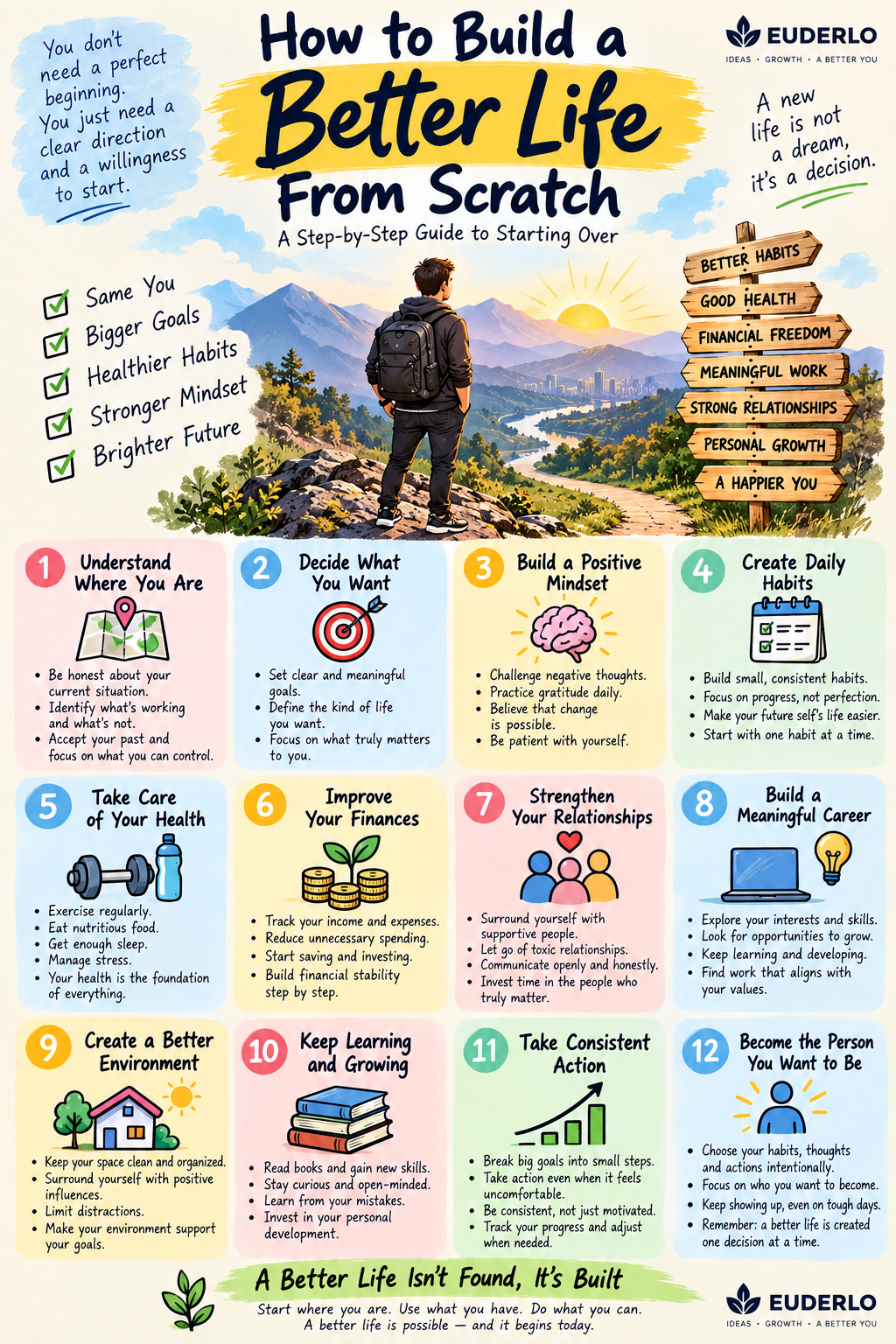
If you want to change your life, start by understanding one thing: you don't need to fix everything today. You need to stop moving in the wrong direction and begin taking small steps toward the right one. Your health, money, career, relationships, habits, environment, mindset, and purpose are connected. When you improve one area, it can make the others easier to improve too.
This guide will show you how to build a better life from scratch, even if you currently feel lost, behind, unmotivated, financially stressed, emotionally exhausted, or uncertain about your future. We will look at personal growth, self-improvement, habits, psychology, money, health, relationships, career, purpose, routines, and a practical 30-day life reset that you can actually follow.
1. Accept Where You Are Before You Try to Change Your Life
The first step toward building a better life is not changing everything. It is telling yourself the truth about where you are.
You cannot build a new future while constantly pretending that your current situation does not exist. If your finances are poor, look at your finances. If your health has been neglected, acknowledge it. If your career is making you miserable, admit it. If a relationship is hurting you, recognize it. If you have developed habits that are wasting your time, stop pretending they are harmless.
This is not about blaming yourself. It is about becoming honest enough to take responsibility.
There is an enormous difference between saying, “My life is terrible,” and saying, “These three things in my life are not working, and I can begin changing them.” The first statement creates helplessness. The second creates a starting point.
If you are wondering how to accept your current life, try this simple exercise. Take ten minutes and write four lists:
Keep: What is already good in my life?
Change: What needs to improve?
Remove: What consistently makes my life worse?
Build: What do I want to create?
Do not write what sounds impressive. Write what is true.
Maybe you want to keep your family, change your career, remove unnecessary spending, and build financial independence. Maybe you want to keep your current friendships, change your health habits, remove social-media distractions, and build a better routine. Your answers will be different because your life is different.
Learning how to move forward in life requires understanding that your past is information, not a prison. You can regret something without spending the next ten years punishing yourself for it.
You cannot change yesterday.
But you can decide what yesterday is going to teach you.
2. Decide What You Actually Want Your Life to Look Like
One of the biggest reasons people struggle with how to create the life they want is that they have never clearly defined what they want.
They know they don't want their current situation, but they haven't decided what should replace it.
You might say, “I want to be successful.” But what does success mean to you? More money? More freedom? A better career? A peaceful family life? Owning a business? Traveling? Having control over your time? Creating something meaningful?
Someone else's definition of success can become your personal prison if you never question it.
Instead of asking only, “What do I want to achieve?” ask:
What kind of person do I want to become?
What do I want my ordinary day to look like?
Where do I want to live?
What kind of work do I want to do?
What relationships do I want around me?
How important is money to me?
What does financial security mean to me?
What do I want to learn?
What do I want to contribute?
What do I want to stop tolerating?
What would make my life feel meaningful?
This is essentially how to design your life instead of simply reacting to whatever happens to you.
Psychologists Edward Deci and Richard Ryan's Self-Determination Theory identifies three important psychological needs: autonomy, competence, and relatedness. In simple language, people generally benefit from having some sense of choice over their lives, feeling capable of doing things well, and experiencing meaningful connection with others. (Self-Determination Theory)
That gives you a useful framework for thinking about your future.
A good life should not only look successful from the outside. It should also feel like it belongs to you.
3. Stop Trying to Change Everything at Once
When people decide to change their life, they often make the same mistake.
On Monday, they decide to wake up at 5 AM, exercise every day, read 50 pages, meditate, stop using social media, start a business, save half their salary, eat perfectly, learn a new language, and become a completely different person.
By Friday, most of the plan has disappeared.
The problem is not always a lack of discipline. Sometimes the plan is simply too large.
If you want to build better habits, start smaller than your ambition tells you to.
Instead of saying:
“I will exercise for one hour every day.”
Start with:
“I will move my body for 15 minutes.”
Instead of:
“I will read 50 books this year.”
Start with:
“I will read five pages every night.”
Instead of:
“I will completely fix my finances.”
Start with:
“I will track every expense for 30 days.”
Small actions are not insignificant when they are repeated.
Research on habit formation by Phillippa Lally and colleagues found that the time required for a behavior to become automatic varied considerably between individuals and behaviors. The study does not support the popular idea that every habit takes exactly 21 days. (European Journal of Social Psychology)
So don't become obsessed with the number of days.
Become obsessed with returning.
Miss one workout? Return.
Overspend one day? Return.
Skip reading? Return.
Have a bad week? Return.
The ability to restart is one of the most underrated forms of discipline.
4. Build Daily Habits That Make Your Future Easier
Your future is influenced by what you repeatedly do today.
This is why daily habits for a better life are more important than occasional bursts of motivation.
Think about your habits as votes for the person you are becoming.
Every time you exercise, you are voting for a healthier version of yourself.
Every time you save money, you are voting for financial stability.
Every time you read, practice, or learn, you are voting for competence.
Every time you keep a promise to yourself, you are voting for self-trust.
You do not need dozens of habits. Start with a small foundation:
Wake up and sleep at reasonably consistent times.
Move your body regularly.
Eat in a way that supports your health.
Spend some time learning.
Limit unnecessary digital distractions.
Review your priorities every morning.
Spend meaningful time with people you care about.
Review your finances regularly.
Keep your environment reasonably organized.
Give yourself time to think without constant stimulation.
If you are looking for habits that change your life, don't focus only on dramatic habits. The boring ones are often the ones that survive.
A five-minute daily practice can become more valuable than an ambitious plan you abandon after a week.
5. Take Control of Your Health
You cannot fully enjoy a better life if you constantly feel exhausted.
Your health is not something you should postpone until your career succeeds or your finances improve. It is part of the foundation that allows you to build everything else.
Start with the basics.
Sleep. Movement. Nutrition. Recovery. Mental well-being.
The World Health Organization recommends that adults perform 150–300 minutes of moderate-intensity aerobic physical activity per week, or an equivalent amount of vigorous activity, while emphasizing that some physical activity is better than none. (WHO Guidelines on Physical Activity)
That does not mean your first step needs to be an extreme fitness program.
It could be a 20-minute walk.
It could be taking the stairs.
It could be returning to the gym.
It could be playing a sport you enjoy.
The goal is to make movement normal.
The same principle applies to food and sleep. You don't need a perfect diet or an elaborate morning routine. You need sustainable habits that support your body.
Ask yourself:
What would change if I treated my body as something I was responsible for rather than something I expected to keep functioning regardless of how I treated it?
That question can change the way you approach health.
6. Get Your Money Under Control
It is difficult to feel completely free when you are constantly worried about money.
Building a better financial life does not necessarily mean becoming rich. It means becoming more aware, more capable, and more intentional.
If you want to know how to improve your finances, begin with reality.
Write down:
Your monthly income.
Your essential expenses.
Your discretionary spending.
Your debts.
Your savings.
Your subscriptions.
Your financial goals.
For one month, track where your money goes.
You may discover that the problem is not one huge expense. It may be dozens of small decisions repeated every week.
The Consumer Financial Protection Bureau's research on financial well-being looks beyond income and includes factors such as financial behavior, skills, attitudes, savings, and the ability to handle financial shocks. (CFPB Financial Well-Being Research)
That is important because earning more money alone does not automatically create financial security.
A practical financial reset can begin with four steps:
Know your numbers.
Control unnecessary spending.
Build an emergency buffer.
Increase your earning ability.
If you have debt, write it down rather than avoiding it.
If you want to build wealth, focus not only on cutting expenses but also on increasing your skills and earning potential over time.
Money should eventually become a tool that gives you more choices, not a source of constant fear.
7. Build a Better Career Instead of Simply Chasing a Job
Your career can have a major influence on your life because you may spend thousands of hours working.
If you feel trapped professionally, ask yourself whether the problem is your company, your role, your industry, your skills, your environment, or simply the fact that you have never seriously explored alternatives.
Learning how to find a career does not mean waiting for a magical moment when your “true passion” appears.
Try things.
Learn skills.
Work on projects.
Talk to people.
Volunteer.
Freelance.
Experiment.
Notice what you enjoy becoming good at.
Sometimes passion follows competence. You try something, become better, see progress, and gradually develop deeper interest.
If you want a better career, you don't necessarily need to quit immediately.
You can build your next chapter while still living your current one.
Spend 30–60 minutes several days a week learning a valuable skill. Build something with it. Create a portfolio. Meet people in the field. Apply for opportunities.
Your career can change gradually.
You do not have to burn down your present life to create your future.
8. Improve Your Relationships
A better life without meaningful relationships can still feel empty.
You don't need hundreds of friends. You need people with whom you can be honest, laugh, talk, disagree, grow, and feel accepted.
Research on social relationships has found a substantial association between stronger social relationships and survival across a large body of studies. A major meta-analysis by Holt-Lunstad and colleagues included 148 studies and more than 300,000 participants. (PLOS Medicine / PMC)
The practical lesson is not “collect more friends.”
It is to take meaningful connection seriously.
If you want how to build better relationships, start with basic behaviors:
Listen without immediately trying to fix everything.
Keep your promises.
Say thank you.
Ask people how they are actually doing.
Make time for people who matter.
Apologize when you are wrong.
Communicate clearly.
Set healthy boundaries.
Stop expecting people to read your mind.
Do not stay in relationships that repeatedly involve disrespect or abuse.
Sometimes improving your life means adding better people.
Sometimes it means becoming a better person for the people already around you.
And sometimes it means accepting that certain relationships have reached their natural end.
9. Fix Your Mindset Without Pretending Everything Is Positive
The internet often talks about mindset as if you can think your way out of every problem.
Real life is more complicated.
Positive thinking cannot magically remove poverty, grief, illness, discrimination, unemployment, heartbreak, or other difficult circumstances.
But the way you interpret and respond to your circumstances can influence what you do next.
There is a difference between:
“My life is difficult, so nothing I do matters.”
and:
“My life is difficult, but what is the next thing I can influence?”
That second question returns some agency to you.
If you want to learn how to change your mindset, begin by changing the questions you repeatedly ask yourself.
Instead of:
“Why does this always happen to me?”
Ask:
“What can I learn from this?”
Instead of:
“I am so far behind.”
Ask:
“What can I improve this month?”
Instead of:
“I have no idea what I am doing.”
Ask:
“What is the next thing I need to learn?”
Instead of:
“I failed.”
Ask:
“What did this attempt teach me?”
You are not trying to convince yourself that everything is wonderful.
You are training yourself to look for useful action even when circumstances are difficult.
10. Use If–Then Planning When Motivation Fails
One of the most practical psychological strategies for behavior change is implementation intention.
Instead of simply saying what you want to do, decide in advance what you will do when a specific situation occurs.
Research by Peter Gollwitzer and Paschal Sheeran examined implementation intentions and found evidence that these specific “if–then” plans can improve goal attainment. (ScienceDirect / DOI)
For example:
If I want to skip my workout, then I will at least walk for ten minutes.
If I want to buy something unnecessary, then I will wait 24 hours.
If I feel overwhelmed, then I will write down the next three actions.
If I start scrolling during work, then I will put my phone in another room.
If I miss one day of a habit, then I will restart the following day.
If I feel like giving up, then I will reduce the task instead of abandoning it.
This matters because motivation is unreliable.
Systems are more dependable.
11. Create an Environment That Supports the Person You Want to Become
Sometimes you don't need more discipline.
You need fewer temptations.
If your phone is beside you every time you work, notifications are constantly appearing, unhealthy food is always available, and your room is chaotic, you are asking willpower to solve an environmental problem.
Make good behavior easier.
Put your phone away when you need to focus.
Keep your workout clothes ready.
Put a book beside your bed.
Prepare tomorrow's priorities before going to sleep.
Remove unnecessary notifications.
Keep healthy food accessible.
Clean your workspace.
Unsubscribe from things that constantly distract you.
Your environment silently tells you what to do.
If you want to create a positive environment, design one that makes the behavior you want easier and the behavior you want to avoid slightly harder.
You don't have to redesign your entire house.
Change one friction point.
Then another.
12. Create a Daily Routine That You Can Actually Maintain
A routine should support your life, not become another source of stress.
You do not need to copy an influencer's five-hour morning routine.
A realistic productive daily routine could be remarkably simple.
Morning: Wake up, get ready, move your body, review your priorities, and begin meaningful work.
Afternoon: Focus on your important tasks, eat properly, take breaks, and avoid unnecessary distractions.
Evening: Finish your responsibilities, spend time with people, exercise if appropriate, learn or read, and prepare for tomorrow.
Night: Reduce stimulation, review your day briefly, and give yourself enough time to sleep.
The best morning routine is the one that makes your morning better.
The best night routine is the one that helps tomorrow become easier.
Do not create a routine because it looks impressive.
Create one because it works.
13. Set Goals for Your New Life
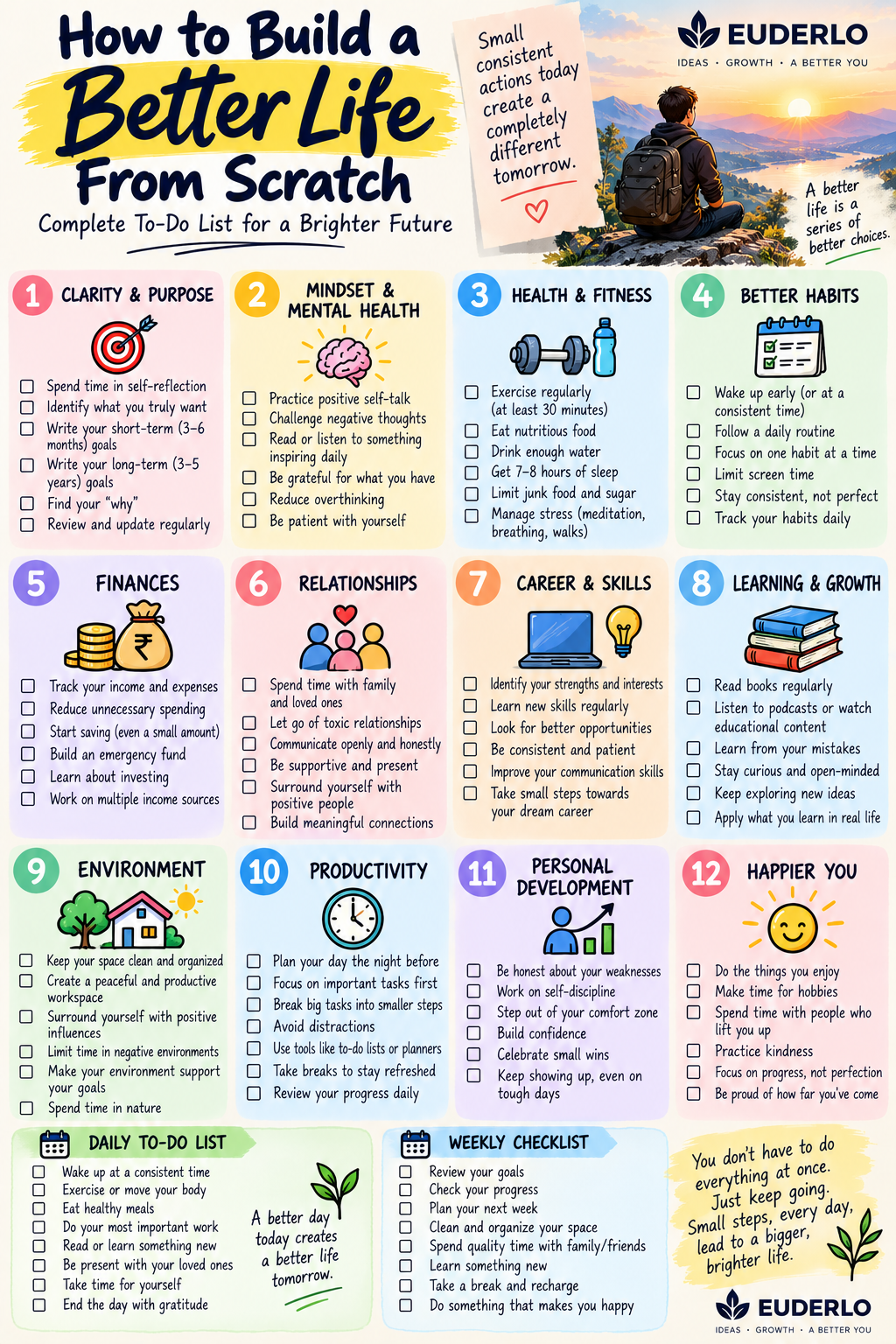
Goals give you direction, but goals become useful only when they influence behavior.
Instead of writing:
“I want to get fit.”
Write:
“I will exercise four days a week for the next 12 weeks.”
Instead of:
“I want to save money.”
Write:
“I will track my expenses every day for the next 30 days and transfer a fixed amount into savings each payday.”
Instead of:
“I want a better career.”
Write:
“I will spend five hours each week developing one marketable skill.”
This creates a bridge between life goals and daily action.
Try dividing your goals into three levels:
Direction: Who am I becoming?
Outcome: What result do I want?
Behavior: What will I repeatedly do?
For example:
Direction: Become financially independent.
Outcome: Build a strong emergency fund.
Behavior: Save a fixed amount every month and review expenses every Sunday.
This makes your future much easier to act upon.
14. Become the Person You Want to Be
One of the most powerful questions you can ask yourself is not:
“What do I want?”
It is:
“Who do I want to become?”
If you want to write, become someone who writes.
If you want to become healthy, become someone who takes care of their body.
If you want financial stability, become someone who pays attention to money.
If you want meaningful relationships, become someone who knows how to communicate, listen, and show up.
If you want success, become someone who can consistently do difficult things.
This is personal growth in practice.
Every small action gives you evidence about yourself.
When you keep a promise to yourself, you build self-trust.
When you repeatedly avoid something important, you reinforce avoidance.
This is why tiny actions matter.
You are not merely completing a task.
You are practicing becoming a certain kind of person.
15. Stop Doing the Things That Keep You Stuck
When people think about self-improvement, they often ask what they should add.
Sometimes the better question is what they should remove.
You might need to stop:
Checking your phone every few minutes.
Comparing your life with strangers online.
Saying yes when you mean no.
Spending money to impress people.
Waiting for motivation.
Making excuses for habits you know are hurting you.
Trying to please everyone.
Staying in conversations that constantly drain you.
Avoiding difficult decisions.
Turning one failure into an identity.
Sleeping at random times every night.
Consuming endless advice without taking action.
Starting ten projects and finishing none.
Living entirely in the past.
Constantly worrying about a future you refuse to prepare for.
You do not need to remove all of these tomorrow.
Choose the one that is creating the biggest problem.
Then work on it.
16. Learn How to Stop Wasting Your Life
One of the most painful realizations can be noticing how much time disappears without you realizing it.
A few minutes of scrolling becomes an hour.
An hour becomes an evening.
An evening becomes a week.
A week becomes a year.
The solution is not to become productive every minute.
Rest matters.
Entertainment matters.
Doing nothing sometimes matters.
The problem is unconscious living.
Ask yourself at the end of the day:
Did I spend my time on things I actually value?
You don't need every day to be perfect.
You need enough days to be intentional.
If you want to stop wasting your life, start noticing where your attention goes.
Your calendar is a record of your time.
Your spending is a record of your priorities.
Your habits are a record of your repeated choices.
Your relationships are a record of where you invest your emotional energy.
Look at them honestly.
They will tell you a lot about your current life.
17. Build a Meaningful Life, Not Just an Impressive One
There is a difference between success and meaning.
You can have a high salary and still dislike your life.
You can have thousands of followers and still feel lonely.
You can have a beautiful home and still feel restless.
You can achieve a goal and immediately wonder what comes next.
Meaning gives achievements a deeper context.
Psychological research commonly discusses meaning in life through concepts such as purpose, coherence, and significance or mattering. A review published in the Annual Review of Psychology examines these dimensions and the relationship between meaning and psychological functioning. (Annual Review of Psychology)
Meaning does not have to be grand.
It could be raising children.
Building a company.
Writing books.
Teaching.
Helping your family.
Serving your community.
Creating art.
Learning.
Taking care of someone.
Becoming excellent at your profession.
Living according to your values.
If you are trying to find your purpose, don't pressure yourself to discover one sentence that explains your entire existence.
Ask a smaller question:
“What makes my time feel worthwhile?”
Then build more of that into your life.
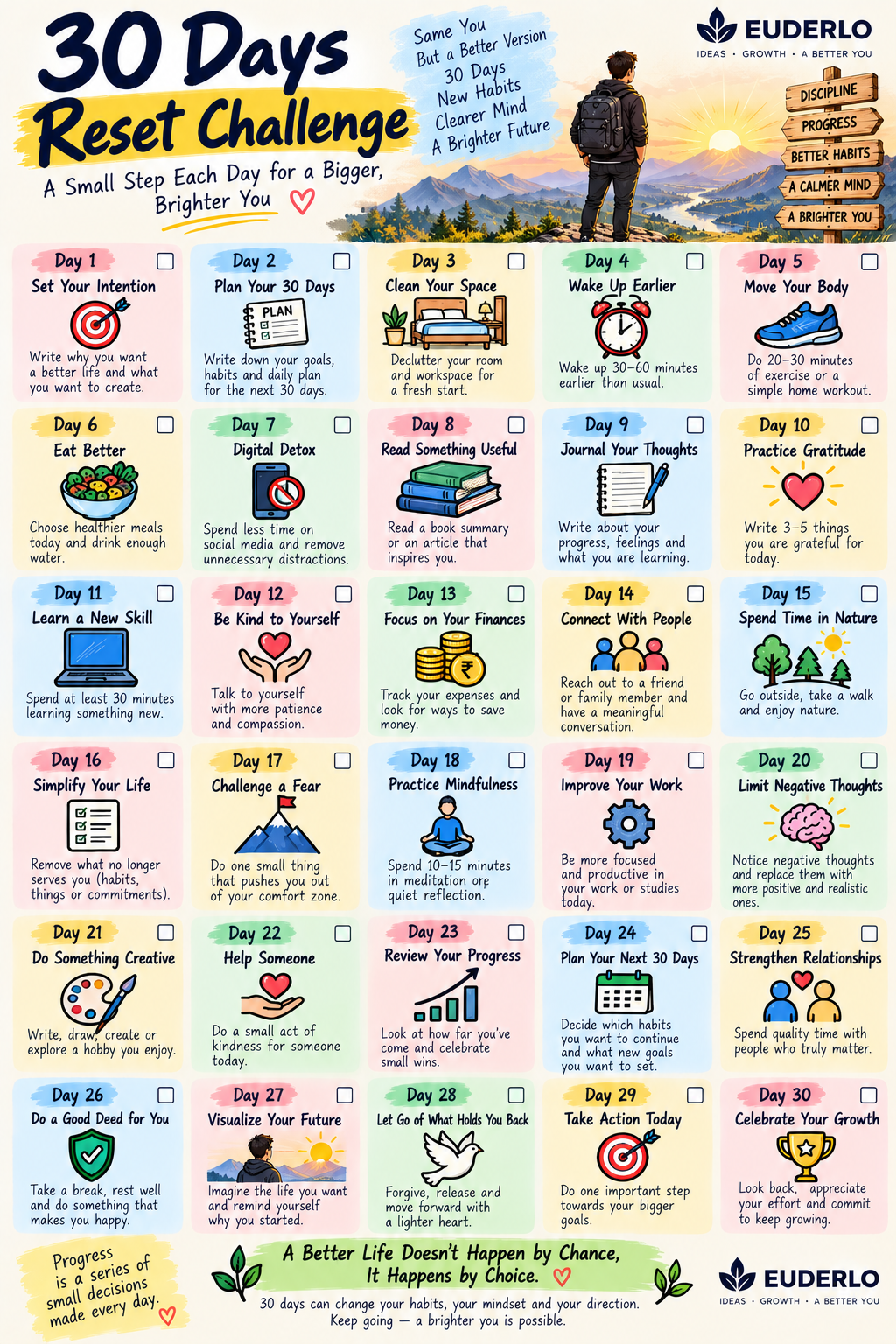
18. Your 30-Day Life Reset
If everything above feels like too much, start here.
The goal of a 30 day life reset is not to transform yourself completely in 30 days. The goal is to prove that you can take control of your direction.
Days 1–3: Get Honest
Write down what is working, what is not working, what you want to remove, and what you want to build.
Do not judge yourself.
Observe yourself.
Days 4–7: Clean Your Environment
Clean your room.
Organize your workspace.
Remove unnecessary apps.
Turn off notifications.
Put your phone away during important work.
Make your surroundings support your goals.
Days 8–10: Build a Basic Routine
Choose a consistent wake-up time.
Choose a reasonable bedtime.
Decide when you will exercise.
Decide when you will work.
Decide when you will disconnect.
Keep the routine simple.
Days 11–14: Improve Your Health
Walk.
Exercise.
Eat better.
Drink enough water.
Pay attention to sleep.
Spend some time outside.
Do not attempt an extreme transformation.
Build consistency.
Days 15–17: Fix Your Finances
Track every expense.
List your debts.
Review subscriptions.
Identify unnecessary spending.
Create a savings target.
Think about one skill that could increase your future income.
Days 18–20: Improve Your Relationships
Call someone you care about.
Have a meaningful conversation.
Thank someone.
Apologize if necessary.
Set one healthy boundary.
Spend less time with people who repeatedly damage your peace.
Days 21–23: Work on Your Future
Choose one skill.
Spend at least 30 minutes a day developing it.
Create something.
Practice.
Share your work.
Learn from feedback.
Days 24–26: Design Your Future
Write down:
The person I want to become.
The life I want to create.
The work I want to do.
The relationships I want.
The financial situation I want.
The habits I want.
The things I will no longer tolerate.
Days 27–29: Build Your System
Turn your intentions into recurring behaviors.
Choose three daily habits.
Choose three weekly habits.
Choose three 90-day goals.
Create if–then plans for the situations that normally make you quit.
Day 30: Review Your Progress
Don't ask:
“Did I completely change my life?”
Ask:
“Am I moving in a better direction?”
If the answer is yes, continue.
If the answer is no, adjust the system.
The 30 days were not the destination.
They were the beginning.
19. You Do Not Need to Throw Away Your Entire Life
When people search how to start over in life, they sometimes imagine that starting over means leaving everything behind.
Sometimes major change is necessary.
But often, rebuilding is quieter.
You may not need a new personality.
You may need a better routine.
You may not need hundreds of new friends.
You may need two meaningful relationships.
You may not need to become rich.
You may need financial control.
You may not need to find your ultimate purpose.
You may need to find something worth doing next.
You may not need to move to another country.
You may need to change the way you spend your evenings.
You may not need a five-year plan.
You may need a good next step.
This is the part people often misunderstand about rebuilding your life from scratch.
You are rarely starting with nothing.
You are starting with experience.
You have knowledge from your mistakes.
You have memories from relationships.
You have skills from previous jobs.
You have lessons from failures.
You have evidence of what you don't want.
You have already survived things you once thought you couldn't.
That is not nothing.
That is your starting material.
20. The Life You Want Is Built in Ordinary Days
A better life rarely arrives with dramatic music in the background.
Most of the time, it looks ordinary.
You wake up and make a better choice.
You go for the walk.
You save the money.
You finish the work.
You read the book.
You call your parents.
You practice the skill.
You apologize.
You say no.
You go to bed instead of scrolling for another two hours.
You try again after failing.
Nobody applauds.
But something is changing.
Your habits are changing.
Your confidence is changing.
Your environment is changing.
Your relationships are changing.
Your skills are changing.
Your financial position is changing.
And eventually, your life starts changing.
That is how life transformation usually works.
Not all at once.
But gradually.
The person you become five years from now is being influenced by what you repeatedly do this week.
So if you currently feel lost, don't demand that you figure out your entire life.
Ask a smaller question:
What is one thing I can improve today?
If your finances are difficult, look at one number.
If your health is poor, take one walk.
If your career is uncertain, learn one skill.
If your relationship is damaged, have one honest conversation.
If your mind is overwhelmed, remove one source of unnecessary noise.
If you feel stuck, take one step.
Then another.
Then another.
Eventually, the path becomes visible because you are walking it.
21. You Are Allowed to Become Someone New
Perhaps the most important part of personal development is realizing that you are not obligated to remain the person you were five or ten years ago.
You can change your priorities.
You can change your habits.
You can change your career.
You can change your social circle.
You can learn new skills.
You can become healthier.
You can become calmer.
You can become more disciplined.
You can become kinder.
You can become more ambitious.
You can decide that the version of success you once chased is no longer what you want.
You can start again.
You can make mistakes.
You can change your mind.
You can build something completely different.
That does not mean rejecting your past.
It means refusing to let your past become the only story you can tell about yourself.
Conclusion: Start With the Life You Have
Maybe you are not actually starting from scratch.
You are starting from experience.
You know what did not work.
You know which habits wasted your time.
You know which relationships mattered.
You know which mistakes you do not want to repeat.
You know more about yourself than you did years ago.
Use that knowledge.
You do not have to build your entire future today.
Build today.
Then build tomorrow.
Then build the next day.
One habit.
One decision.
One conversation.
One skill.
One healthier choice.
One honest step.
That is how you build a better life.
Not in one giant transformation, but through the ordinary decisions that eventually become an extraordinary life.
And if you don't know where to begin, begin here:
Take responsibility for the next 24 hours.
You don't need to know exactly where the road ends.
You only need to choose a better direction and take the next step.
Frequently Asked Questions
1. How do I build a better life from scratch?
Start by honestly assessing your current life. Identify what you want to keep, change, remove, and build. Then focus on a few foundational areas such as health, habits, money, relationships, career, environment, and mindset. Make small changes consistently instead of trying to transform everything at once.
2. How can I start over in life?
You can start over by changing your direction, even if your circumstances cannot immediately change. Create a realistic routine, improve your health, organize your finances, develop useful skills, strengthen healthy relationships, and establish new goals. Starting over does not require erasing your past.
3. How do I rebuild my life when I feel lost?
Start with stability rather than searching immediately for a grand purpose. Sleep properly, move your body, organize your environment, review your finances, and create a simple daily routine. Once your foundation becomes more stable, you can make clearer decisions about your career, relationships, and future.
4. How do I get my life back on track?
Identify the three areas causing the most difficulty and choose one practical action for each. For example, you could track your spending, exercise three times a week, and spend 30 minutes a day learning a career skill. Review your progress every week and adjust your approach.
5. Can I completely change my life?
People can make significant changes to their habits, skills, relationships, routines, environment, career direction, and financial behavior. However, meaningful change usually happens gradually. Focus on what you can influence rather than expecting one decision to solve everything.
6. How long does it take to build a better life?
There is no universal timeline. Some changes can begin immediately, while deeper changes take months or years. Habit research also shows considerable variation in how quickly behaviors become automatic, so there is no scientifically guaranteed number of days for changing a habit. (European Journal of Social Psychology)
7. What should I change first in my life?
Start with the change that would make other improvements easier. For one person, that might be sleep. For another, it might be debt, an unhealthy relationship, substance use, career instability, or constant digital distraction. Identify the biggest source of friction and begin there.
8. How do I create the life I want?
First define what you value and what you want your ordinary life to look like. Then translate those values into goals and those goals into repeated behaviors. A meaningful life generally involves more than achievement; relationships, autonomy, competence, health, purpose, and financial stability can all matter.
9. How can I change my life in 30 days?
Use 30 days to establish momentum rather than expecting a complete transformation. Improve your environment, establish a routine, exercise consistently, organize your finances, reconnect with important people, develop a useful skill, and create a 90-day plan for what comes next.
10. What should I do if I keep failing?
Do not automatically interpret failure as proof that you cannot change. Identify what caused the behavior to fail. Make the action smaller, remove friction, and create an if–then plan. For example: “If I miss my workout, I will walk for ten minutes the following day.” Specific implementation plans have been studied as a way to support goal achievement. (ScienceDirect)
Main Takeaway
You don't need to rebuild your entire life in one dramatic moment. A better life is created through small, consistent decisions that gradually change your habits, health, finances, relationships, environment, mindset, and direction. Start where you are, focus on what you can control, and choose one meaningful action today. You are not starting from nothing—you are starting from experience.
All
A little context before you go
At Euderlo, we believe that useful ideas should help you think, reflect, and make your own informed choices. This article has been created to offer practical perspectives on rebuilding your life, developing healthier habits, improving your mindset, and making more intentional decisions. Some ideas are informed by books, research, expert perspectives, and reputable external sources, which we link so you can explore the original material yourself.
A note before you apply anything: your life, health, finances, relationships, responsibilities, and circumstances are unique. Not every suggestion in this article will be appropriate for everyone, and you should never feel pressured to follow a recommendation simply because it worked for someone else. Information on Euderlo is provided for general educational and informational purposes and should not be treated as personalized medical, mental-health, financial, legal, or professional advice. For important personal decisions, speak with a suitably qualified professional who can understand your individual circumstances.
External links are provided to help readers learn more from original or reputable sources. Euderlo does not control external websites and cannot guarantee that their content, availability, or recommendations will remain unchanged. Research can also evolve, and individual studies may have limitations. We encourage you to read sources critically, consider the wider evidence, and use your own judgment.
Most importantly, you do not need to change your entire life overnight. Take one useful idea, adapt it to your circumstances, and focus on making small, sustainable improvements. Your goal is not to build a perfect life—it is to build a life that feels meaningful and genuinely yours.
Where these ideas come from
Sources are listed here when an article uses books, studies, official information, research, or other external material.
- 01 https://onlinelibrary.wiley.com/doi/10.1002/ejsp.674?u
- 02 https://onlinelibrary.wiley.com/doi/10.1002/ejsp.674?
- 03 https://www.who.int/publications/i/item/9789240014886?
- 04 https://www.consumerfinance.gov/data-research/research-reports/financial-well-being/?
- 05 https://journals.plos.org/plosmedicine/article/citation?id=10.1371%2Fjournal.pmed.1000316&
- 06 https://www.annualreviews.org/content/journals/10.1146/annurev-psych-072420-122921?