
The good news is that there is more than one way to increase your income. You can improve your career prospects, learn a marketable skill, offer freelance services, help local businesses, create digital products, or explore a small business idea. The right choice depends on your abilities, available time, financial circumstances, and the needs of potential customers.
In this guide, we will explore practical ways to make more money without relying on unrealistic promises or shortcuts. You will learn how to evaluate opportunities, take manageable steps, avoid common mistakes, and develop a plan that suits your situation. The goal is to help you move from uncertainty towards informed, purposeful action.
On this page
Jump directly to the part you want to read.
“Making more money begins when you stop searching for shortcuts and start building value. Learn something useful, solve a real problem, and become someone people can trust to deliver what they need. Your first opportunity may be small, your progress may feel slow, and your results may not arrive when you expect them. Keep improving your skills, understand the needs of others, and make thoughtful decisions with the money you earn. Wealth is not built by chasing every possibility; it grows through patience, useful work, responsible choices, and the courage to keep moving forward when progress takes time.”
Making more money can change your life, but figuring out where to start is often the hardest part. You might be working a full-time job and still struggling to save. Perhaps you want to support your family, pay off debt, start a business, or build a more comfortable future. You may even be wondering, “How can I make more money when I already spend most of my day working?”
The answer is not always to work longer hours. Sometimes, you need to develop a more valuable skill, negotiate a better salary, find a second source of income, or build something that can earn money beyond your regular job.
If you want to understand how to make more money, start by looking at three things: what you can offer, who might pay for it, and how you can deliver that value consistently. You do not need to try every opportunity you see online. You need to identify an approach that fits your skills, available time, financial situation, and long-term goals.
In this guide, we will explore practical ways to increase your income, from improving your career and offering freelance services to starting a small business and learning how to manage your money more effectively. The goal is to help you choose a realistic next step instead of chasing every new money-making idea.
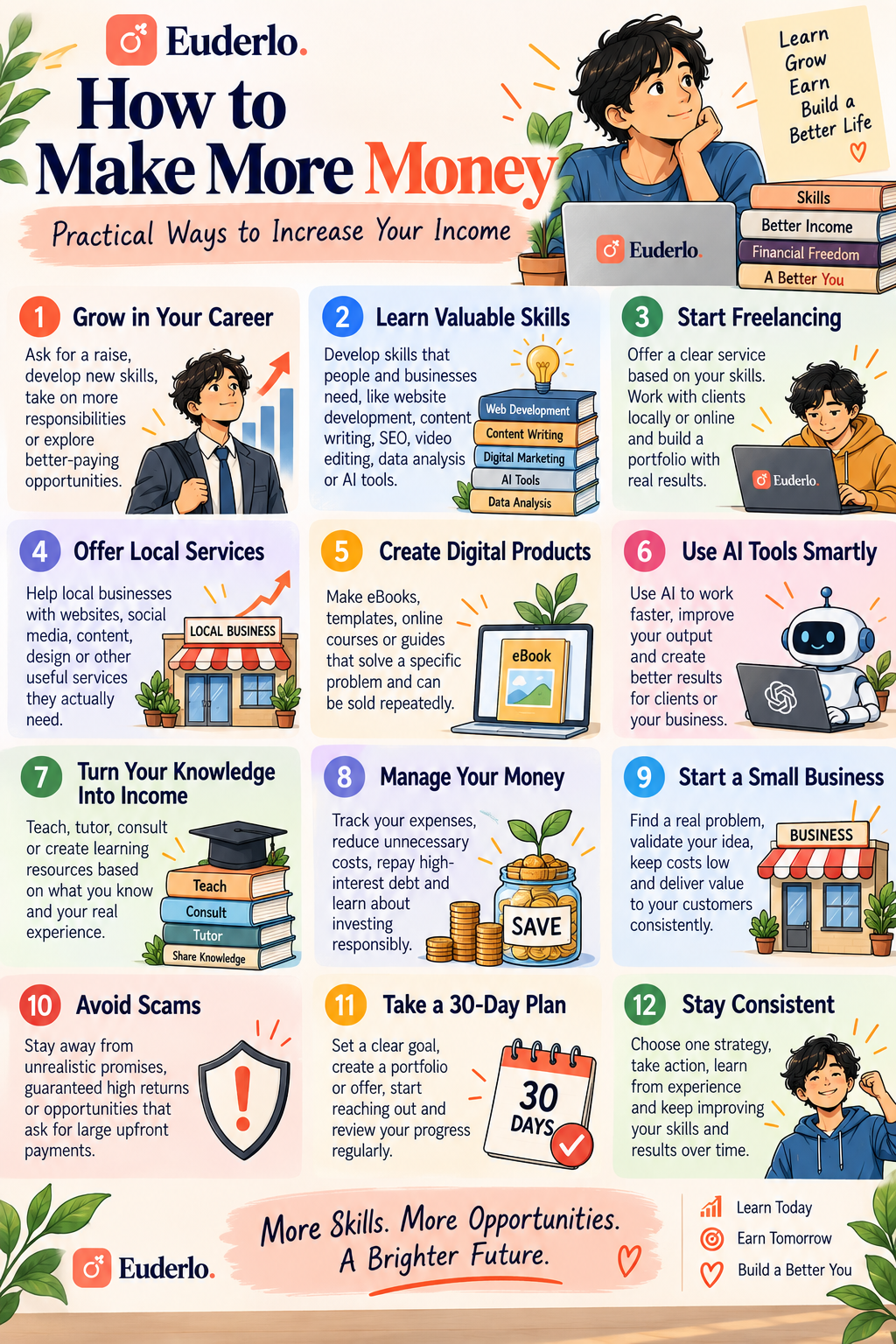
Why Making More Money Requires a Different Approach
Many people assume that earning more money simply means working harder. However, effort alone does not always lead to higher income.
Consider two people who work for the same number of hours. One performs a task that many people can do, while the other has a specialised skill that businesses urgently need. Depending on the market, experience, and quality of their work, the second person may have more opportunities to charge higher rates or negotiate better compensation.
This does not mean every specialised skill guarantees a high income. Demand, competition, location, experience, and the ability to find customers all matter. But it highlights an important principle: increasing the value you can provide may be more effective than simply increasing the number of hours you work.
You can approach income growth through three broad strategies.
Earn more from your existing work: Ask for a raise, change employers, improve your performance, or move into a better-paid role.
Earn from an additional source: Offer freelance services, tutor students, work part-time, or provide a useful service to local businesses.
Build long-term income-producing assets: Develop a digital product, create a business, or invest according to your financial circumstances and risk tolerance.
You do not have to pursue all three at once. In fact, choosing one main strategy and working on it consistently can be a better starting point.
1. Improve Your Current Income Before Starting Something New
One of the most overlooked answers to “How do I make more money?” is to improve the income you already receive.
If you have a job, your existing experience may give you a faster starting point than beginning an entirely new career. You already understand your industry, know how workplaces operate, and may have relationships with colleagues or clients.
Start by examining your current role. Are you performing responsibilities beyond your job description? Have you developed skills that make you more valuable? Are similar roles at other companies paying more?
These questions can help you identify whether you should negotiate a salary increase, pursue a promotion, or look for a better opportunity elsewhere.
Ask for a salary increase
Before asking for a raise, collect evidence of your contribution. Think about projects you completed, problems you solved, responsibilities you took on, and improvements you helped deliver.
Instead of saying that you need more money because your expenses have increased, explain how your work contributes to the organisation.
For example, you could say:
“I would like to discuss my compensation in light of my responsibilities and recent contributions. Over the past several months, I have taken ownership of additional tasks and helped improve our team's results. Could we review my current salary and discuss a suitable adjustment?”
The outcome will depend on your employer, performance, and available budget. Still, preparing a clear case gives you a stronger starting point.
Consider changing employers
Sometimes, your current workplace may have limited opportunities for salary growth. In that situation, researching comparable jobs can help you understand your market value.
Update your CV, improve your professional profile, and apply for roles that offer better compensation or more valuable experience. Do not resign before considering your financial obligations, the reliability of a new offer, and the risks involved.
Best for: People who already have work experience and want to increase their main source of income.
2. Learn Skills That People and Businesses Will Pay For
If you want to earn more income over the long term, learning a marketable skill can open new opportunities.
However, do not choose a skill merely because someone on social media claims it will make you rich. Look for evidence that people or businesses actually need the service, and consider how long it will take you to become competent enough to deliver it.
Some areas worth researching include:
Website design and development
Search engine optimisation (SEO)
Content writing and editing
Video editing and short-form video production
Graphic design and presentation design
Data analysis and spreadsheet automation
Generative AI tools and practical AI workflows
Email marketing and digital marketing
Bookkeeping and administrative support
Sales, customer support, and lead generation
These are possible directions, not guaranteed routes to a particular salary. Their value depends on the quality of your work, the market you serve, and your ability to find paying clients or employers.
For example, learning website development becomes more useful when you can build a complete website that solves a real problem. Learning video editing becomes more valuable when you can deliver polished videos that meet a client's requirements on time.
How to choose the right skill
Start with three questions.
What can I learn realistically? Choose something that fits your interests, current abilities, equipment, and available study time.
Who needs this skill? Search job advertisements, freelance listings, and local businesses to see what people are requesting.
How can I prove my ability? Create sample projects, build a portfolio, complete practical exercises, or work on a small project with clear expectations.
You do not need to master five skills before earning your first payment. Develop one useful skill, demonstrate it through real work, and improve based on feedback.
For current market context, you can review Upwork's report on in-demand skills for 2025. Remember that a platform's findings reflect its own marketplace and should not be treated as a guarantee of demand everywhere.
3. Start Freelancing With a Service You Can Deliver
Freelancing can be a practical way to earn additional money without immediately leaving your job. You offer a service to clients and receive payment for agreed work.
The most important decision is what service to sell. You do not need an expensive office, a large team, or a complicated business plan to test a simple service.
For instance, if you can write clearly, you might offer blog writing, website content, or editing. If you know how to build websites, you might help small businesses establish an online presence. If you understand social media, you might create posts and captions for local brands.
The key is to sell a clear result rather than a vague promise.
Instead of advertising yourself as someone who can do “all types of digital work,” offer a specific service such as:
Creating a basic website for a local clinic
Writing four SEO-focused blog articles
Editing a set of short videos
Designing a simple presentation for a small business
Updating product descriptions for an online store
A clear offer makes it easier for potential customers to understand what they will receive.
How to find your first freelance client
Begin with a small portfolio. If you have not worked with paying clients yet, create two or three realistic sample projects and clearly label them as samples.
Next, identify potential customers who genuinely need your service. These might include local businesses, independent professionals, startups, agencies, or people in your existing network.
Send personalised messages that explain what you noticed, how you could help, and what the next step would be. Avoid sending hundreds of identical messages or making promises you cannot fulfil.
For example:
“I noticed that your business could benefit from a simple, mobile-friendly website that explains your services and makes it easier for customers to contact you. I build websites for small businesses and would be happy to share a few ideas for your business if you are interested.”
Follow up politely, keep track of your conversations, and improve your offer when you learn why people accept or decline.
Before starting a project, agree on the scope, deadline, revisions, payment terms, and ownership of the finished work. This protects both you and your client.
Best for: People who have a practical skill and can dedicate time outside their primary work.
4. Offer Website Services to Local Businesses
A local service business can be a useful market to explore if you know how to create websites or manage basic digital tasks.
Many types of businesses can benefit from a professional online presence, including clinics, coaching centres, salons, repair services, consultants, restaurants, and independent professionals. Their needs vary, so do not assume that every business without a website is ready to pay for one.
Instead, look for a real problem. Perhaps a business has outdated information, no mobile-friendly website, a confusing contact process, or no clear explanation of its services.
You can offer a package that addresses the specific issue.
For example, a basic website package might include:
A homepage describing the business
A services page
Contact details and a contact form
Mobile-friendly design
Basic on-page SEO
Clear calls to action
A map or directions link, where appropriate
You can also offer ongoing maintenance, content updates, and technical support for an agreed fee.
How much should you charge?
Your pricing should reflect the complexity of the work, the time required, your experience, the client's requirements, and local competition.
Research comparable providers before setting a price. Be clear about what is included and charge separately for additional work when appropriate.
For your first projects, focus on delivering good results and collecting honest testimonials with permission. Do not work indefinitely for free, and do not guarantee that a website will produce a particular number of customers or a specific Google ranking.
A reliable reputation can help you build a business gradually.
5. Use AI Tools to Improve Your Productivity
Artificial intelligence tools can help you complete certain tasks faster, but they are not automatic money-making machines.
Their value comes from how effectively you use them to solve a real problem.
For example, AI tools may help you brainstorm content ideas, organise research, create initial drafts, analyse spreadsheets, develop website prototypes, or automate repetitive administrative tasks. You still need to check accuracy, protect confidential information, and ensure the final work meets the client's requirements.
A sensible approach is to combine AI with a skill you already have or are actively learning.
A content writer might use AI to organise an outline before revising the article for accuracy, originality, and usefulness. A website developer might use it to explore implementation options before testing the finished code. A small business owner might use it to prepare draft marketing material that is reviewed before publication.
To earn money from AI-assisted work, identify the outcome customers want. They are usually paying for a useful deliverable, not merely for access to a tool.
Avoid selling unreviewed AI output, making unsupported claims, or using confidential client material in tools without appropriate permission.
6. Start a Part-Time Service Business
Freelancing is not the only way to earn more money. You can also offer a simple service directly to people in your community.
The right option depends on your abilities, location, available time, startup costs, and customer demand.
Possible services include tutoring, home organisation, photography, event assistance, computer support, translation, basic design work, and other services you can perform safely and competently.
For example, someone comfortable with computers might help individuals set up software, organise files, or troubleshoot basic issues. Someone with strong subject knowledge might offer tutoring to students.
Before investing money, speak with potential customers. Ask what they need, how they currently solve the problem, and what they expect from a service provider.
Then test a small version of the service. Keep the first offer simple, record your expenses, and calculate what remains after travel, supplies, platform fees, taxes, and other costs.
Revenue is not the same as profit. A service that brings in money but consumes too much time or requires high expenses may not be worth continuing.
7. Create Digital Products That Solve a Specific Problem
Digital products can be another way to generate income. These products may include e-books, templates, online courses, printable planners, educational resources, or specialised guides.
The appeal is that a digital product can sometimes be sold repeatedly without recreating it for every customer. However, this does not mean the income is automatic or passive. You still need to create something valuable, reach the right audience, handle customer questions, and improve the product over time.
Start with a problem you understand.
For example, you could create a practical guide that helps beginners learn a particular skill, a spreadsheet that simplifies a repetitive task, or a template that helps small businesses organise their work.
Before spending weeks creating a product, validate the idea. Talk to potential buyers, research existing alternatives, and identify what your product would do better or more clearly.
You can also publish helpful free content to understand which topics attract genuine interest.
If you already run a blog, consider whether your readers need a related downloadable resource. Make sure the product offers meaningful value beyond information that is easily available elsewhere.
How to sell a digital product
A simple process looks like this:
Identify a specific audience and problem.
Create a small product that solves that problem.
Show examples of what buyers will receive.
Set a transparent price and clear refund policy.
Promote it through relevant content, communities, or partnerships.
Gather feedback and improve the product.
Do not expect immediate sales just because you have published something. Distribution, trust, product quality, and audience fit matter as much as creation.
8. Make More Money From Your Existing Knowledge
You may already know something that another person wants to learn.
Perhaps you understand a school subject, speak more than one language, have experience in customer support, know how to use a particular software tool, or have learned how to solve a problem at work.
You could potentially turn that knowledge into tutoring, training, consulting, writing, or educational material.
The first step is to identify what you can teach accurately and responsibly. Then choose a format that suits the audience.
For example, you might offer one-to-one tutoring, prepare a short beginner's guide, conduct a small online workshop, or provide practical assistance to people who are struggling with a task you understand well.
Start with a manageable scope. Ask for feedback, improve your teaching, and expand only when you can maintain quality.
Do not present yourself as a qualified professional in a field where you lack the required expertise, particularly in areas such as medicine, law, or regulated financial advice.
9. Explore a Better-Paying Career Path
Sometimes, the most sustainable way to make more money is to move into a role with better compensation or more opportunities for advancement.
This may require improving your current skills, earning a relevant certification, gaining experience, or changing industries.
Research job advertisements to understand the requirements for roles you want. Compare the qualifications employers request with your current abilities, then identify the smallest useful gap to close.
For example, someone working in customer support might explore quality analysis, team leadership, customer success, technical support, or sales-related roles. Whether these options are appropriate depends on the person's experience, interests, and the opportunities available.
Create a learning plan around actual job requirements rather than collecting certificates without a clear goal.
You can also improve your CV by describing your responsibilities and achievements clearly. Where possible, explain the scale of your work, the problems you solved, and the results you contributed to without exaggerating.
Apply consistently, prepare for interviews, and compare complete compensation packages rather than focusing only on the advertised salary.
10. Use Your Existing Money More Intentionally
If you want to know how to make more money with money, it helps to distinguish between earning additional income, saving money, and investing.
These are related, but they are not the same.
Saving money can free up cash by reducing unnecessary expenses. Investing may help you pursue long-term financial goals, but it involves risk and does not guarantee a profit. Earning additional income usually requires providing work, a service, a product, or capital that generates a return.
Start by understanding where your money goes each month.
Review your essential expenses, debt repayments, subscriptions, discretionary purchases, and savings. Look for spending you can reduce without undermining your health, safety, or essential needs.
If you have high-interest debt, compare the cost of that debt with your available options before committing money to investments. Make sure you understand fees, repayment conditions, and the consequences of missed payments.
Learn the basics before investing
If you are considering investments, begin with your financial goals, time horizon, ability to tolerate losses, and need for accessible cash.
Different asset classes have different levels of risk, liquidity, and potential return. No investment is suitable for everyone.
Learn from official investor-education resources, read the relevant product documents, and understand what you are buying before committing money. Be particularly cautious of anyone promising guaranteed high returns, pressuring you to invest immediately, or asking you to recruit others to earn money.
Useful starting points include SEBI's investor education portal, its guide to things to consider before investing, and its information on investment risk management.
Do not borrow money simply to speculate in the hope of getting rich quickly. Protecting your financial stability is part of building wealth.
11. Build a Small Business Around a Real Need
A business can provide an additional source of income, but starting one requires more than a good idea.
You need customers who are willing to pay, a way to deliver the product or service, and a pricing model that covers costs.
You could explore a service business, a niche online store, a specialised educational product, or a local business that addresses an unmet need. The best option depends on your skills, available resources, and market research.
Before spending heavily on equipment, inventory, office space, or advertising, test whether people want what you plan to offer.
A small experiment can help you answer important questions:
Who is the ideal customer?
What problem are you solving?
What alternatives do customers already use?
What will it cost to deliver the service?
How will customers discover you?
How much will remain after expenses?
Can you deliver consistently without harming your existing obligations?
You can begin with a limited offer and improve it as you learn. Keep personal and business finances organised, maintain accurate records, and check the legal, tax, and registration requirements relevant to your activity.
A business does not have to grow quickly to be worthwhile. Consistent demand, healthy margins, and reliable delivery are better foundations than impressive-looking revenue alone.
12. Avoid Money-Making Scams and Unrealistic Promises
When people are looking for ways to earn more money, they can become vulnerable to schemes that promise easy results.
Be cautious of opportunities that guarantee unusually high returns, require large upfront payments without a clear explanation, pressure you to recruit friends, or refuse to explain how the business actually generates income.
Also be careful with jobs that ask you to pay unexplained registration fees, share sensitive banking information, or complete suspicious financial transactions on someone else's behalf.
Before paying for a course, business opportunity, or investment, investigate the provider, read independent information, and understand the terms. A genuine opportunity should withstand reasonable questions.
Remember that even legitimate opportunities involve trade-offs. Freelancing takes time to build. Businesses can lose money. Investments can fall in value. New skills may take months to become commercially useful.
The goal is not to find a way to make money without effort. It is to choose an effort that has a realistic chance of producing value.
13. Choose the Right Strategy for Your Situation
You do not need to follow every method in this article. Choose one based on your circumstances.
| Your situation | A practical starting point |
|---|---|
| You have a full-time job | Explore a raise, promotion, or better-paying role |
| You have a marketable skill | Offer a clearly defined freelance service |
| You know website development | Approach suitable businesses with a specific website offer |
| You enjoy teaching | Explore tutoring or educational resources |
| You have useful knowledge and an audience | Test a digital product |
| You have limited startup money | Begin with a service that uses skills and tools you already have |
| You want long-term financial growth | Improve money management and learn about appropriate investments |
| You are unsure what to do | Research customer demand and test one small idea |
| You love writing | Write books and then sell them |
A useful rule is to prioritise opportunities that let you learn, demonstrate your ability, and receive feedback without putting your financial stability at unnecessary risk.
14. A Practical 30-Day Plan to Increase Your Income
You can spend a long time thinking about how to make more money without taking action. A short, structured plan can help you move from ideas to evidence.
Days 1–7: Identify your best opportunity
Write down your current income sources, financial obligations, available hours, skills, and interests.
Choose one income strategy to explore. Research potential customers or employers, compare existing offers, and identify what people are actually paying for.
By the end of the first week, you should have one clear direction rather than a list of unrelated ideas.
Days 8–14: Create something you can demonstrate
Build a sample project, prepare a portfolio, improve your CV, or develop a simple service package.
Keep the scope small enough to finish. Ask someone knowledgeable to review your work, and correct obvious weaknesses before presenting it to potential customers or employers.
Days 15–21: Start reaching out
Apply for relevant jobs, contact suitable businesses, offer a service to your network, or publish useful content related to your product.
Focus on genuine conversations instead of vanity metrics. A small number of relevant responses can teach you more than hundreds of unfocused messages.
Record whom you contacted, what you offered, and what happened next.
Days 22–30: Review and improve
Look at the evidence. Did people respond? What questions did they ask? Did they understand your offer? Was your price appropriate for the scope of work? What prevented potential customers from moving forward?
Improve your offer and continue with the approach that shows the most promise. If there is little interest, investigate whether the problem is the audience, the service, your presentation, or actual market demand before investing more money.
At the end of 30 days, your goal is to have a clearer understanding of a viable opportunity and a repeatable next step. You may earn money during this period, but a particular result is not guaranteed.
15. Mistakes to Avoid When Trying to Earn More Money
One common mistake is trying too many opportunities at the same time. Constantly switching between freelancing, trading, dropshipping, content creation, and other ideas can prevent you from developing any one of them properly.
Another mistake is spending money before validating demand. Expensive courses, subscriptions, equipment, and advertisements can quickly consume a limited budget.
Some people also confuse revenue with profit. Earning ₹20,000 from a project does not mean keeping ₹20,000 if you spent money on delivery, contractors, software, travel, taxes, or other costs.
It is also important not to compare your beginning with someone else's highlight reel. Online success stories often leave out unsuccessful attempts, existing resources, timing, and other factors.
Finally, avoid relying on income that you cannot reasonably sustain. Protect your health, meet your existing financial obligations, and allow enough time to learn and improve.
A thoughtful approach may feel slower than chasing a quick win, but it can help you make better decisions and build something more durable.
Conclusion: Make Your Next Step Count
Learning how to make more money begins with understanding what you can offer and where that offer may be valuable. You might improve your current career, develop a specialised skill, start freelancing, provide a service to local businesses, or build a product that solves a specific problem.
You do not need to pursue every opportunity. Choose one realistic direction, research the demand, and take a small step that helps you learn. Track the time and money you invest, listen to feedback, and improve your approach as you gain experience.
Making more money is not only about earning a larger amount. It is also about building financial stability, making informed decisions, and creating more options for your future.
Start with what you have, work on what you can improve, and give your chosen strategy enough time to produce useful evidence.
Frequently Asked Questions
1. How can I make more money?
You can explore a salary increase, move to a better-paying role, learn a marketable skill, offer freelance services, start a small business, or create a useful digital product. The best option depends on your current abilities, time, finances, and the demand for your offer.
2. How do I make more money without leaving my job?
Start by reviewing opportunities within your current career. You might negotiate a raise, develop skills for a promotion, or offer a small freelance service outside working hours. Check your employment agreement for any restrictions and avoid taking on more work than you can manage.
3. How can I earn more money with no investment?
You may be able to start with a service that uses skills and tools you already have, such as writing, tutoring, editing, or administrative assistance. Although you might not need substantial startup capital, you will still invest time and may incur small expenses.
4. How do I earn more money online?
Possible approaches include freelancing, remote employment, online tutoring, selling digital products, and running a legitimate online business. Research demand, develop the necessary skills, and verify the terms of any platform or opportunity before committing money.
5. How can I make more money with money I have saved?
First, maintain enough accessible savings for your needs and consider any high-interest debt. Then learn about suitable investment options, their risks, fees, and time horizons. Returns are uncertain, and you should never invest money you cannot afford to lose without understanding the consequences.
6. What skills can help me increase my income?
Depending on your interests and local demand, useful skills may include website development, SEO, writing, sales, video editing, data analysis, AI-assisted workflows, and bookkeeping. Choose a skill based on evidence of demand and your ability to become proficient.
7. Can I make more money with a part-time job?
Yes, a part-time role can provide additional income if the pay, schedule, travel, and other costs make sense. Compare the net benefit with the time required, and check that the extra work does not interfere with your main job or essential responsibilities.
8. Is freelancing a reliable way to earn more income?
Freelancing can become a useful income source, but earnings may fluctuate, particularly when you are starting out. Building a portfolio, finding repeat customers, managing expenses, and maintaining clear agreements can help you approach it more professionally.
9. How long does it take to start earning more money?
It depends on the strategy. A salary increase may depend on your employer's review cycle, while freelancing requires finding clients and delivering work. Developing a new skill or building a business can take considerably longer. Avoid relying on a guaranteed timeline.
10. Should I start a business to increase my income?
A business may be suitable if you have identified a real customer need and can deliver a product or service at a sustainable cost. Test demand on a small scale before making substantial financial commitments.
11. Can AI tools help me earn more money?
AI tools can support tasks such as research, drafting, coding, analysis, and workflow automation. You still need to check accuracy, protect sensitive information, and deliver quality work. The tool alone does not guarantee paying customers or income.
12. What is the safest way to increase my income?
There is no universally risk-free method. Improving your existing career, developing a useful skill, and testing a small service may limit some financial risks compared with borrowing heavily to launch an untested business. Consider your obligations and the potential downsides before deciding.
13. How can I increase my income if I have little experience?
Start with an achievable skill, practise through sample projects, and seek entry-level work or small projects that match your abilities. Be honest about your experience and use feedback to improve. You do not need to pretend to be an expert to begin learning professionally.
14. Should I focus on earning more or saving more?
Both can matter. Reducing unnecessary expenses may improve your available cash, while increasing income can give you more room to save, repay debt, and meet financial goals. The right balance depends on your present income and obligations.
15. How do I stay motivated when my income does not increase immediately?
Set goals based on actions you can control, such as completing a portfolio, applying for suitable jobs, or contacting potential customers. Review your progress regularly and adjust your approach based on evidence rather than judging yourself solely by immediate financial results.
Main Takeaway
The most practical way to make more money is to focus on providing something valuable that people are willing to pay for. This could mean improving your current career, learning a useful skill, freelancing, offering a local service, creating a digital product, or building a small business. You do not need to pursue every opportunity at once. Start by assessing your strengths, available time, financial responsibilities, and the demand for your chosen service or skill. Test your idea on a small scale, learn from feedback, and improve your approach before making substantial investments. Remember that higher income is not guaranteed, and every opportunity has trade-offs. Combine consistent effort with careful money management, realistic expectations, and informed decisions to work towards greater financial stability over time.
This guide is for employees, students, freelancers, aspiring entrepreneurs, and anyone who wants to increase their income.
A little context before you go
This article is created for educational and informational purposes to help readers explore practical ways to increase their income. It discusses career development, skill-building, freelancing, entrepreneurship, digital products, and responsible money management. The information is intended to encourage thoughtful decisions rather than promise quick wealth or guaranteed financial results. Individual outcomes may vary depending on skills, experience, market demand, financial circumstances, and the effort invested. Readers should independently evaluate opportunities, verify relevant information, and understand potential risks before making financial decisions. This content does not replace personalised financial, investment, legal, or professional advice from qualified experts.
Where these ideas come from
Sources are listed here when an article uses books, studies, official information, research, or other external material.
- 01 https://www.upwork.com/press/releases/upwork-unveils-2025s-most-in-demand-skillshttps://investor.sebi.gov.in/
- 02 https://investor.sebi.gov.in/investment-thingsbeforeinv.html
- 03 https://investor.sebi.gov.in/investment_risk_managment.html
- 04 https://investor.sebi.gov.in/investment-assetclasses.html