Why We Procrastinate — And How to Finally Stop Delaying the Life We Want
Why we put off the things that matter, what procrastination is really trying to protect us from, and how to make starting feel easier
Procrastination is not always about being lazy or having poor time management. Sometimes, we delay because a task feels uncomfortable, overwhelming, boring, uncertain, or simply too difficult to face right now. The problem is that avoiding something may give us relief for a moment, but the task—and the stress that comes with it—usually waits for us.
C
Chandan GiriWriter & Creator, Euderlo · 17 min read
You know what you need to do. You may even have a clear plan sitting in your head. But somehow, you find yourself checking your phone, watching another video, cleaning your desk, replying to messages, or telling yourself, “I'll start tomorrow.”
Then tomorrow comes, and you do it again. I think this is what makes procrastination so frustrating. It's not that we don't care about our goals. Often, we care deeply. We want to write the book, start exercising, apply for the job, study for the exam, build the business, have that difficult conversation, or finally work on the idea we've been carrying around for months. Yet knowing what matters doesn't always make it easier to begin.
Procrastination is something most of us experience, but it is often misunderstood. We call ourselves lazy, undisciplined, distracted, or incapable when the real problem may be more complicated. Sometimes we're avoiding a feeling rather than avoiding a task. A task can make us feel bored, anxious, uncertain, overwhelmed, or afraid that we won't do it well enough. Putting it off gives us a small moment of relief. Unfortunately, that relief can make it easier to repeat the same behaviour the next time.
And this is where the cycle begins: the task creates discomfort, we avoid it, we feel better temporarily, and later we feel stressed because we still haven't done it.
Breaking that cycle isn't simply about becoming more productive or forcing yourself to work harder. It's about understanding why you keep delaying, making the first step smaller, and learning to act even when you don't feel completely ready.
Because sometimes the hardest part isn't doing the work. It's starting.
There is a moment almost all of us know. You have something important to do, you know it matters, you know what needs to be done, and yet you suddenly find yourself doing everything except that thing. You check your phone, answer an unnecessary message, make coffee, clean your desk, watch one video, open another tab, scroll for a few minutes and then tell yourself, “I'll start in a little while.” Somehow, that little while becomes an hour. Then the day becomes tomorrow. Then tomorrow becomes next week. We often call this laziness, but procrastination is more complicated than simply not wanting to work. Research increasingly describes it as a problem of self-regulation and, importantly, emotion regulation: sometimes we delay a task because doing it brings uncomfortable feelings, while avoiding it gives us immediate emotional relief.
The Strange Thing About Procrastination
The strange thing about procrastination is that we usually know we are doing it. We know the assignment is due. We know the email needs to be sent. We know the application needs to be completed. We know the book needs to be written, the business needs to be started, the exam needs to be prepared for and the workout needs to happen. There is rarely a complete lack of awareness. Instead, there is a conflict between what we want eventually and what feels easier right now. I might want to become healthier, but I may want to stay in bed this morning. You might want to build a successful career, but opening a difficult project may feel uncomfortable today. We can genuinely care about our future and still choose something that makes the present moment easier.
Procrastination Is Often About How We Feel, Not How We Manage Time
For a long time, procrastination was commonly discussed as a time-management problem. The advice was familiar: make a schedule, create a to-do list, set deadlines and manage your time better. Those things can help, but they don't always explain why a person can create the perfect schedule and still avoid the task sitting directly in front of them. Fuschia Sirois's research and work on procrastination emphasizes mood regulation: when a task feels boring, frustrating, intimidating, uncertain or anxiety-provoking, avoiding it can temporarily make us feel better. That temporary relief can reinforce the avoidance. In other words, the brain learns something very simple: “When this task makes me uncomfortable, escape from it and the discomfort goes down.”
The Procrastination Cycle
This is how the cycle often looks in real life: an important task appears, the task creates an uncomfortable feeling, we avoid the task, we experience immediate relief, time passes, the deadline gets closer, pressure increases, we feel guilty or anxious, the task becomes even more unpleasant and we look for another escape. Then the cycle begins again. Imagine that you need to write an important article. You open the document and see a blank page. Suddenly you feel pressure because you want the article to be good. Instead of writing, you check your phone. For the next twenty minutes, you feel better because you are no longer facing the blank page. But the article is still waiting. Later, the deadline is closer, the pressure is higher and the blank page feels even more threatening. This is why procrastination can become self-reinforcing: avoidance solves the feeling for a moment without solving the problem.
We Are Often Choosing Today Over Tomorrow
One of the deepest ideas behind procrastination is the conflict between our present self and our future self. Today, watching a movie gives us pleasure immediately. Studying gives us a reward later. Today, scrolling social media feels easy. Going to the gym requires effort first and gives benefits later. Today, avoiding a difficult conversation gives us relief. Having the conversation may give us a healthier relationship later. Our future self wants the long-term result, but our present self is standing in front of the discomfort. This is why procrastination isn't necessarily proof that we don't care. Sometimes we care so much about the outcome that the possibility of failure makes starting emotionally difficult.
Why Do We Procrastinate on Things That Matter Most?
Think about the things you procrastinate on most. They are often not completely meaningless. In fact, they may be some of the things you care about the most. We rarely spend hours avoiding something because it has absolutely no emotional importance. We often avoid things that can change something: an exam, a job application, a business idea, a difficult conversation, a creative project, a financial decision or a personal goal. The more uncertain the outcome, the more emotional weight the task can carry. If I write something nobody likes, I can feel rejected. If I apply for a job, I can be rejected. If I start a business, I can fail. If I publish my work, people can criticize it. If I begin studying seriously, I may discover how much I don't know. Avoidance can therefore become a way of protecting ourselves from an uncomfortable possibility.
The Psychology Behind the Task
Research supports the idea that some tasks are naturally easier to postpone than others. Piers Steel's major 2007 meta-analysis examined 691 correlations and found strong and consistent relationships between procrastination and factors including task aversiveness, delay, self-efficacy, impulsiveness and aspects of conscientiousness such as self-control, distractibility, organization and achievement motivation. The review also connected these findings with Temporal Motivation Theory, which considers factors such as expected success, value, delay and sensitivity to delayed rewards. This makes intuitive sense. If a task feels unpleasant, the reward is far away and you aren't confident you can do it well, starting becomes harder. If another activity is immediately enjoyable and requires almost no effort, that alternative becomes very attractive. Your brain doesn't necessarily need to believe the distraction is more important. It only needs to believe the distraction feels better right now.
The Problem With Waiting for Motivation
One of the biggest mistakes we make is waiting to feel motivated before starting. We say, “I'll do it when I feel motivated.” But motivation isn't always the beginning of action. Sometimes action creates motivation. Think about exercise. You may not want to put on your shoes, but after ten minutes of movement you may feel completely different. Think about writing. You may stare at the blank page and feel nothing, but after writing one imperfect paragraph, the next paragraph becomes easier. Think about studying. The first ten minutes may feel terrible, but once your brain enters the subject, continuing becomes less difficult. We often imagine motivation as a feeling that arrives before action. In reality, action can sometimes be what creates the feeling we were waiting for.
Perfectionism Can Make Procrastination Look Productive
There is another form of procrastination that is much harder to recognize because it looks productive. You research more. You plan more. You buy another notebook. You watch another tutorial. You redesign your website. You improve your résumé again. You read another book before starting the project. You tell yourself you are preparing, and sometimes you genuinely are. But there is a point where preparation becomes avoidance. Perfectionism can create this trap because if we believe the final result must be excellent, beginning becomes frightening. The first version will probably be imperfect, so we postpone creating it. Research distinguishes between different forms of perfectionism, and perfectionistic concerns have been associated with problematic outcomes, while high standards themselves are not automatically unhealthy. The question we need to ask ourselves is simple: “Am I improving the work, or am I avoiding the moment when the work becomes real?”
The First Draft Is Supposed to Be Bad
This applies to almost everything. Your first article may be weak. Your first business idea may change. Your first video may feel awkward. Your first workout may feel difficult. Your first attempt at learning a skill may be embarrassing. That is not evidence that you should stop. It is evidence that you have reached the beginning. We sometimes demand the quality of the finished product from the first attempt. That is impossible. Creation and improvement are different stages. First create something. Then improve it. If you try to edit a blank page before writing anything, you can spend forever preparing for a result that doesn't exist.
Procrastination Can Damage More Than Your To-Do List
The cost of procrastination isn't only that something remains unfinished. Habitual procrastination has been associated with stress and poorer health behaviours in research. A 2023 three-wave longitudinal study involving 379 participants found that chronic procrastination was positively associated with stress and negatively associated with health behaviours across the assessments; the researchers also found an indirect relationship between procrastination and health problems through stress after accounting for conscientiousness and neuroticism. These findings describe associations and pathways in the study; they should not be interpreted as proof that procrastination alone causes every health problem. A 2026 meta-analysis covering 36 samples and 8,603 participants likewise found an association between trait procrastination and poorer self-rated health, with stress accounting for part of that relationship. Again, this is evidence about association rather than a simple cause-and-effect claim.
Stress Can Make Procrastination Even Easier
There is an uncomfortable paradox here: stress can make us procrastinate, and procrastination can create more stress. When we are already mentally exhausted, our ability to tolerate an unpleasant task can become weaker. Sirois's conceptual review argues that stressful contexts can increase vulnerability to procrastination because stress can deplete coping resources and reduce our tolerance for negative emotions. This explains why the advice “just be more disciplined” can sometimes feel useless. When your mind is overloaded, adding more self-criticism may not solve the underlying problem. Sometimes we first need to reduce the size of the task and make it emotionally approachable.
Stop Calling Yourself Lazy
The word “lazy” can become a dangerous shortcut because it ends the investigation. If I tell myself, “I'm lazy,” I no longer need to ask why I'm avoiding the task. But what if I'm not lazy? What if I'm overwhelmed? What if I'm afraid of failing? What if I don't know where to start? What if the task is badly defined? What if I am exhausted? What if I have turned one small responsibility into a giant mental mountain? What if I am demanding perfection before I allow myself to begin? The answer matters because different problems require different solutions. If the problem is confusion, create clarity. If the problem is fear, reduce the emotional risk. If the problem is perfectionism, create a deliberately imperfect first version. If the problem is distraction, change your environment. If the problem is exhaustion, recovery may be part of the solution.
So How Do We Actually Stop Procrastinating?
The answer isn't to become a completely different person tomorrow morning. It is to make starting easier today. The first thing I would do is stop asking, “How can I finish this?” and start asking, “What is the smallest action that begins this?” That question changes everything. If you need to write an essay, don't promise to finish the essay. Open the document and write the first paragraph. If you need to study, don't promise to master the entire chapter. Read the first page. If you need to clean your room, don't think about the entire room. Pick up five things. If you need to start a business, don't build the whole business today. Write down the first problem you want to solve. The goal is to turn an abstract mountain into a visible step.
Make the First Step Almost Ridiculously Small
We often make our goals so large that our brain rejects them before we begin. “I need to lose weight.” “I need to become successful.” “I need to write a book.” “I need to learn coding.” “I need to fix my finances.” These statements describe destinations, not actions. Your brain cannot execute a destination. It can execute a behaviour. So turn the goal into something physical and specific. Open the document. Write 100 words. Read two pages. Walk for fifteen minutes. Send one email. Make one call. Solve one question. The smaller the starting point, the less opportunity your mind has to create a dramatic argument against beginning.
Separate the Feeling From the Action
One of the most powerful changes you can make is to stop treating your feelings as instructions. You can feel anxious and still send the email. You can feel tired and still take a short walk. You can feel uncertain and still research the first step. You can feel afraid and still submit the application. You can feel unmotivated and still work for ten minutes. The sentence “I don't feel like doing it” describes your current emotional state. It doesn't have to determine your behaviour. We don't need to eliminate every uncomfortable feeling before we act. Sometimes we simply need to become better at carrying discomfort while taking the next step.
Make Distractions Harder to Reach
We often expect ourselves to have unlimited self-control while designing our environment around distraction. Our phone is beside us. Notifications are active. Social media is one click away. Entertainment is always available. Then we sit down to work and blame ourselves when we get distracted. Instead, change the environment. Put your phone away. Close unnecessary tabs. Turn off notifications that aren't important. Keep the document you need open. Prepare your workspace before you start. You don't need extraordinary discipline if your environment isn't constantly asking you to make a decision.
Use the If–Then Rule
Instead of saying, “I'll study tomorrow,” create a specific rule: “If it is 8 p.m., I will sit at my desk and study for twenty minutes.” Instead of saying, “I should exercise more,” say, “If I finish work at 6:30, I will change clothes and go for a walk.” Instead of saying, “I need to read more,” say, “If I get into bed, I will read five pages before opening social media.” The more specific the decision, the less room there is for negotiation. You are no longer asking yourself what to do in the moment. You already decided.
Stop Trying to Fix Your Entire Life in One Day
This is another reason people procrastinate. We suddenly become inspired and create a massive plan. We will wake up at 5 a.m., exercise, meditate, read fifty pages, work eight focused hours, learn a new skill, start a business, eat perfectly and sleep early. It sounds impressive at night. It often collapses within days. Then we conclude that we lack discipline. Maybe the problem wasn't your character. Maybe the plan was unrealistic. Sustainable change is usually less dramatic. Choose a few behaviours you can repeat. Make them ordinary. Make them boring. Make them reliable. A small promise kept repeatedly can change your identity more effectively than a giant promise broken every week.
Be Kinder to Yourself, But Don't Let Yourself Escape
Self-compassion doesn't mean telling yourself that nothing matters. It means responding to your mistakes without adding unnecessary shame. Research discussed by the APA has linked self-compassion with healthier responses to difficult emotions and has specifically discussed its relationship with procrastination and stress. If you procrastinated today, you don't need to spend the next three hours attacking yourself for it. That doesn't complete the task. Say, “I avoided this. I understand why. Now I'm going to take ten minutes and begin.” There is strength in that response because it combines honesty with action.
Don't Confuse Planning With Progress
Planning is useful until it becomes a hiding place. You can spend an entire day organizing the work and still avoid doing the work. You can download productivity apps, create colour-coded schedules, watch videos about discipline and make beautiful to-do lists without completing the one thing that actually matters. At some point, preparation must become execution. Ask yourself, “What would progress physically look like right now?” If progress means writing, write. If it means calling someone, call. If it means studying, study. If it means applying, complete the application. If it means creating, create. The difference between planning and progress is often visible in what exists at the end of the hour.
Give Your Future Self a Better Day
Before you postpone something, imagine tomorrow morning. The unfinished task will still be there. The email will still need to be sent. The report will still need to be written. The application will still be incomplete. The difficult conversation will still be waiting. But the opposite is also true. If you do something today, even something small, tomorrow becomes easier. You don't need to finish everything for your future self. You only need to leave that person with a little less weight to carry. One paragraph written today is one paragraph your future self doesn't have to write. One application submitted today is one application your future self doesn't have to worry about. One workout completed today is one promise you kept.
What If You Have Been Procrastinating for Years?
Then don't try to repair years in one afternoon. Start with one area of your life. Choose one task you have been avoiding. Sit down for fifteen minutes. Don't promise yourself that you will never procrastinate again. That promise is unnecessary. Your goal is simply to interrupt the pattern. Once you experience yourself beginning despite discomfort, you have created new evidence about yourself. You learn, “I can feel resistance and still act.” Repeat that enough times and the relationship between discomfort and action can begin to change.
The 15-Minute Rule
If you are reading this while avoiding something, try this immediately. Write down the task. Write down why you don't want to do it. Then identify the emotion underneath the resistance. Are you bored? Confused? Afraid? Overwhelmed? Worried about failing? Trying to make it perfect? Once you know what you're dealing with, reduce the task until it can be started in fifteen minutes. Put your phone away. Set a timer. Begin. You are allowed to stop after fifteen minutes. But you are not allowed to spend those fifteen minutes preparing to begin. Begin. The purpose of this exercise isn't to finish everything. It is to prove that starting is possible.
The Real Goal Isn't to Never Procrastinate Again
You will procrastinate again. I will too. There will be mornings when we choose comfort. There will be evenings when we waste time. There will be days when our plans collapse. That doesn't mean we have failed. The goal is to notice it earlier. Instead of spending three hours avoiding a task, notice it after twenty minutes. Instead of waiting until the deadline, begin when the discomfort first appears. Instead of turning one bad day into one bad month, restart the next day. Progress isn't the absence of mistakes. Progress is becoming faster at returning to the path.
What Procrastination Can Teach Us About Ourselves
Perhaps the most useful thing about procrastination is that it can reveal what we are trying to avoid emotionally. The task is sometimes only the surface. Underneath it may be fear, uncertainty, perfectionism, boredom, resentment, confusion or exhaustion. Once we understand that, we can stop fighting a vague enemy called “laziness” and start solving the actual problem. Maybe you don't need a stricter schedule. Maybe you need clarity. Maybe you don't need another motivational video. Maybe you need to lower the size of the first step. Maybe you don't need to criticize yourself harder. Maybe you need to stop making the task emotionally larger than it really is.
Your Life Is Built From the Things You Keep Postponing
There is something uncomfortable about procrastination that we rarely discuss. The things we repeatedly postpone can quietly become the things we never experience. The book remains unwritten. The business remains an idea. The conversation never happens. The application never gets submitted. The skill never gets learned. The trip never gets planned. The person you wanted to become remains an idea in your head. And this is why procrastination matters. Not because every minute must be productive, but because your life is limited. Rest matters. Entertainment matters. Doing nothing sometimes matters. But there is a difference between consciously resting and repeatedly escaping from the life you say you want.
Start Before You Feel Ready
You may never feel completely ready. The person who waits for confidence before beginning may wait forever because confidence often grows through experience. You become confident after doing difficult things, not before every difficult thing. You learn that you can survive an imperfect result. You learn that rejection isn't the end. You learn that uncertainty can be tolerated. You learn that you can begin without having the entire path mapped out. And eventually, something changes. The task that once looked enormous becomes ordinary.
The Deeper Lesson
Maybe the real opposite of procrastination isn't productivity. Maybe it is willingness. Willingness to experience a little boredom. Willingness to feel uncertain. Willingness to create something imperfect. Willingness to be judged. Willingness to begin without guarantees. We cannot control every feeling that appears when we work toward something meaningful, but we can become less dependent on feeling comfortable before we act. That is a much more powerful form of discipline because it doesn't require us to become emotionless. It simply teaches us that emotions can be present without being in charge.
Final Thought
The next time you catch yourself saying, “I'll do it later,” pause for a moment. Ask yourself what “later” is protecting you from. Maybe it's protecting you from boredom. Maybe from failure. Maybe from uncertainty. Maybe from the possibility that your first attempt won't be perfect. Then make the task smaller and begin anyway. You don't need to finish your entire life today. You don't need a perfect routine, an extraordinary morning or unlimited motivation. You need one honest decision followed by one small action. Write the first sentence. Read the first page. Send the first message. Make the first call. Take the first step. Your future is not created somewhere far away. It is being created in these ordinary moments when you decide whether to keep postponing or finally begin. And sometimes the biggest change in your life starts with the smallest sentence you can say to yourself: “I don't have to finish it right now. I just have to start.”
What to remember
You don't have to feel ready to start; you have to make starting easier. When you notice yourself avoiding something important, don't immediately call yourself lazy. Ask what you are feeling, understand what makes the task difficult, reduce it to the smallest possible action and take that action before your mind creates another reason to wait. Procrastination often becomes stronger when we use avoidance to escape uncomfortable emotions, so the goal is not to eliminate discomfort but to learn that we can experience discomfort and still move forward.
Key points
Procrastination is not simply laziness: It is often connected with self-regulation, motivation, and the desire to escape uncomfortable feelings associated with a task.
We often choose immediate comfort over future benefits: The present reward of watching, scrolling, resting, or avoiding can feel more powerful than a benefit that will arrive later.
Difficult tasks are easier to postpone: Task aversiveness, delayed rewards, lower self-efficacy, impulsiveness, distractibility, and weaker self-control are among factors associated with procrastination.
Avoidance can create temporary relief: When we escape an uncomfortable task, we may feel better in the short term, which can reinforce the habit of avoiding similar tasks.
Stress can strengthen procrastination: Stress may reduce our ability to cope with difficult emotions, making avoidance more tempting and potentially creating another cycle of stress.
Perfectionism can make starting harder: When we believe our work must be perfect, the fear of producing an imperfect first attempt can become another reason to delay.
Motivation does not always come first: Sometimes beginning the task creates momentum, making it easier to continue.
Make the first step smaller: Instead of thinking about finishing the entire task, focus on one paragraph, one page, one question, one email, or fifteen minutes of work.
Separate feelings from actions: Feeling anxious, bored, uncertain, or unmotivated does not mean you have to stop. You can acknowledge the feeling and still take the next step.
Change your environment: Put distractions farther away, turn off unnecessary notifications, close unrelated tabs, and make the task you want to complete easier to access.
Use specific plans: Replace “I will do it later” with a clear action such as “At 8 p.m., I will sit at my desk and work for 20 minutes.”
Don't confuse preparation with progress: Planning, researching, organizing, and learning about a task are useful only when they eventually lead to actually doing it.
Practice self-compassion: Be honest when you procrastinate without using guilt and self-criticism as another reason to avoid the task.
Focus on starting rather than finishing: You don't need to complete everything today. You need to create movement.
Learn from the emotion behind the delay: Procrastination can sometimes reveal boredom, fear, uncertainty, overwhelm, perfectionism, or confusion that needs to be addressed.
Don't try to change everything at once: Choose one important task, make the first action small, and repeat the behavior consistently.
Expect setbacks: The goal isn't to become someone who never procrastinates. The goal is to recognize the pattern sooner and return to action faster.
Your future is affected by today's small decisions: Every small action you complete makes something easier for your future self, while every repeated delay can leave another unfinished responsibility waiting.
Conclusion
Procrastination is not simply about being lazy or having poor time management. Very often, we delay because a task makes us feel uncomfortable—uncertain, overwhelmed, bored, anxious, pressured or afraid of failing. Avoiding the task gives us relief for a moment, but the unfinished work eventually returns with more pressure. Research on procrastination has increasingly highlighted this connection between short-term mood regulation and delayed goals. The good news is that we don't have to wait until we feel perfectly motivated to change. We can make the first step smaller, remove distractions, accept imperfect beginnings, understand the emotion behind our avoidance and act even when we don't feel completely ready. We may still procrastinate sometimes—that is part of being human—but we can become better at noticing it, interrupting the cycle and starting again. Your future is not changed by one enormous decision; it is shaped by the small decisions you make when nobody is watching. Sometimes the most important thing you can do is simply stop negotiating with yourself and begin.
Take the Challenge
Turn what you learned into action with a simple challenge you can actually complete.
7-DAY CHALLENGE
7-Day Challenge
7-Day Challenge — Break the Procrastination Cycle
Goal: Stop waiting for motivation and practice taking immediate action.
Day 1 — Identify What You're Avoiding
Write down 3 things you have been postponing.
Choose the one that matters most.
Write honestly: “What am I feeling when I think about doing this?”
Look for emotions such as fear, boredom, uncertainty, overwhelm, or perfectionism.
Spend just 5 minutes working on it.
Today's rule: Don't finish it. Just begin.
Day 2 — Make the First Step Ridiculously Small
Take yesterday's task.
Break it into the smallest possible action.
Instead of “write my book,” make it “open the document and write the first paragraph.”
Complete that one action.
If you feel like continuing, continue—but don't force yourself.
Today's rule: Make starting easier than avoiding.
Day 3 — Remove One Distraction
Choose your biggest distraction.
Put your phone away, close unnecessary tabs, or disable notifications.
Create a 25-minute distraction-free work session.
Work only on your chosen task.
Take a short break afterward.
Today's rule: Protect your attention before demanding more discipline from yourself.
Day 4 — Use the “Just 10 Minutes” Rule
Pick one task you've been avoiding.
Tell yourself you only need to work for 10 minutes.
Start a timer.
Continue if you naturally want to.
Stop after 10 minutes if you genuinely want to stop.
Today's rule: You don't need to finish the task; you need to overcome the resistance to starting.
Day 5 — Stop Waiting for Perfect
Identify something you're delaying because you want to do it perfectly.
Create a deliberately imperfect first version.
Write the rough draft.
Make the first attempt.
Remind yourself: “I can improve something that exists. I can't improve something I haven't started.”
Today's rule: Finished and imperfect is more useful than perfect and unfinished.
Day 6 — Do the Thing You Keep Postponing
Choose the most important unfinished task from your list.
Give it a 30-minute focused session.
No social media.
No unnecessary research.
No reorganizing your workspace instead of doing the work.
When the timer ends, record what you accomplished.
Today's rule: Action before comfort.
Day 7 — Build Your Anti-Procrastination System
Write down:
The situations where you procrastinate most.
The emotions that usually trigger it.
Your biggest distractions.
The strategies that helped you start this week.
One habit you will continue every day.
One important task you will complete next week.
Then create your personal rule:
“When I notice myself avoiding something important, I will make the task smaller and start for 5–10 minutes.”
7-day outcome: You haven't “cured” procrastination—you've practiced recognizing it and acting despite the resistance.
30-DAY CHALLENGE
30-Day Challenge
30-Day Challenge — Become Someone Who Starts
Goal: Turn the lessons from the essay into a repeatable daily system.
Week 1 — Understand Your Procrastination
Day 1: List your top 5 delayed tasks.
Day 2: Identify the emotions behind each task.
Day 3: Identify your biggest digital distractions.
Day 4: Track every time you catch yourself procrastinating.
Day 5: Notice your common excuses.
Day 6: Choose one important task and break it into tiny steps.
Day 7: Review the week and identify your biggest procrastination trigger.
Week 2 — Make Starting Easier
Day 8: Use the 5-minute starting rule.
Day 9: Prepare tomorrow's most important task tonight.
Day 10: Work for one distraction-free 25-minute session.
Day 11: Put your phone away during important work.
Day 12: Start the task you've been avoiding longest.
Day 13: Use “just one step” instead of thinking about the entire project.
Day 14: Review what made starting easier.
Week 3 — Build Discipline
Day 15: Choose one daily non-negotiable task.
Day 16: Complete it before entertainment.
Day 17: Practice working even when you don't feel motivated.
Day 18: Finish one small unfinished task.
Day 19: Say no to one unnecessary distraction.
Day 20: Complete a 45-minute focused session.
Day 21: Review your consistency—not your perfection.
Week 4 — Become a Finisher
Day 22: Choose one project to finish this week.
Day 23: Remove everything unnecessary from the project.
Day 24: Complete the hardest remaining part first.
Day 25: Finish an imperfect version.
Day 26: Review and improve it.
Day 27: Complete the final remaining step.
Day 28: Finish and publish, submit, send, or deliver it.
Day 29: Write down what you learned about yourself.
Day 30: Create your long-term anti-procrastination system.
Your 30-day rule
Don't ask, “Do I feel motivated?”
Ask:
“What is the smallest useful action I can take right now?”
90-DAY CHALLENGE
90-Day Challenge
90-Day Challenge — Rebuild Your Relationship With Action
Goal: Move from repeatedly fighting procrastination to building a lifestyle where important things get started and finished.
Days 1–30 — Awareness & Action
Focus on understanding your patterns and becoming better at starting.
During these 30 days:
Track your procrastination triggers.
Identify tasks you consistently avoid.
Reduce unnecessary phone use.
Practice the 5-minute rule.
Use 25-minute focused sessions.
Break large projects into smaller actions.
Start important tasks before entertainment.
Practice working without waiting for motivation.
Finish small tasks instead of constantly starting new ones.
Build a simple daily priority system.
Milestone: Become better at starting.
Days 31–60 — Discipline & Focus
Now increase the difficulty.
Build these habits:
Choose 1–3 important priorities every morning.
Complete your most important task before unnecessary scrolling.
Schedule focused work.
Create distraction-free environments.
Practice longer periods of concentration.
Finish what you start.
Avoid unnecessary multitasking.
Keep promises you make to yourself.
Review your progress every evening.
Learn to tolerate temporary boredom and discomfort.
Weekly challenge
Each week, choose one uncomfortable but important task and deliberately complete it.
Examples:
Make the difficult phone call.
Apply for the job.
Start the project.
Have the conversation.
Submit the application.
Publish the article.
Complete the assignment.
Organize your finances.
Milestone: Become better at continuing when the initial excitement disappears.
Days 61–90 — Build Your Future Self
The final 30 days are about making the system sustainable.
Work on:
Long-term goals.
Consistent routines.
Deep work.
Healthy digital habits.
Better sleep and recovery.
Weekly planning.
Completing meaningful projects.
Reducing unnecessary commitments.
Learning to say no.
Reviewing your progress every Sunday.
Create 3 personal rules
For example:
Rule 1: I start important tasks before checking social media.
Rule 2: When something feels overwhelming, I make the first step smaller.
Rule 3: I don't need to feel ready to begin.
Day 90 — Your Personal Review
Answer:
What did I stop postponing?
What triggers my procrastination?
What distractions hurt me most?
What strategies helped me start?
What helped me finish?
What important thing am I still avoiding?
What habit do I want to maintain for the next year?
What would change in my life if I consistently acted on what matters?
Then choose one meaningful goal for the next 90 days.
90-day outcome: The objective isn't to become a person who never procrastinates. It's to become someone who notices avoidance sooner, starts sooner, and returns to important work more consistently.
CURATED READING
Read Books Related to This Topic
Explore books that can help you go deeper into the ideas in this essay.
Drag, swipe or use the arrows
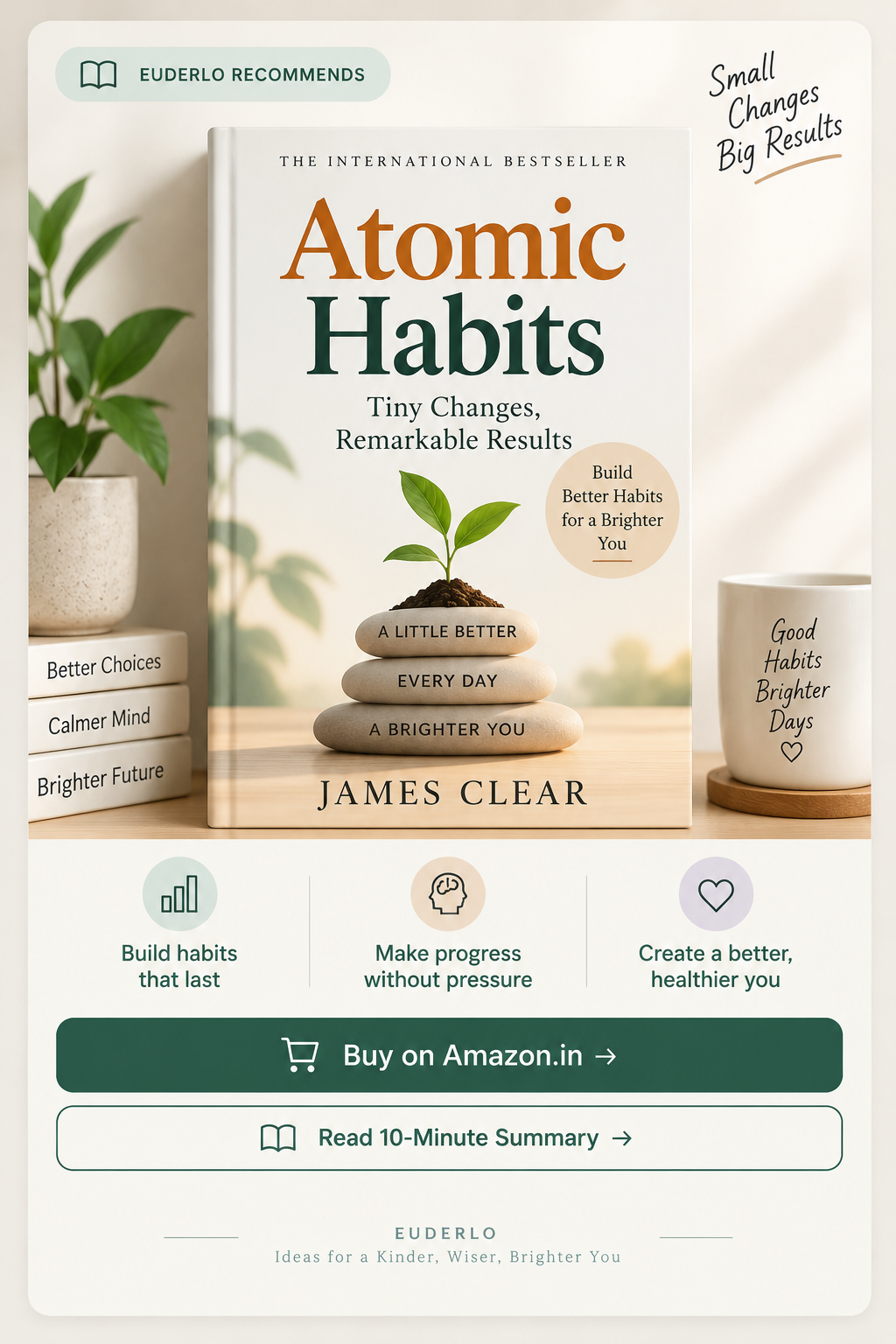
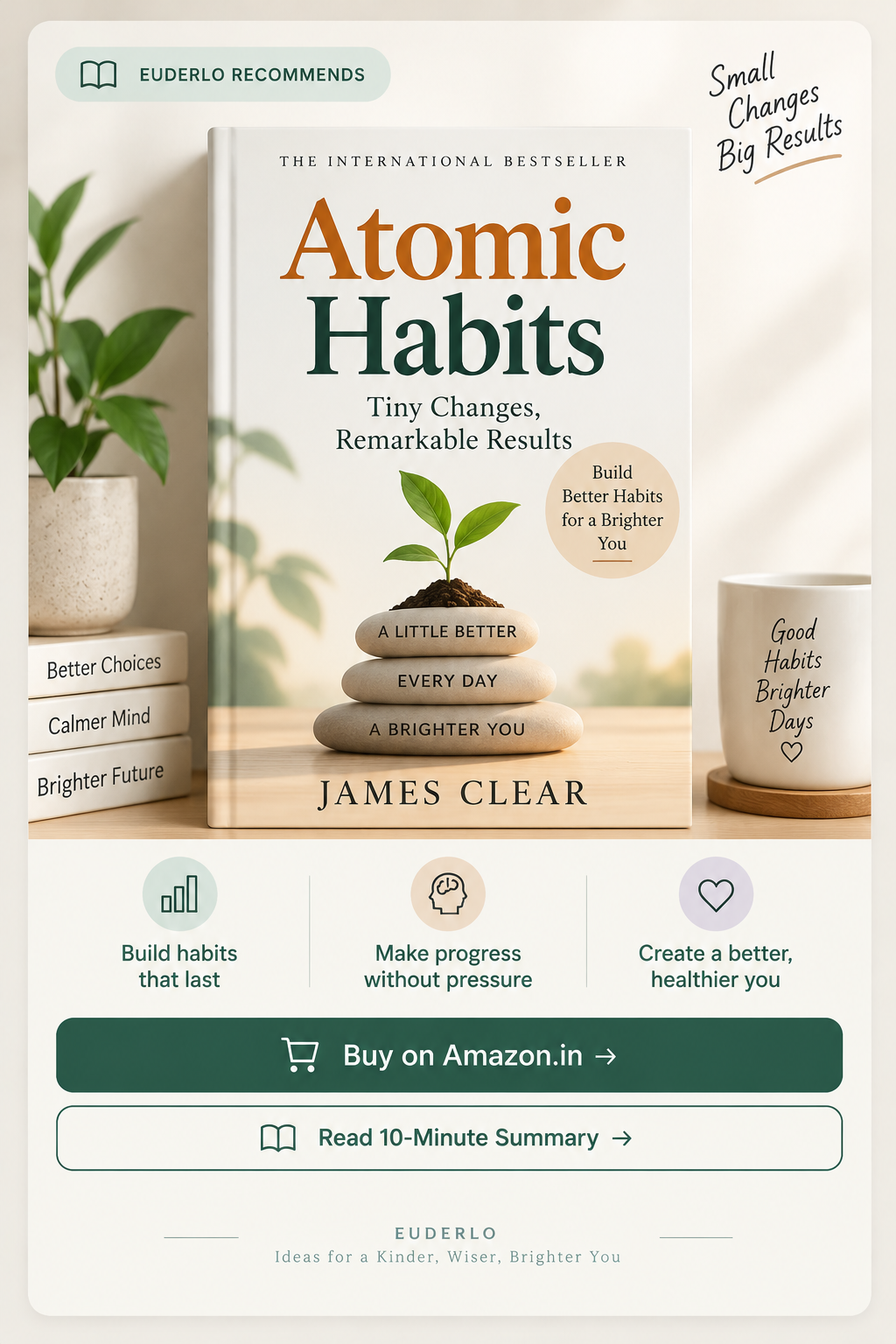
Atomic Habits
James Clear
Best for: Building systems that make good behaviour easier.
Readers can connect the essay's idea of making the first step smaller with Clear's approach to designing better habits.
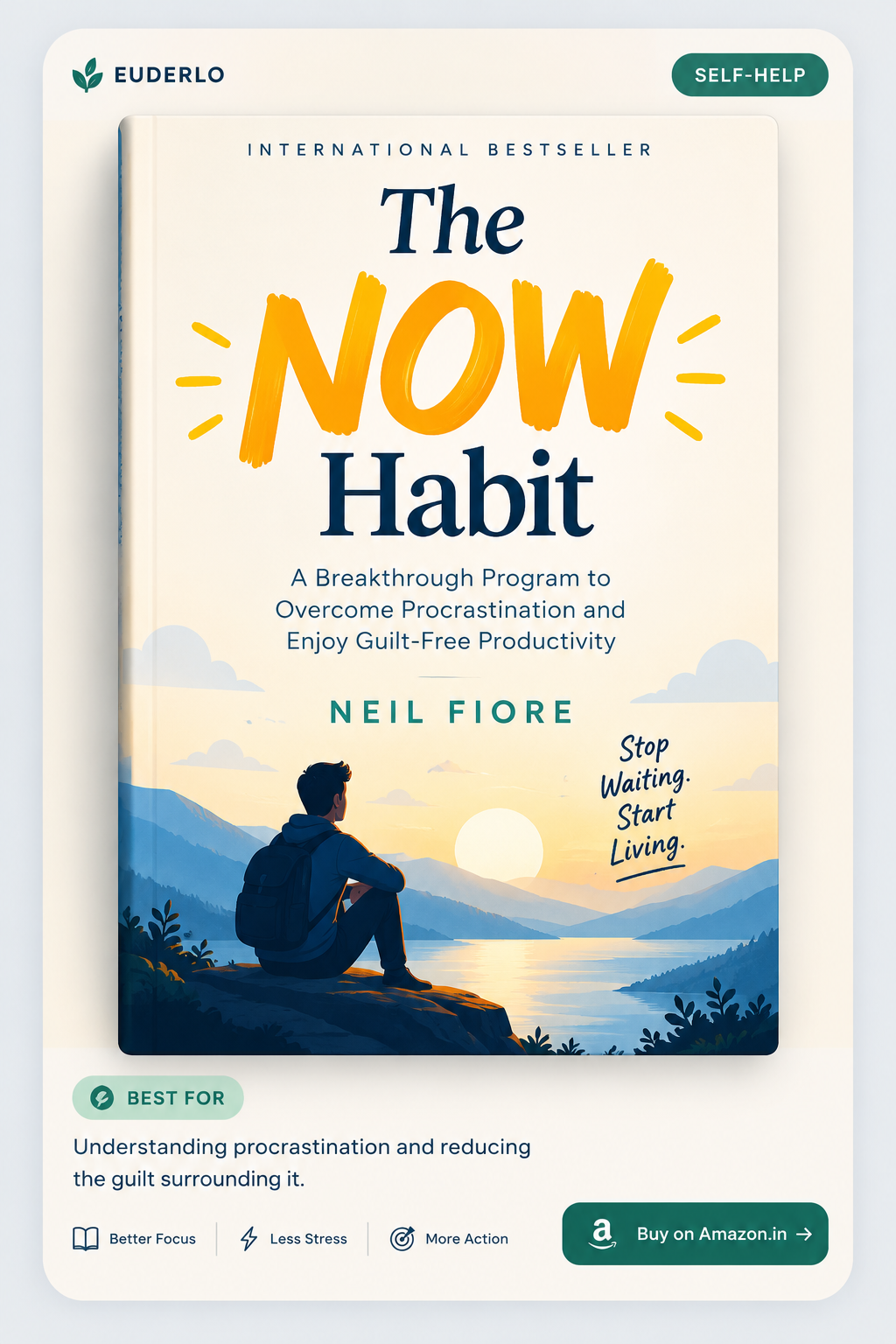
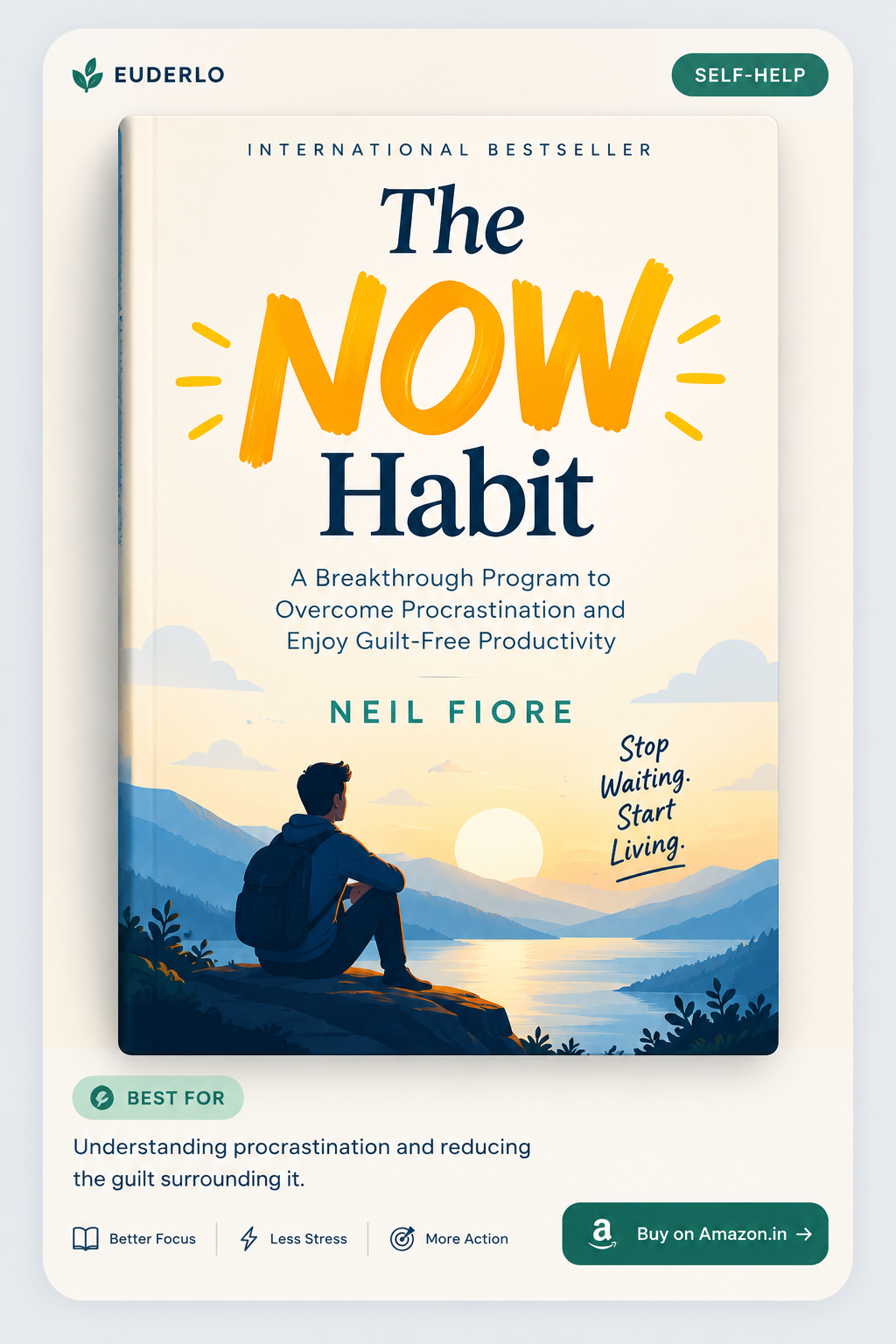
Best for: Understanding procrastination and reducing the guilt surrounding it.
A useful follow-up for readers who repeatedly tell themselves, “Why can't I just get things done?”
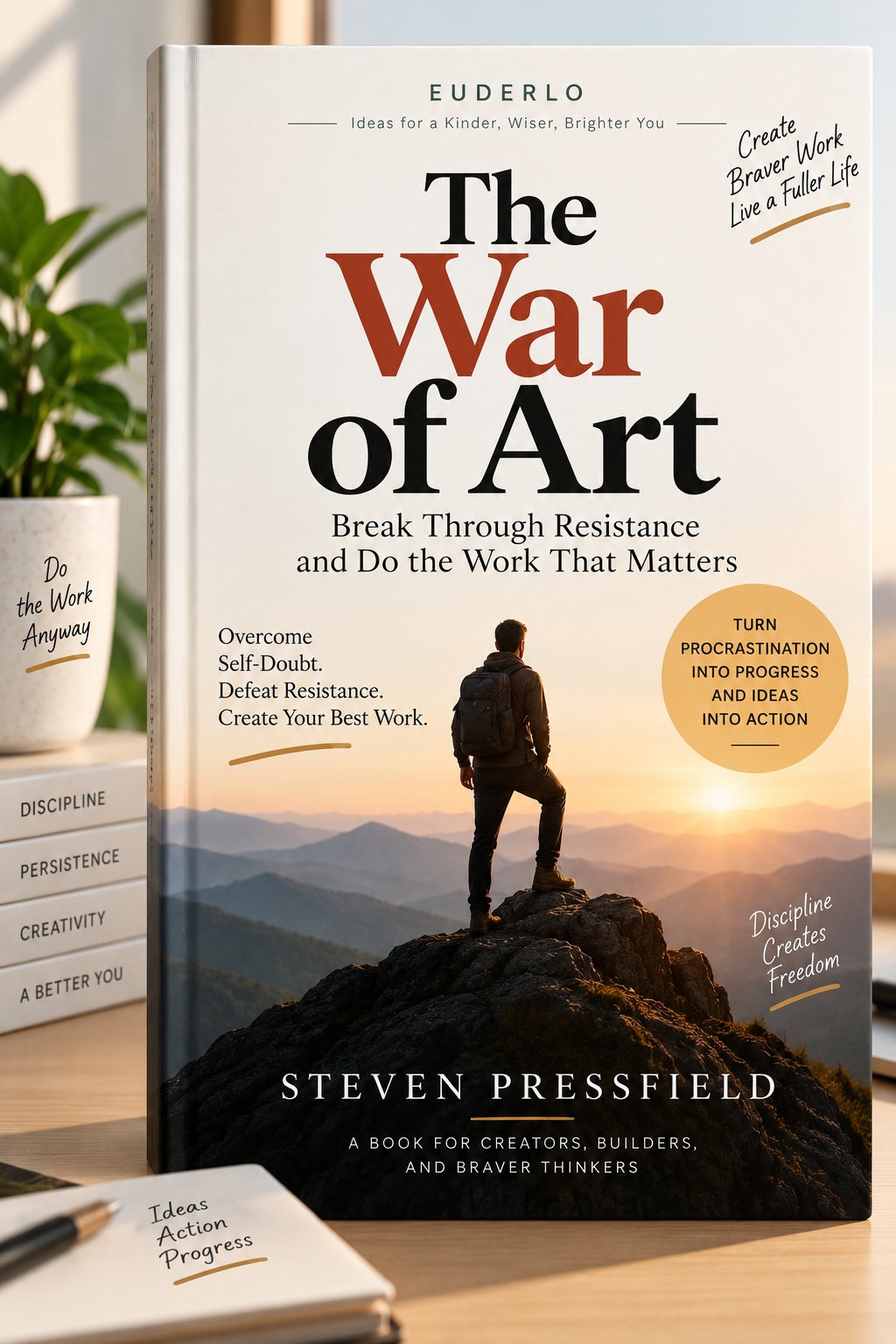
Best for: Understanding resistance to meaningful creative work.
Especially relevant for writers, artists, entrepreneurs and anyone trying to create something difficult.
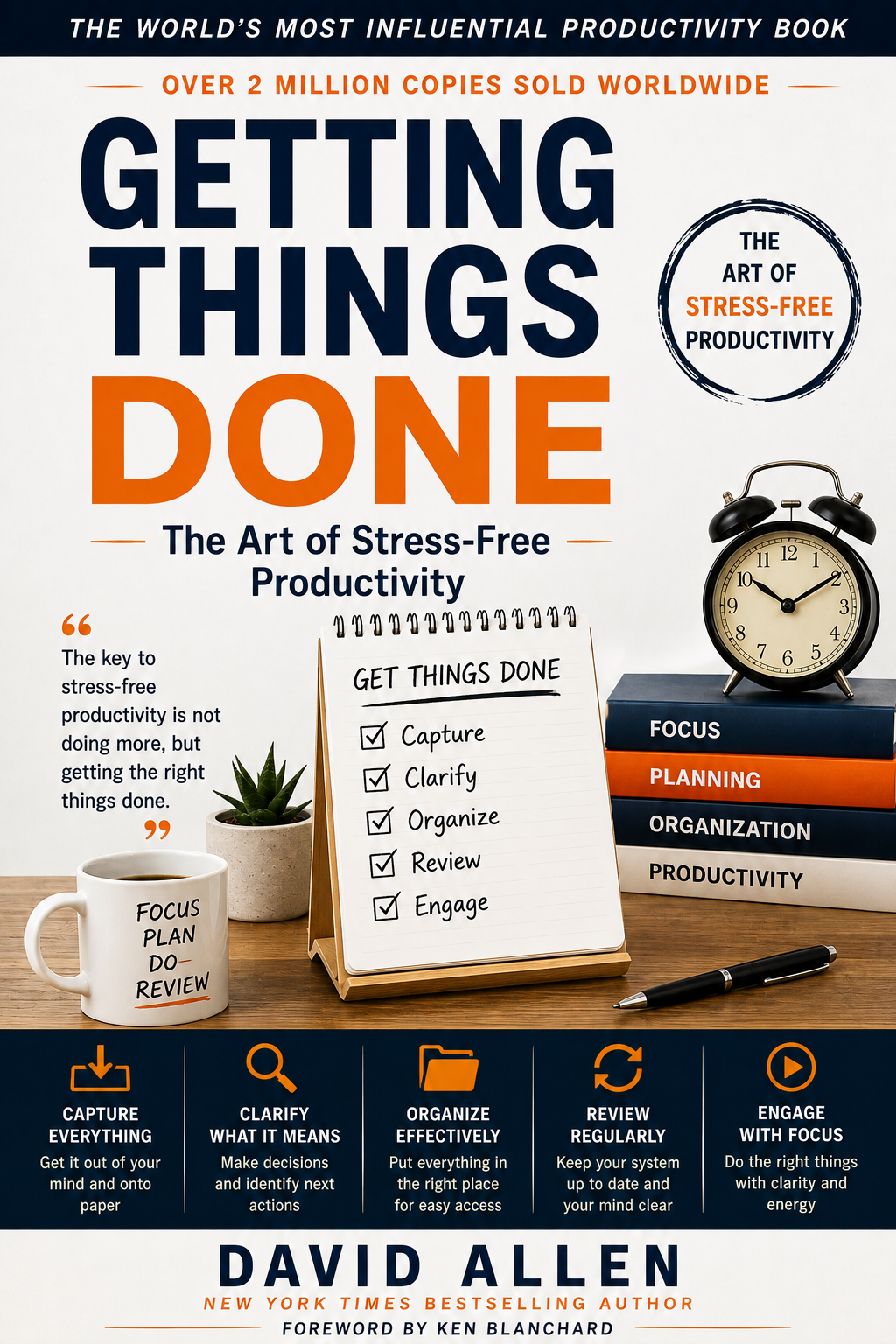
Best for: Organizing tasks and reducing mental clutter.
Particularly useful when procrastination comes from having too many unfinished commitments in your head.
Short, practical summaries of books connected to this topic. Click any book to read the complete Euderlo summary.
Drag, swipe or use the arrows
Atomic Habits
James Clear
Atomic Habits — James Clear
Small Changes, Remarkable Results
Atomic Habits by James Clear is ultimately a book about how small, repeated actions can quietly transform the direction of your life. We often imagine that meaningf…
Atomic Habits — James Clear
Small Changes, Remarkable Results
Atomic Habits by James Clear is ultimately a book about how small, repeated actions can quietly transform the direction of your life. We often imagine that meaningful change requires a dramatic decision—a completely new routine, extraordinary discipline, or a sudden burst of motivation. Clear presents a more practical idea: lasting improvement usually comes from what we repeatedly do. A single healthy meal will not transform your health, one workout will not change your body, and reading a few pages will not suddenly make you well-read. But when these actions become part of your everyday life, their effects begin to accumulate. The same is true of negative habits. One distracted afternoon may not matter much, but repeatedly checking your phone, postponing important work, sleeping too late, or choosing comfort over effort can gradually become the pattern that shapes your days.
Your Habits Shape Who You Become
One of the most important ideas in the book is that habits are not simply about achieving goals; they are also about building an identity. Instead of thinking only about what you want to accomplish, Clear encourages you to think about the kind of person you want to become. Someone who says, “I want to write a book” has a goal, but someone who begins thinking, “I am a writer,” is beginning to build an identity around the behaviour. Every time you write, you reinforce that identity. Every time you exercise, you cast another vote for becoming someone who takes care of their body. Every time you read, you reinforce the identity of someone who values learning. This makes habits more meaningful because you are no longer simply completing tasks; you are repeatedly proving to yourself who you are becoming.
Goals Give Direction, but Systems Create Progress
Clear also makes an important distinction between goals and systems. A goal might be to lose weight, write a book, read twenty books, build a business, or become more productive. But a goal alone does not tell you what you should do tomorrow morning. A system does. If your goal is to write a book, your system might be writing five hundred words every morning. If you want to read more, your system could be reading ten pages before bed. If you want to become healthier, your system might involve preparing your meals and exercising at a specific time. Goals tell you where you want to go, but systems determine what you repeatedly do along the way. This is why focusing entirely on a final result can be misleading. A person may achieve a goal and then return to their previous behaviour, while a person who builds a sustainable system can continue improving even after the original goal has been reached.
Small Improvements Become Powerful Through Repetition
The idea of tiny improvements is at the heart of Atomic Habits. A small change rarely feels important when you make it today. Reading five pages does not feel life-changing. Saving a small amount of money does not make you wealthy immediately. Spending fifteen minutes learning something new does not make you an expert. Yet habits operate over time. The real power comes from repetition. Small actions can compound, just as small negative behaviours can accumulate. This is why you should not underestimate an action simply because its immediate result looks insignificant. The question is not, “Did this change my life today?” The better question is, “If I repeated this behaviour for the next year, where would it take me?”
Make Good Habits Obvious
Clear explains that many habits begin with cues in our environment. We see something, experience something, or arrive in a particular situation, and that becomes a signal for a familiar behaviour. This is why deliberately designing your environment can make habit formation easier. If you want to read more, keep your book somewhere visible instead of hiding it in a drawer. If you want to exercise in the morning, prepare your clothes the night before. If you want to write, leave your document ready so that beginning requires almost no preparation. You can also make your intentions specific by deciding exactly when and where a behaviour will happen. “I will read more” is vague, while “I will read for fifteen minutes in bed before sleeping” gives the habit a clear place in your day. Another useful approach is connecting a new behaviour to an existing one. After making your morning coffee, for example, you could immediately spend five minutes reading. The old habit becomes the trigger for the new one.
Make Good Habits Attractive
We naturally find some behaviours more appealing than others, and that affects what we repeat. Clear suggests making desirable habits more attractive by connecting them with things you already enjoy. If you like listening to podcasts but want to walk more, you might listen to your favourite podcast while walking. If you enjoy coffee and want to develop a reading habit, you can create a small ritual around having coffee and reading a few pages together. The deeper point is that habits become easier to repeat when they are associated with something enjoyable. Your surroundings also influence what appears attractive. When your phone is constantly within reach, checking it becomes tempting. When a book is open beside you, reading becomes easier to choose. What surrounds you throughout the day is quietly shaping your decisions.
Make Good Habits Easy
Another major lesson is that you should reduce the amount of friction between yourself and the behaviour you want to repeat. People often create ambitious routines that require too much effort from the beginning. They decide that they will exercise for an hour every day, read fifty pages every night, meditate for thirty minutes, wake up extremely early, and completely eliminate every bad habit at once. Such plans may sound impressive, but they can become difficult to sustain. A better approach is to make the beginning almost effortless. If you want to exercise, prepare everything beforehand. If you want to read, keep the book nearby. If you want to write, have your document ready. The easier it is to begin, the less resistance you have to overcome. This is particularly valuable when dealing with procrastination because sometimes the solution is not forcing yourself to become more disciplined but simply making the first step smaller.
Start With the Two-Minute Version
This idea leads naturally to the two-minute rule. When a habit feels too difficult, reduce it to a version that can be started almost immediately. Instead of telling yourself that you must read an entire chapter, read one page. Instead of deciding that you need to complete an entire workout, put on your workout clothes and begin. Instead of telling yourself that you need to write an entire article, open the document and write one sentence. The purpose isn't to limit yourself to two minutes forever. The purpose is to remove the psychological resistance that comes before starting. Once you begin, continuing is often easier than you expected. A small beginning can therefore become the doorway to a much larger behaviour.
Make Good Habits Satisfying
Good habits can sometimes feel difficult because their rewards arrive much later. Studying today may help you months later. Exercising today may contribute to a healthier body over time. Saving money today may eventually give you financial security. Meanwhile, many bad habits provide immediate pleasure but create problems later. Scrolling through your phone feels rewarding immediately, while the cost is lost attention and time. Clear therefore emphasizes the importance of creating some immediate sense of satisfaction around good behaviour. Habit tracking can help because seeing your progress gives you a visible reminder that you are following through. The satisfaction doesn't have to be dramatic. Sometimes simply seeing that you kept a promise to yourself can be enough to strengthen the behaviour.
Don't Let One Bad Day Become a New Pattern
Consistency does not mean perfection. You will miss workouts, skip reading, eat something you didn't plan to eat, lose focus, or have days when you accomplish very little. That doesn't mean your entire habit-building effort has failed. The bigger danger is allowing one missed day to become a new routine. You skip today and tell yourself you'll start tomorrow; tomorrow becomes next week, and eventually the old pattern returns. The useful response to a mistake is therefore to return quickly. You don't need to punish yourself or wait for a perfect Monday to begin again. One missed day is simply one missed day. What matters is what you do next.
Your Environment Can Be Stronger Than Willpower
One of the most practical lessons from the book is that behaviour is strongly influenced by surroundings. If your phone is beside you while you're working, you will probably feel the temptation to check it. If unhealthy snacks are constantly visible, they become easier to reach for. If your exercise clothes are already prepared, working out becomes easier to start. This means that building better habits isn't always about becoming stronger through willpower. Sometimes it is about changing the environment so that the better choice requires less effort. Rather than asking yourself to resist the same temptation twenty times a day, remove the temptation from your immediate environment whenever possible.
Progress Isn't Always Visible Immediately
Habit change can be frustrating because the effort you put in today may not produce an obvious result today. You might exercise for weeks without seeing the change you expected. You might write consistently without gaining an audience. You might study every evening before your improvement becomes obvious. This can create the feeling that your effort isn't working. But progress often happens quietly before it becomes visible. The absence of an immediate result doesn't necessarily mean that nothing is happening. This is why consistency becomes particularly important during the period when your effort is visible but your results are not. Continuing through that period is often what separates a temporary attempt from a lasting habit.
Choose Habits That Fit Your Life
Clear also emphasizes the importance of choosing behaviours that suit you rather than blindly copying somebody else's routine. If another person loves running but you hate it, forcing yourself to run every morning may not be the best long-term strategy. You might enjoy cycling, swimming, walking, strength training, or another form of movement. The same principle applies to learning, productivity and creativity. You don't have to build the exact routine that works for someone else. You need to discover a version that fits your personality, circumstances and lifestyle. When a habit feels compatible with who you are, maintaining it becomes considerably easier.
The Real Transformation Happens Through Repetition
The deeper message of Atomic Habits is not that you need to become perfect. It is that you need to become more intentional about the behaviours you repeat. Your future is influenced by what you repeatedly do today. If you want to read more, start with a page. If you want to write, start with a paragraph. If you want to exercise, start with a short session. If you want to stop procrastinating, begin with the smallest part of the task you are avoiding. The action may look insignificant, but repetition gives it meaning.
Ultimately, Atomic Habits asks us to stop waiting for a dramatic moment when everything suddenly changes. Real change is usually quieter than that. It happens when you make a slightly better choice, then another one, and then another. You create an environment that supports those choices, make the good behaviour easier to begin, and continue even when the results aren't immediately visible. Over time, those small actions become routines, routines become habits, and habits begin to shape your identity. You don't have to transform your entire life in one day. You simply have to make the next small action one that your future self will be grateful you took.
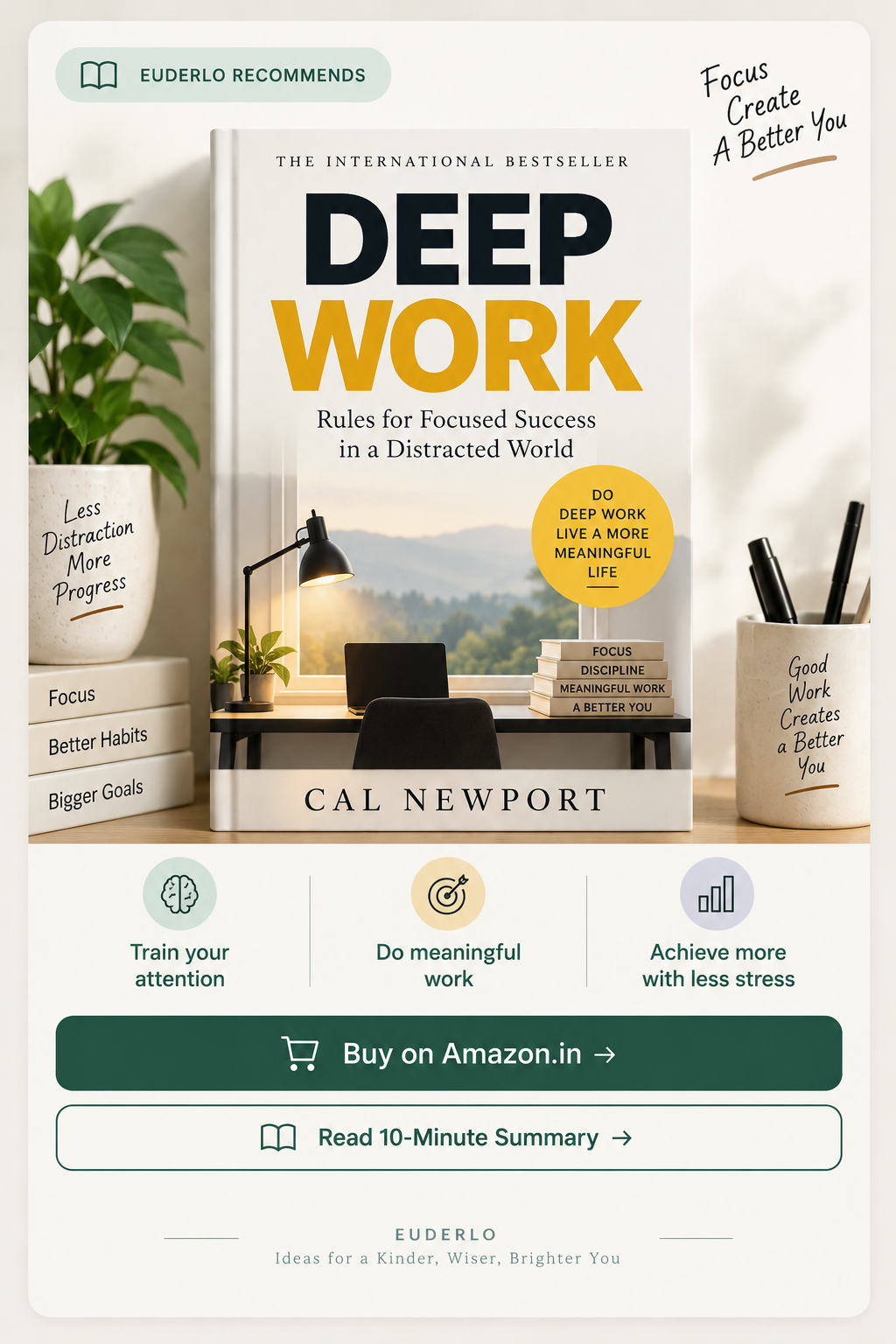
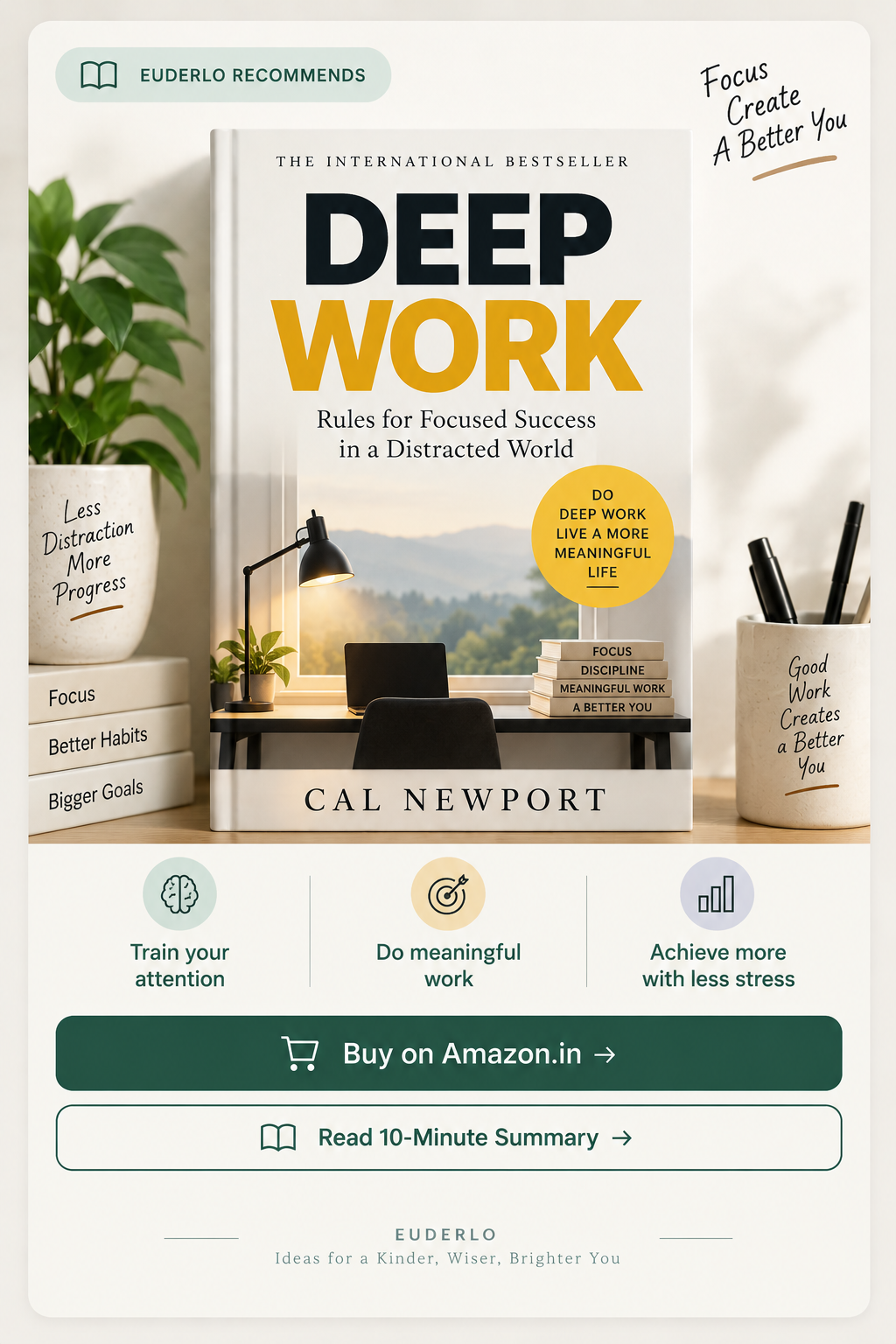
Deep Work
Cal Newport
Deep Work — Cal Newport
Why Focus Has Become So Valuable
Deep Work by Cal Newport explores an increasingly important skill: the ability to concentrate without distraction on something intellectually demanding. Modern life make…
Deep Work — Cal Newport
Why Focus Has Become So Valuable
Deep Work by Cal Newport explores an increasingly important skill: the ability to concentrate without distraction on something intellectually demanding. Modern life makes this difficult. Notifications, social media, email, messages, meetings, short-form videos and constant online activity compete for our attention throughout the day. We may believe we are being productive because we are always doing something, but being busy is not the same as doing meaningful work. Newport argues that the ability to concentrate deeply allows us to learn difficult things, produce valuable work and improve our skills in ways that constant distraction makes much harder. The central message is not simply “work harder.” It is to protect your attention so that your best mental energy goes toward the things that matter.
Deep Work and Shallow Work
Newport makes an important distinction between deep work and shallow work. Deep work requires serious concentration and pushes your abilities. Writing an important article, learning a difficult subject, solving a complicated problem, designing something meaningful or developing a valuable skill can all require this kind of attention. Shallow work, on the other hand, consists of activities that generally require less cognitive effort and can often be performed while distracted, such as routine emails, administrative tasks, basic meetings and repeatedly checking messages. Shallow work isn't necessarily useless, and some of it is unavoidable. The problem occurs when shallow activities consume so much of your day that you have little time or energy left for the work that actually develops your abilities.
Attention Is Becoming Rare
One of the book's important observations is that focused attention has become increasingly valuable precisely because it has become increasingly difficult to maintain. If everyone has access to the same information and digital tools, the ability to use those tools while maintaining concentration can become a meaningful advantage. Someone who can spend an uninterrupted period learning, thinking and producing can often accomplish something that would be difficult to create through constant task-switching. In this sense, concentration is not merely a productivity trick. It is a skill that can influence what you are capable of learning and creating.
Distraction Has a Cost
We often assume that checking a message for a few seconds doesn't matter. The problem is that attention doesn't necessarily return to its previous depth immediately after an interruption. When you repeatedly switch between writing, email, social media and other activities, part of your mental attention remains connected to the previous task. The result can be a fragmented workday in which you spend hours working but rarely experience sustained concentration. Deep work requires creating conditions in which your attention can remain with one meaningful problem long enough for your thinking to become deeper.
Train Your Ability to Concentrate
Newport treats concentration as something that can be developed rather than a fixed personality trait. If you spend every spare moment checking your phone, scrolling through social media or consuming short pieces of information, constant stimulation can become normal. Then sitting quietly with a difficult problem may feel uncomfortable. The solution is not necessarily to eliminate technology completely. It is to practice periods in which you deliberately resist the urge to switch attention. Like physical training, concentration improves through repeated practice. The more often you deliberately focus, the more comfortable sustained attention can become.
Schedule Deep Work Instead of Hoping for It
One of the most practical ideas from Deep Work is that important concentration should be deliberately protected. If you simply wait for a free moment to appear, shallow tasks will often fill that space. Messages arrive, meetings appear, notifications interrupt and other responsibilities expand into whatever time remains. Instead, give deep work a specific place in your schedule. Decide what you will work on, when you will begin, how long you will continue and what distractions you will remove. The exact routine can differ from person to person. What matters is treating focused work as something that deserves deliberate protection.
Create a Ritual for Focus
A useful deep-work routine can make the beginning easier. You might choose a particular place where you work, decide on a fixed duration, define one specific objective and remove unnecessary distractions before beginning. Over time, these signals can help your mind recognize that it is time to concentrate. For example, you might sit at the same desk, put your phone away, close unrelated browser tabs and work on one clearly defined task for an hour. The purpose isn't to create an elaborate productivity ritual. It is to reduce unnecessary decisions so that your attention can go toward the work itself.
Embrace Boredom
One of Newport's more challenging ideas is that we should become comfortable with boredom. Modern technology makes it incredibly easy to eliminate every moment of silence. Waiting in a queue becomes an opportunity to check a phone. A few seconds without stimulation can trigger the urge to open an app. If we constantly train ourselves to seek stimulation, concentration can become more difficult because focused work often involves periods when nothing exciting is happening.
Learning to tolerate boredom can therefore become part of learning to concentrate. You don't need to entertain yourself every moment. Sometimes allowing your mind to remain quiet is useful training for deeper attention.
Don't Let Your Phone Decide Where Your Attention Goes
The smartphone is not automatically the enemy, but the way we use it can influence our ability to focus. When every notification can interrupt us, our attention becomes partly controlled by whatever appears on the screen. A useful approach is to decide when technology deserves access to your attention rather than allowing every notification to make that decision for you. Turning off unnecessary notifications, putting your phone away during important work and establishing specific times for checking messages can create a clearer boundary between focused work and communication.
Social Media Should Serve a Purpose
Newport takes a deliberate approach to social media and digital tools. Instead of automatically using a platform because it provides some benefit, consider whether that benefit is genuinely important enough to justify the attention the platform consumes. Almost every digital tool offers some advantage. Social media can help people communicate, discover information, promote work or maintain relationships. But the existence of a benefit doesn't automatically make constant use worthwhile.
A better question is: Does this tool meaningfully support the things I value? If it does, use it intentionally. If it doesn't, reducing its role may create more space for meaningful attention.
Don't Confuse Busyness With Productivity
A person can spend an entire day answering emails, attending meetings, checking notifications and moving between small tasks while making little progress on their most important work. Busyness can feel productive because there is always something happening. But meaningful productivity often requires periods when you are doing less visible activity and more concentrated thinking.
Deep work may look less busy from the outside. Someone sitting quietly and writing for two hours may appear to be doing less than someone attending five meetings. Yet the focused session might produce something far more valuable. The appearance of activity is not the same as the value of the result.
Learn Difficult Things
Newport connects deep work with the ability to learn difficult skills. In a rapidly changing world, valuable knowledge doesn't remain static. The ability to learn new tools, concepts and methods can therefore become extremely important. But difficult learning requires concentration. You need enough uninterrupted attention to understand complicated ideas, practice them and connect them with what you already know.
This is another reason to protect deep work. It isn't only about finishing today's task. It is about developing the ability to handle increasingly difficult work in the future.
Work Deeply, Then Rest
Deep work shouldn't become an excuse for working endlessly. Concentrated thinking consumes mental energy, and recovery matters. Newport emphasizes the importance of deliberately ending work and allowing the mind to step away from professional responsibilities. Rest can provide space for recovery and can also allow ideas to develop in the background.
A clear boundary between work and non-work can therefore be valuable. When you finish your workday, genuinely step away when possible rather than carrying every unfinished task mentally into the evening.
Protect Your Attention Outside Work Too
The principles of deep work aren't limited to offices or professional tasks. The same attention can affect reading, conversations, relationships and personal projects. If every quiet moment is filled with a screen, it becomes difficult to experience activities that require patience. Reading a long book, having an uninterrupted conversation or learning a complex subject all benefit from sustained attention.
Your attention is one of the resources you carry everywhere. How you use it shapes what you experience and what you are capable of creating.
The Importance of Saying No
Deep work also requires accepting that you cannot give your full attention to everything. Every commitment consumes some amount of time and mental energy. If you accept every meeting, request, message and opportunity, there may be little space left for your highest-priority work. Saying no isn't necessarily selfish. Sometimes it is necessary to protect commitments that matter more.
The question isn't whether an activity has some value. The question is whether it deserves a portion of your limited attention compared with everything else competing for it.
Produce Valuable Work
A major theme of Deep Work is that meaningful results often come from combining high-quality attention with enough time. If you want to become better at something, you need opportunities to practice it without constant interruption. If you want to create something valuable, you need periods in which your mind can work on the problem deeply.
This applies to writers, programmers, designers, students, researchers, entrepreneurs and many other knowledge workers. The specific work differs, but the underlying requirement is similar: difficult things require attention.
Build a Life Around Focus
The deeper message of the book is not that you should spend every day isolated from the world. It is that your attention deserves to be treated as something valuable. Decide what deserves your deepest concentration and protect time for it. Reduce unnecessary distractions. Create routines that make focus easier. Accept periods of boredom. Use technology deliberately. Then give yourself permission to stop working and recover.
Deep work is ultimately a choice about what you want your mind to be available for.
The Biggest Lesson From Deep Work
The most important lesson is simple: your ability to concentrate is one of the most valuable resources you have, so don't give it away casually.
You don't need to eliminate every distraction or become a productivity machine. Start with one protected period of focused work. Put the phone away. Choose one meaningful task. Close unnecessary tabs. Work until the session ends. Then rest.
Over time, those periods of concentration can become a habit. You may discover that you can learn faster, produce better work and think more clearly when your attention isn't constantly being divided.
In a world that constantly asks for your attention, choosing where to place it becomes one of the most important decisions you can make.
Written by Chandan Giri for Euderlo.
Book Information
Book: Deep Work
Author: Cal Newport
Summary by: Chandan Giri
Published by: Euderlo
This is an original Euderlo summary focused on the book's central ideas and practical lessons. It is not a substitute for reading the original book.
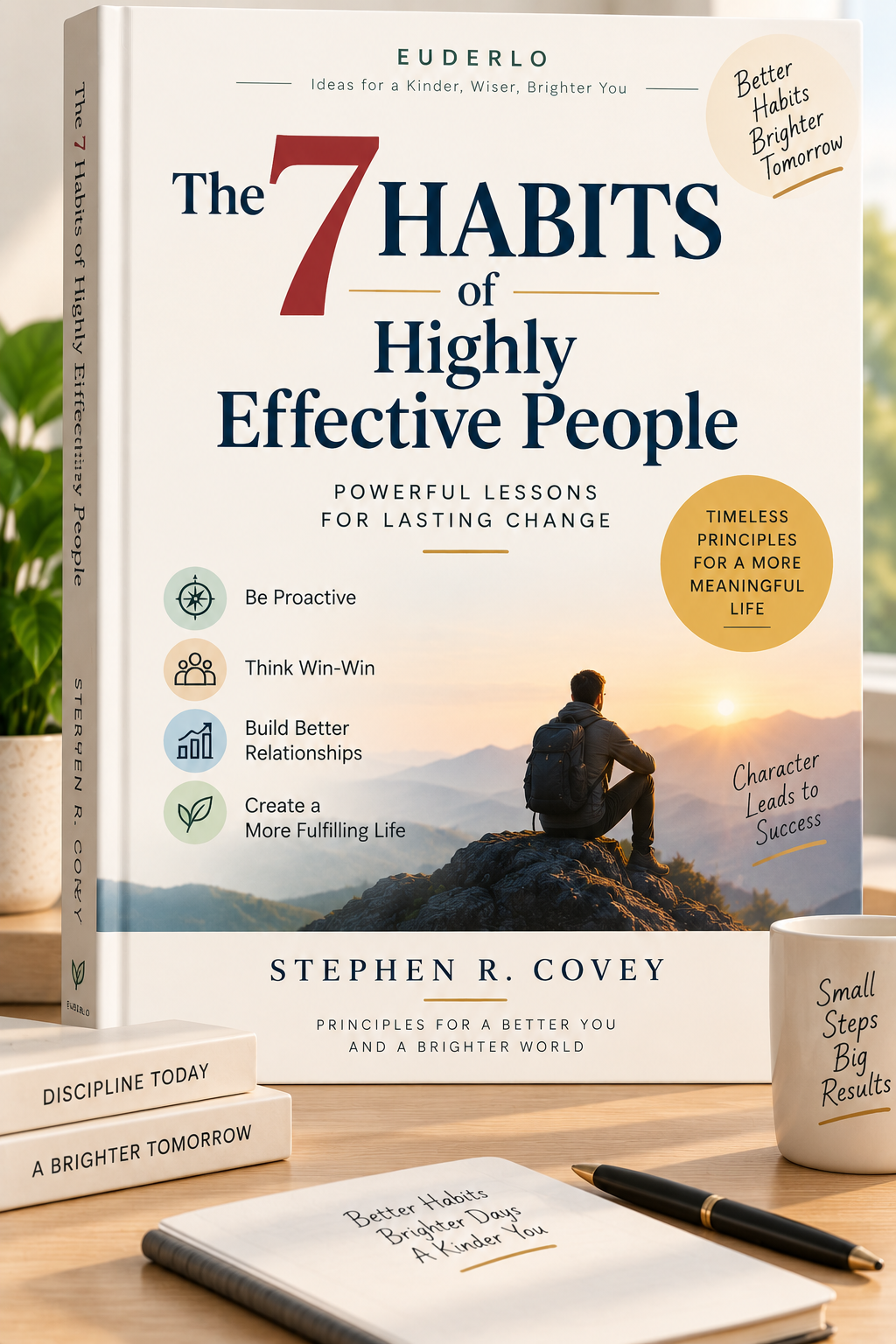
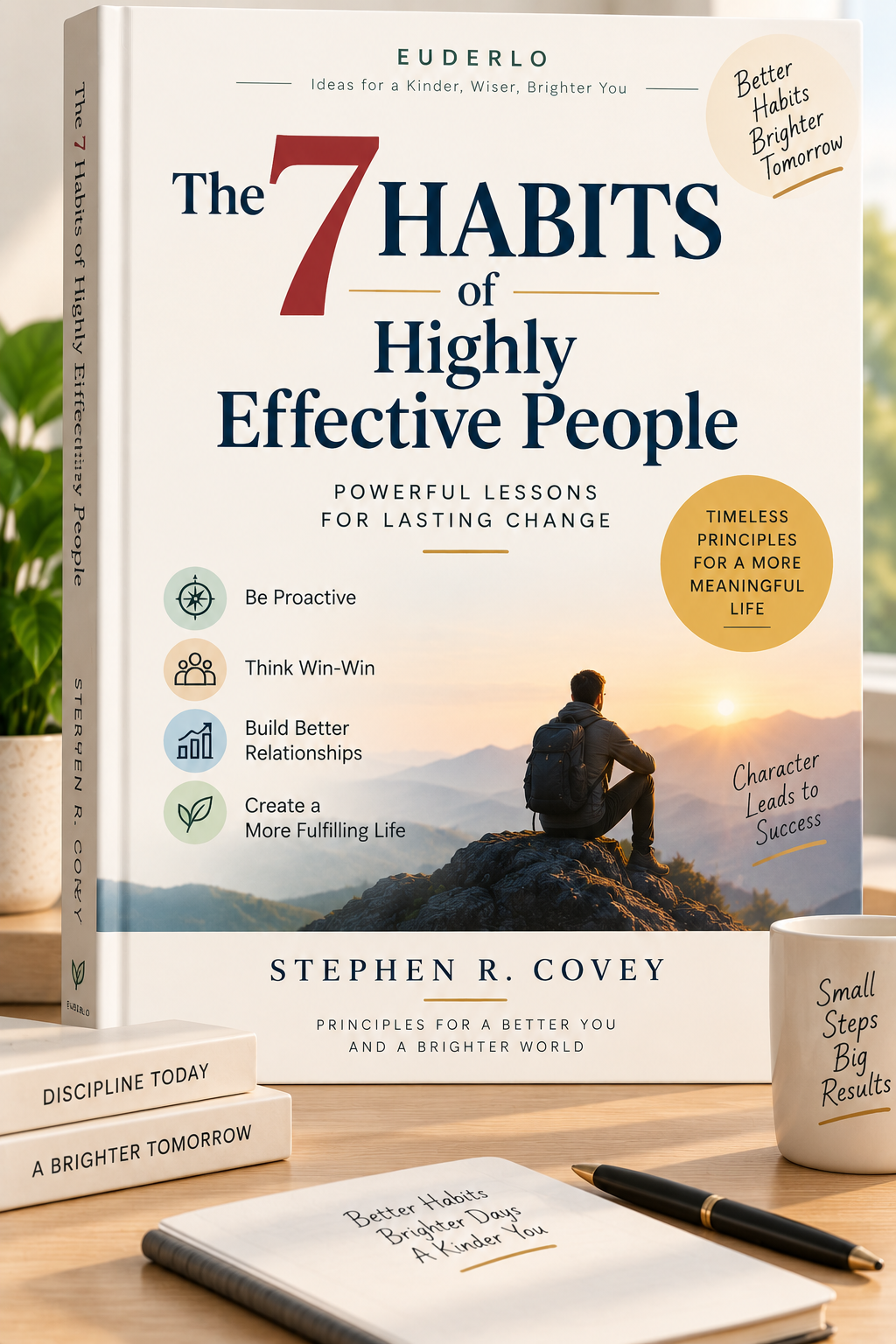
7 Habits of Highly Effective People
Stephen R. Covey
The 7 Habits of Highly Effective People — Stephen R. Covey
A practical summary of the principles that can help you live with greater clarity, responsibility, purpose, and effectiveness.
Written by Chandan Giri for Euderlo
…
The 7 Habits of Highly Effective People — Stephen R. Covey
A practical summary of the principles that can help you live with greater clarity, responsibility, purpose, and effectiveness.
Written by Chandan Giri for Euderlo
Introduction: Effectiveness Begins From Within
The 7 Habits of Highly Effective People by Stephen R. Covey is not simply a book about getting more things done. Its deeper message is about becoming a person who can make thoughtful choices, build meaningful relationships, and live according to clear principles. Covey argues that lasting effectiveness begins from the inside and gradually becomes visible in the way we work, communicate, make decisions, and respond to other people. Instead of looking for quick techniques or shortcuts, the book encourages us to change the way we see ourselves and the world around us. When our thinking changes, our behaviour can change as well. The seven habits therefore form a progression: first learning to manage ourselves, then learning to work effectively with others, and finally continuing to renew ourselves so that growth does not stop.
The Inside-Out Approach
One of the central ideas of the book is the inside-out approach. We often want external circumstances to change before we change ourselves. We may blame our workplace, our family, our circumstances, our manager, our partner, or other people for the difficulties we experience. Covey suggests beginning somewhere different: with ourselves. We cannot control everything that happens around us, but we can examine our attitudes, choices, responses, and principles. This doesn't mean that every problem is our fault or that circumstances don't matter. It means that meaningful personal change begins with the part of life over which we have the greatest responsibility—our own choices. When we change the way we respond, we often change the possibilities available to us.
Habit 1: Be Proactive
Being proactive is the foundation of the other habits. Covey distinguishes between simply reacting to circumstances and consciously choosing how to respond. Life will always contain things we cannot control: other people's opinions, unexpected events, economic conditions, mistakes, disappointments, and changes we didn't ask for. But between what happens to us and how we respond, there is room for choice.
A proactive person does not pretend that problems don't exist. Instead, they focus attention on what they can influence. Covey describes this through the idea of the Circle of Concern and the Circle of Influence. Our Circle of Concern contains everything we care about, while our Circle of Influence contains the things where we can actually take action. Spending all our energy complaining about things outside our control can make us feel powerless. Focusing on our own decisions, behaviour, preparation, communication, and effort gives us something constructive to work with.
This habit is ultimately about responsibility. Instead of constantly saying, “They made me feel this way,” or “I can't do anything because of my circumstances,” we can ask, “What can I choose to do next?” That question shifts us from helplessness toward action.
Habit 2: Begin With the End in Mind
The second habit is about having a clear sense of direction before becoming busy. Covey asks readers to imagine what they want their life to represent and what kind of person they want to become. Without a clear destination, it is possible to become extremely busy while moving in the wrong direction.
This principle applies to both life and everyday decisions. Before beginning a project, ask what outcome actually matters. Before accepting another commitment, consider whether it supports your priorities. Before chasing success, think about what success means to you.
Covey uses the powerful idea of personal mission to encourage readers to define their values and principles. A personal mission statement can act as an internal compass. It doesn't have to be perfect or permanent. Its purpose is to help you make decisions based on what matters most rather than simply reacting to whatever demands your attention.
The deeper lesson is that creation happens twice: first mentally, through intention and planning, and then physically, through action. If you don't consciously create your direction, circumstances and other people's priorities may end up creating it for you.
Habit 3: Put First Things First
Once you know where you want to go, you need to organize your life around what matters most. This is the focus of the third habit.
Many people confuse being busy with being effective. A day can be filled with emails, notifications, meetings, messages, errands, and small tasks without producing meaningful progress. Covey emphasizes the difference between what is urgent and what is important.
Urgent things demand immediate attention. Important things contribute to your values, responsibilities, relationships, goals, and long-term development. Some of the most important activities in life—planning, learning, exercising, building relationships, preparing for the future, and working on meaningful goals—may not feel urgent today. That is precisely why they are easy to postpone.
Putting first things first means learning to organize your time around your principles and priorities instead of allowing every new demand to control your schedule. It means sometimes saying no to something good so that you can say yes to something more important.
The lesson is not to become obsessed with productivity. It is to ensure that your time reflects what you claim to value.
From Independence to Interdependence
The first three habits focus primarily on private victory—developing personal responsibility, direction, and discipline. The next three habits move toward public victory, where effectiveness involves other people.
Covey's larger point is that independence is important, but human beings also live in relationships. Families, friendships, workplaces, businesses, and communities all require cooperation. Becoming effective therefore isn't only about managing yourself. It is also about learning how to create relationships where people can work together without constantly competing against one another.
Habit 4: Think Win-Win
The fourth habit introduces the idea of Win-Win. Instead of approaching relationships as though one person must succeed at the expense of another, Covey encourages people to search for solutions where both sides can benefit.
This requires a different mindset. If you believe that success is limited and someone else's success automatically reduces yours, competition becomes the default. Win-Win thinking begins from a different assumption: that cooperation, fairness, trust, and mutual benefit can create better outcomes.
This doesn't mean agreeing to everything or avoiding difficult negotiations. Sometimes an agreement genuinely cannot satisfy both sides. Covey therefore also recognizes that a healthy relationship may sometimes require deciding not to make a particular agreement rather than forcing an artificial compromise.
The important lesson is to enter relationships looking not only at “What do I want?” but also “How can we create an outcome that respects both of us?”
Habit 5: Seek First to Understand, Then to Be Understood
Communication often fails because people listen while preparing their response rather than listening to understand.
Covey places empathetic listening at the centre of effective communication. Before immediately giving advice, defending ourselves, correcting someone, or explaining our own position, we should make an effort to understand what the other person is actually experiencing.
This is especially important during disagreements. When someone feels unheard, even a logically correct argument may accomplish very little. People are more likely to listen to us after they feel that we have genuinely listened to them.
Seeking to understand does not mean automatically agreeing. It means making the effort to understand another person's perspective before presenting our own.
A useful question is:
“If I were in this person's position, what might I be seeing, feeling, or trying to communicate?”
Once understanding has been established, communication becomes more constructive. We can then explain our own perspective with greater clarity and empathy.
Habit 6: Synergize
Synergy is about recognizing that people can create something better together than they could have created separately. Differences in experience, personality, knowledge, and perspective don't necessarily have to become sources of conflict. They can become resources.
Covey's idea of synergy is closely connected to the previous habit. When people genuinely listen to one another, they can discover possibilities that neither person initially considered.
Instead of saying, “My way or your way,” the goal becomes asking:
“Is there a better way that we haven't discovered yet?”
This requires respect for differences. A team becomes stronger when people don't have to think identically in order to work together. Creativity often emerges when different perspectives are brought into the same conversation with openness rather than defensiveness.
Synergy therefore isn't simply teamwork. It is the ability to turn differences into a source of better solutions.
Habit 7: Sharpen the Saw
The seventh habit is about renewal. Covey uses the image of sharpening a saw to explain why constant effort without renewal eventually becomes ineffective.
Imagine trying to cut wood with a dull saw. You might work harder and spend more time, but the tool itself needs attention. Human beings are similar. We cannot expect ourselves to perform indefinitely without taking care of our physical, mental, emotional, and spiritual dimensions.
Physical renewal may involve exercise, nutrition, rest, and sleep. Mental renewal can involve reading, learning, writing, and developing new ways of thinking. Emotional and social renewal involves relationships, empathy, connection, and meaningful interaction. Spiritual renewal can involve reflection, values, purpose, meditation, prayer, nature, or whatever gives a person a deeper sense of meaning.
The important idea is that renewal is not wasted time. It is part of effectiveness.
When we continually develop ourselves, we improve our ability to handle everything else in life.
The Seven Habits Work Together
The seven habits are most powerful when understood as a connected system rather than seven unrelated pieces of advice. Being proactive gives you responsibility for your choices. Beginning with the end in mind gives those choices direction. Putting first things first turns that direction into daily priorities. Thinking Win-Win improves the way you approach relationships. Seeking first to understand strengthens communication. Synergizing helps people create better possibilities together. Sharpening the saw keeps the entire process sustainable.
The progression is therefore from dependence to independence and then to interdependence. First, you learn to manage yourself. Then you learn to cooperate effectively with others. Finally, you continue renewing yourself so that growth becomes an ongoing process rather than a temporary project.
The Biggest Lesson From the Book
The most important message of The 7 Habits of Highly Effective People is that effectiveness is deeper than productivity. Getting more tasks completed does not automatically mean that you are living a meaningful or successful life. A person can be extremely productive while neglecting their health, relationships, values, or long-term purpose.
Covey's approach asks a more fundamental question: Are the things you are doing actually connected to the person you want to become?
The answer begins with personal responsibility. You cannot control every event, but you can take responsibility for your response. You can decide what deserves your attention. You can define your values. You can listen before judging. You can search for solutions that respect other people. You can use differences to create better ideas. And you can continually renew yourself.
Perhaps that is why the book remains useful decades after its original publication. Its central message isn't about finding a productivity trick that works for a few weeks. It is about building a way of living around principles that can guide decisions repeatedly.
You don't become effective because you have discovered the perfect routine. You become more effective when your choices, priorities, relationships, and actions increasingly reflect the principles you believe matter.
And that change begins with something very simple: before trying to change everything around you, start by examining what you can change within yourself.
About this Euderlo Summary
Book: The 7 Habits of Highly Effective People
Author: Stephen R. Covey
Summary by: Chandan Giri
Published by: Euderlo
This is an original Euderlo summary focused on the book's central ideas and practical lessons. It is not a substitute for reading the original book.
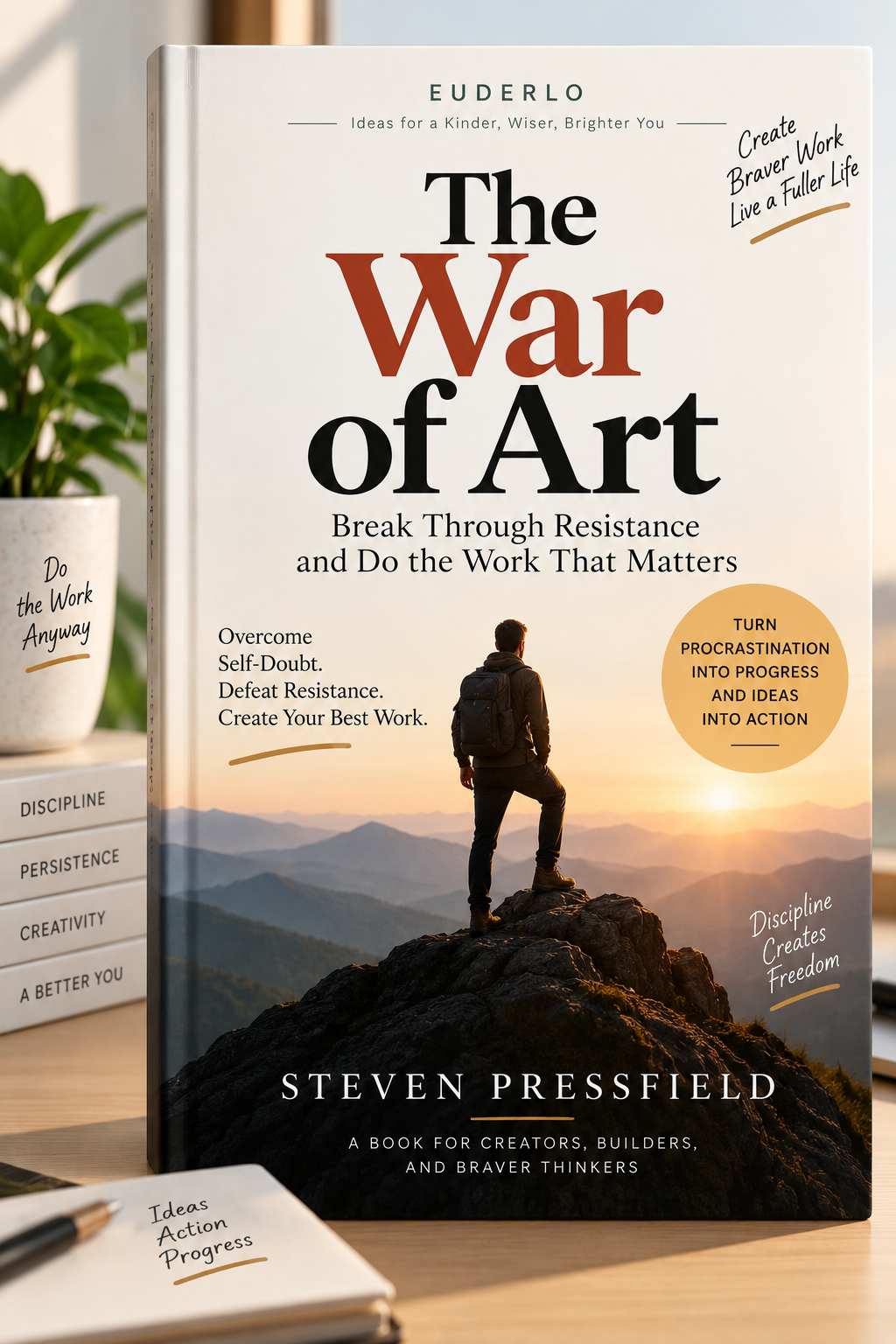
The War of Art
Steven Pressfield
The War of Art — Steven Pressfield
Why resistance appears when we try to create meaningful work, and how to move through it
The War of Art by Steven Pressfield is a short but powerful book about one of the most frustrating e…
The War of Art — Steven Pressfield
Why resistance appears when we try to create meaningful work, and how to move through it
The War of Art by Steven Pressfield is a short but powerful book about one of the most frustrating experiences in creative and ambitious work: knowing what you want to do, caring deeply about doing it, and still finding yourself avoiding it. You may want to write a book, start a business, learn a skill, build a website, create art, improve your life, or pursue an idea that has been sitting in your mind for years. Yet when it is finally time to begin, something seems to pull you away. You check your phone, watch another video, reorganize your workspace, research something unnecessary, or suddenly convince yourself that tomorrow would be a better day. Pressfield gives this force a name: Resistance. His purpose is not to suggest that resistance is a literal external force, but to give a name to the collection of internal behaviours that repeatedly prevent us from doing the work we know matters.
Resistance Appears When the Work Matters
One of the most useful ideas in the book is that resistance tends to become strongest around the work that matters most to us. If you want to spend an afternoon doing something meaningless, you may have little difficulty starting. But if you want to create something that could change your career or express something deeply personal, suddenly the excuses appear. This is because meaningful work involves uncertainty. There is something at stake. You might fail, receive criticism, discover that your ability isn't yet where you want it to be, or find out that the dream you have carried for years requires much more effort than you imagined. Avoiding the work temporarily protects you from confronting those possibilities. The problem is that avoiding the work also prevents you from discovering what you are actually capable of doing.
Resistance Takes Many Forms
Resistance doesn't always look like obvious procrastination. Sometimes it appears as distraction, perfectionism, self-doubt, endless preparation, fear of criticism, rationalization, or constantly starting something new instead of finishing what you already began. You might tell yourself that you need better equipment before starting, more knowledge before publishing, more confidence before applying, or more time before committing. Some preparation is useful, but preparation can also become a comfortable hiding place. You can spend months preparing to do something without ever actually doing it. Pressfield's central question is therefore uncomfortable but valuable: Are you preparing for the work, or are you avoiding the work?
The Difference Between Amateur and Professional
A major turning point in the book is Pressfield's distinction between the amateur and the professional. The amateur often waits for inspiration, confidence, ideal circumstances, or the right emotional state. The professional approaches the work as a commitment. The professional understands that some days will feel exciting and other days will feel difficult, but the work still needs to be done. This doesn't mean becoming emotionless or turning life into an endless productivity contest. It means refusing to allow temporary feelings to determine whether meaningful work happens. A writer cannot always wait until inspiration arrives. A business owner cannot always wait until uncertainty disappears. A student cannot always wait until motivation appears. The professional shows up and begins.
Inspiration Is Not a Requirement
Many people believe creative work should feel inspired before it begins. Pressfield challenges this idea by placing greater emphasis on discipline and consistency. Inspiration can certainly be valuable, but it is unreliable. If your work depends entirely on feeling inspired, your output will depend on your mood. The more dependable approach is to establish a relationship with the work itself. Sit down. Begin. Produce something. Allow the quality to develop through the process. Very often, motivation appears after action rather than before it. You don't always need to feel ready to start. Sometimes starting is what creates the feeling that allows you to continue.
Fear and Self-Doubt Are Part of the Process
Fear doesn't necessarily disappear when you become serious about your work. In many cases, the more important the project becomes, the more vulnerable you may feel. You might worry that your work isn't good enough, that people will criticize you, or that you will fail publicly. Pressfield's message is not that you must eliminate these feelings before acting. Instead, you learn to recognize them without allowing them to make the decision for you. Fear can exist alongside action. You can be uncertain and still write. You can be nervous and still publish. You can doubt yourself and still make the phone call. Courage isn't necessarily the absence of fear; it can be the decision to continue despite it.
Perfectionism Can Become Resistance
Perfectionism often appears to be ambition, but it can become another form of avoidance. If you believe your first attempt must be excellent, starting becomes frightening because the first attempt will almost certainly be imperfect. You may therefore keep thinking, planning and researching instead of producing. A better approach is to create something that can be improved. The first draft doesn't need to be the final draft. The first version of a product doesn't need to be perfect. The first article doesn't need to represent everything you are capable of. Creation gives you something to work with; perfectionism can leave you with nothing at all.
The Importance of Showing Up
The professional mindset is ultimately about showing up consistently. You don't have to create something extraordinary every day. You have to maintain a relationship with the work. A writer writes. An artist creates. A musician practices. An entrepreneur works on the business. A student studies. The activity itself becomes part of the person's identity. This is important because large projects are rarely completed through one enormous burst of effort. They are built through repeated sessions in which you return to the same objective even when progress feels slow.
Treat Your Work Seriously
Pressfield encourages readers to treat their creative work with seriousness. If something matters to you, give it time and attention. This may require creating boundaries around the work. You may need to protect a particular hour of the morning, reduce distractions, establish a routine, or tell people around you that a certain period is reserved for focused work. Seriousness doesn't mean becoming miserable. It means recognizing that meaningful work deserves space in your life rather than whatever time happens to remain after everything else has been completed.
Stop Waiting for Permission
Another important theme is the danger of waiting for external validation. You might be waiting for someone to tell you that you are a real writer, entrepreneur, artist, creator or expert. But sometimes the identity begins with the practice itself. You don't need everyone to agree that your work matters before you begin doing it. You demonstrate your commitment through your actions. Every time you return to the work, you reinforce the fact that it matters to you.
This is particularly relevant for people who have an idea but hesitate because they believe somebody more qualified should do it. There will almost always be people who are more experienced, more educated, more established or more talented in a particular area. Comparison can therefore become another form of resistance. The useful question isn't whether you are already the best person in the field. It is whether you are willing to begin learning and improving.
Resistance Grows Through Avoidance
Avoidance can make a task appear larger than it really is. When you repeatedly postpone something, your mind has more time to imagine everything that could go wrong. The project becomes an abstract threat instead of a concrete activity. Starting changes that relationship. Once you write the first paragraph, the blank page is no longer completely blank. Once you make the first call, uncertainty becomes information. Once you publish the first version, you can learn from actual feedback. Action converts imagined problems into real problems, and real problems are usually easier to work with because they can be examined and addressed.
Don't Confuse Research With Progress
Research can be valuable, but it can also become a sophisticated form of procrastination. You can spend weeks reading about writing without writing, watching business videos without building the business, researching fitness without exercising, or comparing tools without creating anything. At some point, information needs to become action. The purpose of learning is ultimately to enable better decisions and better work. If more information isn't changing what you do, you may be using research as a comfortable substitute for action.
The Work Will Not Always Feel Good
One of the most realistic messages in the book is that meaningful work isn't always enjoyable. There will be boring sessions, frustrating revisions, failed experiments and moments when you question why you started. If you expect meaningful work to feel exciting all the time, discomfort can become a reason to quit. The professional learns to distinguish between “This is difficult” and “This is wrong.” Difficulty alone doesn't prove that you should stop. Sometimes difficulty is simply part of developing the ability required to finish the work.
Build a Practice, Not a Fantasy
It is easy to fall in love with the idea of being successful. You imagine the finished book, the successful company, the completed artwork, the audience, the recognition or the freedom that might come afterward. But the reality is usually much less glamorous. It involves sitting down repeatedly, solving small problems, making mistakes, revising, learning and continuing.
The fantasy focuses on the destination. The practice focuses on today's work.
If you want to become a writer, the important question isn't only whether you can imagine yourself as a published author. It is whether you are willing to write when nobody is watching. If you want to build a business, the question isn't only whether you can imagine the successful company. It is whether you are willing to deal with the small, uncertain tasks that building it requires.
Finish What You Start
Starting can be exciting because the possibilities are unlimited. Finishing is different. Once a project is completed, it can be judged. You have to release it into the world and accept that it may not receive the response you hoped for. This can make finishing uncomfortable. Yet unfinished work cannot create the learning, impact or feedback that completed work can produce.
Finishing doesn't mean that the result will be perfect. It means bringing a version to completion, learning from it, and deciding what comes next. A finished imperfect project can teach you more than an imagined perfect project that never leaves your mind.
The Professional Returns Tomorrow
The professional mindset isn't about winning every day. You may have an unproductive day. You may lose focus. You may become discouraged. You may even abandon the routine temporarily. What matters is returning.
The ability to return is one of the most important skills in long-term creative work. You don't need to prove that you can work perfectly forever. You need to develop the habit of coming back after interruption.
Today might not have gone well.
Tomorrow you return.
The project might have failed.
You learn and return.
The first draft might be poor.
You revise and return.
The important thing is not to turn one difficult day into an identity.
The Deeper Meaning of the Book
At its deepest level, The War of Art is about taking your potential seriously enough to act on it. There will always be reasons to wait. There will always be uncertainty. There will always be people who are more experienced. There will always be distractions that feel easier than difficult work.
But meaningful work requires a willingness to move through that resistance.
The book doesn't promise that resistance will disappear. Instead, it encourages you to recognize it when it appears. When you suddenly feel an overwhelming desire to check your phone instead of writing, notice it. When you start convincing yourself that you need one more month of preparation, notice it. When fear makes you want to abandon something important, notice it.
Then return to the work.
The Biggest Lesson From The War of Art
The most important lesson is simple: you cannot wait for resistance to disappear before you begin. Resistance may appear whenever you move toward something meaningful, but you can learn to recognize it and act anyway. You don't need perfect confidence, perfect circumstances or constant motivation. You need a commitment to showing up.
The blank page doesn't become less intimidating because you stare at it longer. The project doesn't become easier because you keep thinking about it. The first step is usually uncomfortable precisely because it turns an idea into something real.
So begin.
Write the paragraph.
Make the call.
Create the first version.
Open the document.
Take the first step.
Then come back tomorrow and do it again.
Written by Chandan Giri for Euderlo.
Book Information
Book: The War of Art
Author: Steven Pressfield
Summary by: Chandan Giri
Published by: Euderlo
This is an original Euderlo summary focused on the book's central ideas and practical lessons. It is not a substitute for reading the original book.
Getting Things Done
David Allen
Getting Things Done — David Allen
David Allen’s Getting Things Done begins with a problem that almost everyone experiences: there are too many things competing for our attention. We remember an email we need to answer while wor…
Getting Things Done — David Allen
David Allen’s Getting Things Done begins with a problem that almost everyone experiences: there are too many things competing for our attention. We remember an email we need to answer while working on something else, suddenly think about a bill that needs to be paid, remember a conversation we have been avoiding, worry about an unfinished project, and then try to return to whatever we were doing. None of these individual thoughts may seem particularly difficult, but together they create mental clutter. Allen’s central idea is that your mind should be used for thinking, solving problems and creating—not for constantly trying to remember everything you have to do.
The book presents a practical system for getting commitments out of your head and into a trusted external system. This is important because an unfinished task tends to return to our attention repeatedly when we have not decided what it actually means or what we are going to do about it. Simply telling yourself, “I need to remember this,” does not create clarity. In fact, it often creates more mental noise because your brain has to keep checking whether you might forget it. Writing things down and processing them properly gives your mind permission to let go.
Getting Everything Out of Your Head
The first major principle is to capture the things that have your attention. These can be large projects or incredibly small tasks. Maybe you want to start a business, finish an article, call someone, buy something, renew a document, reply to an email or research an idea. Instead of keeping all these commitments in your memory, Allen suggests collecting them in a reliable external system.
The important part is not whether you use a notebook, an app, a computer or another method. What matters is that the system is trustworthy and that you actually use it. If you have some reminders in your phone, others in your email, some written on random pieces of paper and several existing only in your mind, you will still feel the need to mentally keep track of everything. A trusted system should give you confidence that important things have been captured and can be reviewed later.
But capturing everything is only the beginning. A long list of vague thoughts can become another source of stress if you never process it.
Clarifying What You Actually Need to Do
Once something has been captured, Allen's next step is to clarify it. You ask yourself what the item actually means and whether it requires action. This sounds simple, but it can completely change the way a task feels.
Imagine writing “website” on your task list. That isn't really an actionable task. What does “website” mean? Perhaps you need to buy a domain, create a homepage, write the About page or fix a technical problem. Until you define the outcome and the next action, your mind still has to figure out what the statement means.
The same applies to personal goals. “Get fit” is an intention, not a next action. “Research three gyms near me” is more concrete. “Go for a 30-minute walk tomorrow morning” is even more actionable. The clearer the next physical action becomes, the less resistance there is to beginning.
This is one of the most useful ideas in the book because many things feel overwhelming not because they are necessarily enormous, but because they are undefined.
Projects Need Clear Outcomes
Allen considers anything requiring more than one action to be a project. A project could be launching a website, organizing a trip, finding a new job, moving to a new home or writing a book. The problem is that people often put the entire project on a to-do list as though it were one task.
“Launch website” doesn't tell you what to do next. A project becomes easier to manage when you identify the desired outcome and determine the next physical action.
If the desired outcome is “publish a new website,” the next action might be “choose the homepage layout.” After that, another action becomes clear. Then another. Instead of carrying the entire project mentally, you only need to know what the next step is.
This doesn't make the project disappear. It makes the project understandable.
The Two-Minute Rule
One of the most well-known ideas from Getting Things Done is the two-minute rule. Allen suggests that if an action can be completed in roughly two minutes, it is often more efficient to do it immediately rather than organize it for later.
Suppose someone sends you a message asking for a simple piece of information that you already have. You could create a reminder to respond later, place it on a task list and then revisit it. Or you could simply respond now.
The idea is not that every task should be rushed. It is about recognizing that some tiny actions create more organizational work than the effort required to complete them.
A two-minute action finished immediately is no longer taking up space in your system—or in your mind.
Organizing Commitments Properly
After clarifying an item, you need to decide where it belongs. Some things are actions. Some are projects. Some are information that requires no action. Some belong on a calendar because they need to happen at a particular time. Some are things you are waiting for from another person. Others may be useful someday but don't need attention right now.
This separation matters because different kinds of commitments require different kinds of attention.
Your calendar, for example, should primarily tell you what must happen at a particular time or on a particular day. Your action lists can contain things that need to be done but don't necessarily belong at a specific hour.
The objective is to make it easier to see what you can actually do at any given moment.
The Importance of “Next Actions”
A particularly powerful concept in the book is the next action. When you look at something on your list, you should ideally be able to understand what physical action needs to happen next.
Consider the difference between “prepare presentation” and “open the presentation file and create the first three slide headings.” The second one tells you exactly where to begin.
This matters because vague tasks create hesitation. When you don't know where to start, your brain can interpret the project as something much larger than it really is. A clearly defined next action removes some of that uncertainty.
The goal isn't to plan every minute of your life. It is to eliminate unnecessary ambiguity.
Your Calendar Should Not Become Your Entire To-Do List
Allen makes an important distinction between actions that need to happen at a particular time and actions that simply need to happen.
If you have a meeting at 3 p.m., the calendar is the appropriate place for it. If you need to buy a notebook sometime this week, putting it at 3 p.m. on Tuesday doesn't necessarily help. You may have more useful ways to organize that task.
This allows the calendar to remain a reliable representation of your actual time commitments instead of becoming an overwhelming collection of every possible task.
Waiting for Other People
Many responsibilities aren't completely under your control. You may have sent an email and be waiting for a response. Someone may need to send you a document. A payment may be pending. A colleague may need to complete something before you can continue.
These commitments can remain in your mind because you don't want to forget them. Allen suggests maintaining a clear waiting-for list so that you can review these items regularly rather than repeatedly remembering them throughout the day.
This creates a simple psychological benefit: you don't need to keep thinking, “I should check whether they responded.”
You already know where the information will be reviewed.
The Weekly Review
One of the most important parts of Allen's system is the weekly review. Without regular review, even a well-organized system can become outdated and lose your trust.
A weekly review gives you the opportunity to look at your commitments as a whole. You can process your inboxes, review your calendar, look at unfinished projects, check what you're waiting for and capture anything that has been left in your head.
This isn't merely administrative work. It gives you a chance to step out of the daily rush and see what is actually happening in your life.
You may realize that an old project no longer matters. You may notice a deadline approaching. You may identify something you've been avoiding. You may discover that a task you thought was important isn't actually worth doing.
The review therefore isn't only about remembering things. It is about making better decisions.
Productivity Is Not About Doing Everything
A common misunderstanding about productivity is that the goal is to complete as many tasks as possible. Allen's system suggests something more useful: productivity requires clarity about what deserves your attention.
There will always be more things you could do. More emails can be answered. More articles can be read. More ideas can be explored. More projects can be started.
A productive system helps you decide what to do, what to postpone, what to delegate and what not to do at all.
This is why the system isn't simply about speed. It is about control over your commitments.
Creating Mental Space
The deeper purpose of Getting Things Done is mental clarity. Imagine waking up without having to immediately remember every unfinished responsibility because you already have a system that contains them. You can look at that system and decide what deserves your attention.
That doesn't mean life suddenly becomes stress-free. Responsibilities remain. Difficult decisions remain. Unexpected problems remain.
But your brain no longer has to act as a giant reminder application.
That creates space for deeper thinking.
You can concentrate on writing without repeatedly remembering that you need to pay a bill. You can have a conversation without mentally rehearsing tomorrow's tasks. You can work on a difficult problem without constantly wondering whether something else has been forgotten.
The Deeper Lesson of the Book
The most important lesson of Getting Things Done is that organization is not primarily about having a beautiful task list. It is about creating a system that your mind trusts.
Capture what has your attention. Clarify what each thing actually means. Decide whether it requires action. Define the next physical action when it does. Organize it in the right place. Review your commitments regularly. Then use your available attention to do the work that matters.
The result is not a life where everything is perfectly controlled. It is a life where you have a clearer relationship with your responsibilities.
You stop asking yourself repeatedly, “What am I forgetting?”
Instead, you can ask a much better question:
“What should I focus on now?”
That shift is at the heart of David Allen's approach. Productivity is not about filling every available minute. It is about freeing your mind from unnecessary mental clutter so that you can give your attention to the things that genuinely deserve it.
Written by Chandan Giri for Euderlo.
Book Information
Book: Getting Things Done
Author: David Allen
Summary by: Chandan Giri
Published by: Euderlo
This is an original Euderlo summary focused on the book's central ideas and practical lessons. It is not a substitute for reading the original book.
The Now Habit
Neil Fiore
The Now Habit — Neil Fiore
Neil Fiore’s The Now Habit explores procrastination from a perspective that goes deeper than simply telling yourself to become more disciplined. The book asks an important question: Why do we delay th…
The Now Habit — Neil Fiore
Neil Fiore’s The Now Habit explores procrastination from a perspective that goes deeper than simply telling yourself to become more disciplined. The book asks an important question: Why do we delay things we already know we need to do? Instead of treating procrastination as proof that someone is lazy or incapable, Fiore examines the emotions, pressure, fear and internal conflict that can make starting difficult. His approach is based on understanding the psychological patterns behind procrastination and then creating a healthier relationship with work, responsibility and free time.
One of the central ideas of the book is that procrastination is often connected to how we experience a task emotionally. A person may know exactly what needs to be done and still avoid it because the task represents something uncomfortable. It might create fear of failure, fear of criticism, boredom, resentment, pressure or the feeling that there is no freedom until the work is finished. When avoiding the task provides temporary relief, procrastination becomes an understandable pattern: discomfort appears, the person escapes into something more pleasant, the immediate pressure decreases, and the brain learns that avoidance provides relief. The problem is that the unfinished work remains, and the anxiety often returns later with even greater pressure.
Procrastination Is Not Simply Laziness
Fiore challenges the idea that procrastinators are simply lazy people who don't care about their responsibilities. Someone can genuinely care about a goal and still repeatedly postpone it. In fact, the more important the task feels, the more emotional pressure it can sometimes create.
A person who wants to write a book may spend weeks thinking about writing without actually starting. Someone who wants to build a business may keep researching instead of taking the first practical step. A student may clean their room, check their phone or watch videos while knowing that an exam is approaching. From the outside, these behaviours can look irrational. But internally, the person may be trying to escape the uncomfortable feelings associated with beginning.
This distinction matters because calling yourself lazy doesn't necessarily solve the underlying problem. If the real issue is fear, pressure, perfectionism or feeling overwhelmed, simply demanding more discipline may create even more pressure.
The Fear Behind the Delay
Fiore places significant attention on fear. Procrastination can protect a person temporarily from the possibility of failure.
If you never start the project, you cannot discover that your first attempt isn't good enough. If you never submit the application, you don't have to experience rejection. If you never publish your work, nobody can criticize it.
Avoidance therefore creates a strange form of psychological protection.
The difficulty is that avoiding failure also prevents progress. You remain safe from the disappointment you fear, but you also remain stuck in the same place.
The solution is not to eliminate fear completely. It is to learn that you can act while fear exists.
The Pressure Cycle
One of the most interesting ideas in The Now Habit is the relationship between pressure and procrastination. Many people use pressure as their primary motivation. They wait until a deadline becomes close enough to create panic, and then the urgency finally pushes them into action.
This can appear to work because the person eventually finishes the task. But it can create a dangerous cycle. You postpone the work, pressure increases, you experience stress, the deadline becomes urgent, you work intensely, and eventually you finish. Because the task was completed, you may unconsciously conclude that procrastination was necessary.
Then the same pattern repeats with the next deadline.
Fiore encourages readers to find ways of starting earlier without needing extreme pressure as motivation.
Work and Guilt
Another problem with procrastination is that it can destroy the enjoyment of free time.
Imagine deciding to relax for an hour, but while watching a movie you keep thinking, “I should be working.” You aren't fully enjoying the movie, but you're also not doing the work.
You are stuck between work and leisure.
This is one of the psychological costs of procrastination. The task follows you even when you are supposedly taking a break.
Fiore's approach attempts to separate work and leisure more clearly. When you choose to work, work. When you choose to rest, allow yourself to rest without constantly punishing yourself mentally for not working.
This creates a healthier relationship with both activities.
The Power of Starting
The book places considerable importance on beginning rather than waiting for the perfect feeling of motivation.
Many people think they need to feel motivated before starting. But motivation often appears after action begins.
A task can seem enormous when you imagine doing the entire thing. Once you spend five or ten minutes actually working on it, the psychological barrier may become smaller.
Instead of saying:
“I have to finish this entire project.”
you can focus on:
“I will work on this for a short period.”
This changes the psychological meaning of the task. You aren't committing yourself to an endless period of suffering. You're simply deciding to begin.
The Unschedule
One of Fiore's distinctive tools is the Unschedule. Rather than creating a traditional schedule that focuses almost entirely on obligations, the Unschedule begins by recording activities that are already fixed, such as appointments, classes, meetings and other commitments.
Then you schedule leisure and enjoyable activities as well.
The idea is to stop treating your entire life as though it must be sacrificed to work. When you know that you have time reserved for things you enjoy, work can become less threatening.
This approach also helps you see where your time actually goes instead of assuming that there is never enough time.
Replace “I Have to” With Choice
Language plays an important role in Fiore's approach.
When you constantly tell yourself:
“I have to do this.”
you may reinforce the feeling that you have no control.
Changing the wording to:
“I choose to do this.”
can remind you that you are making a decision.
This doesn't mean every responsibility is enjoyable. Paying a bill, studying for an exam or completing an unpleasant work task may still be necessary. The point is to recognize your agency rather than mentally framing yourself as completely powerless.
The difference is subtle but important. “I have to” emphasizes pressure. “I choose to” emphasizes responsibility and control.
Replace “I Must Finish” With “I Can Start”
Another powerful shift is moving attention away from completion and toward beginning.
When a task is large, focusing on the entire outcome can create resistance. You may think about everything that needs to happen before you can finally finish.
Instead, focus on the next small action.
You don't have to write the entire article.
You can write the opening paragraph.
You don't have to finish the entire course.
You can study the first lesson.
You don't have to build the entire business.
You can research the first practical step.
Starting reduces uncertainty. Once you begin, the next action often becomes easier to see.
The Pleasure of Progress
Fiore encourages people to notice progress rather than measuring themselves only by completed outcomes.
If you spend thirty minutes making meaningful progress on something important, that time has value even if the project isn't finished.
This matters because perfectionistic thinking often creates an all-or-nothing mindset. You either finish everything or feel that you haven't accomplished anything.
A healthier approach recognizes that progress itself is meaningful.
Every session in which you show up weakens the habit of avoidance.
Perfectionism and Procrastination
Perfectionism can make starting extremely difficult because the person doesn't simply want to do the task. They want to do it exceptionally well.
That creates pressure before the work even begins.
A writer might believe the first sentence must be brilliant. A student may feel that every study session needs to be perfectly organized. An entrepreneur may wait until the business idea is completely developed before launching anything.
The result can be endless preparation.
Fiore's approach encourages action before perfection. You can create a rough version, make mistakes and improve later.
The first version doesn't need to be the final version.
Success Can Feel Uncomfortable Too
An interesting aspect of the book is that procrastination isn't always about fear of failure. Sometimes people can also experience discomfort around success.
Success creates expectations.
If you perform well once, you may worry that people will expect you to continue performing at the same level. If your work becomes successful, you may have more responsibilities. If you achieve one goal, you may immediately feel pressure to achieve another.
Recognizing these hidden pressures can help explain why someone may avoid opportunities they genuinely want.
Build a Better Relationship With Time
The deeper message of The Now Habit is not simply “stop wasting time.”
It is about changing the relationship between work, responsibility, pressure and freedom.
If every productive activity feels like punishment and every enjoyable activity feels like something you have to earn after suffering, procrastination can become a predictable response.
Instead, Fiore encourages a more balanced approach. Work can be something you choose to engage with. Leisure can be enjoyed without guilt. Progress can be valued without demanding perfection. And starting can become more important than waiting for the perfect emotional state.
The Biggest Lesson From The Now Habit
The biggest lesson from The Now Habit is that procrastination is often less about laziness and more about how we respond to pressure and uncomfortable emotions.
When a task feels threatening, overwhelming or perfectionistic, avoidance can provide temporary relief. But that relief reinforces the habit and leaves the original problem unresolved.
Breaking the pattern begins with changing the way you approach the task. Make the beginning smaller. Focus on starting rather than finishing everything at once. Give yourself permission to produce imperfect work. Recognize that you have choices. Protect genuine leisure instead of mixing relaxation with guilt. And learn to act without waiting for fear or discomfort to disappear.
You don't need to become a completely different person before you can stop procrastinating. You can begin by changing what happens in the few minutes before you usually avoid something.
Instead of opening another distraction, open the document.
Instead of planning endlessly, take the first step.
Instead of waiting until you feel ready, begin while you are still uncertain.
The goal isn't to create a life where every task feels easy. It is to develop the ability to move forward even when a task feels uncomfortable.
Sometimes the most important change is simply this:
Stop waiting to feel ready, and give yourself permission to begin now.
Written by Chandan Giri for Euderlo.
Book Information
Book: The Now Habit
Author: Neil Fiore
Summary by: Chandan Giri
Published by: Euderlo
This is an original Euderlo summary focused on the book's central ideas and practical lessons. It is not a substitute for reading the original book.
Sources & references
1. American Psychological Association. Procrastination: What It Is, Why It's a Problem, and What You Can Do About It. Fuschia M. Sirois, 2022. https://www.apa.org/pubs/books/procrastination
4. Steel, P. (2007). The Nature of Procrastination: A Meta-Analytic and Theoretical Review of Quintessential Self-Regulatory Failure. Psychological Bulletin, 133(1), 65–94. https://pubmed.ncbi.nlm.nih.gov/17201571/
5. Sirois, F. M., Stride, C. B., & Pychyl, T. A. (2023). Procrastination and health: A longitudinal study examining stress and health behaviours. https://pubmed.ncbi.nlm.nih.gov/36919887/
A research-based Euderlo essay exploring why people procrastinate, the emotional and psychological factors behind avoidance, and practical strategies for making meaningful action easier.
Editorial notes
Reviewed against psychological research and evidence-based sources from the American Psychological Association and peer-reviewed studies indexed by PubMed. The essay discusses procrastination through emotion regulation, self-regulation, task aversiveness, self-efficacy, impulsiveness, perfectionism, stress and delayed rewards. Health-related findings are presented as associations rather than claims of direct causation. Practical recommendations are presented as general educational guidance rather than medical or psychological treatment.
SHARE THE IDEA
Found this essay useful?
Share it with someone who might find these ideas useful.
Chandan Giri is a writer and creator of Euderlo. His essays explore personal development, everyday life, relationships, books, human behaviour, technology and the experiences that quietly shape who we become. Through simple observations and reflective storytelling, he aims to turn ordinary moments into useful ideas for living a more thoughtful life.
KEEP READING
Read More Essays
Discover more ideas, stories and practical lessons from Euderlo.