Read the Summary
EXPLORE THE SUMMARY Jump to a Section ⌄
Introduction — Small Changes, Remarkable Results
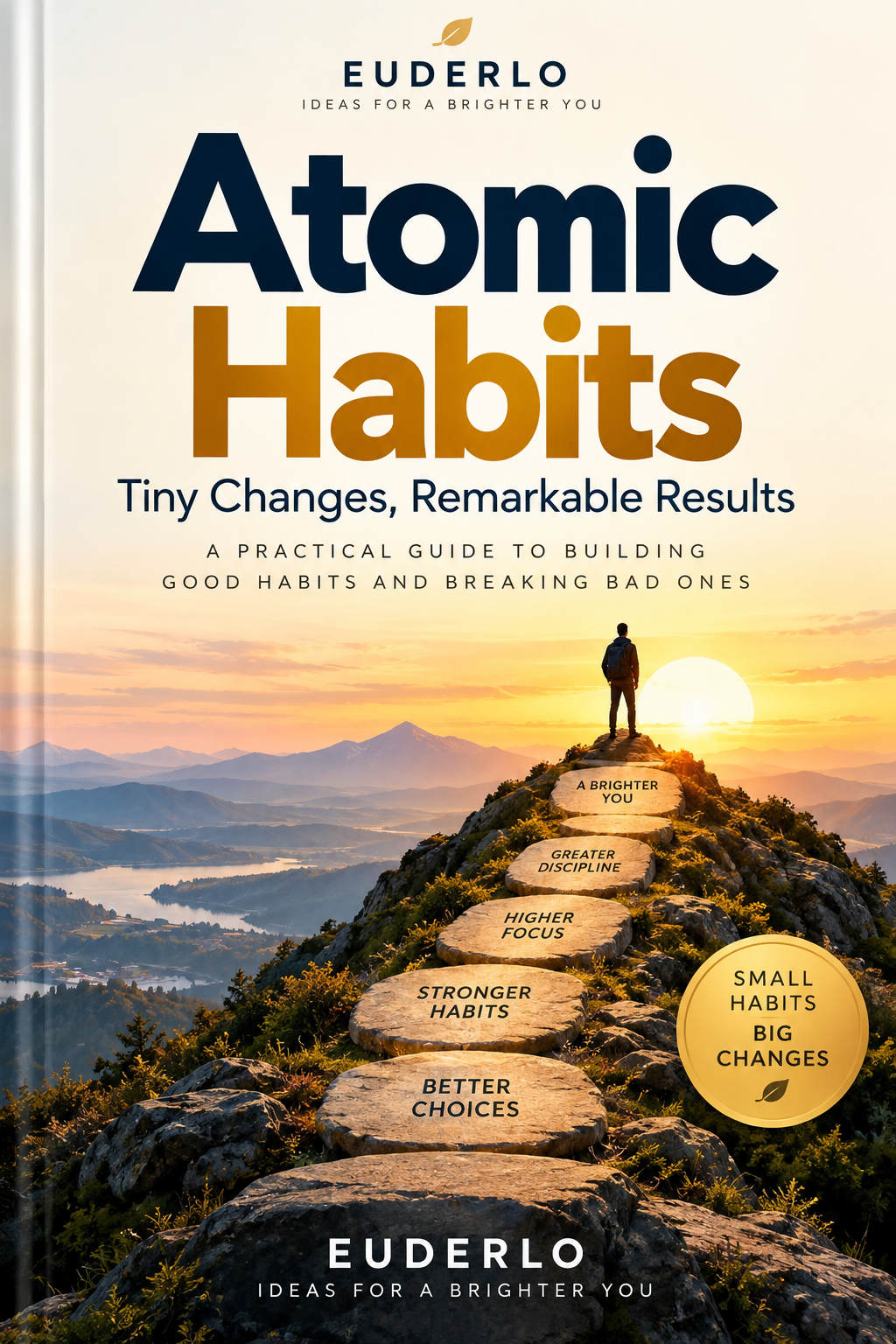
In Atomic Habits, James Clear asks us to rethink what it really means to change our lives. We often believe that personal growth requires a dramatic transformation—a new year, a new routine, a new job, or a sudden burst of motivation. But Clear's message is much more practical: our lives are largely the result of what we repeatedly do. A small habit may seem meaningless today, but when we repeat it for months and years, it can completely change where we end up. If I read a few pages every day, exercise regularly, save a little money, or spend time learning a valuable skill, none of these actions may feel extraordinary in isolation. Yet together, they can transform my life. The same is true in the opposite direction. Small bad habits can quietly compound until they become major problems. James Clear therefore wants us to stop looking for overnight success and start understanding the power of small habits, consistency, discipline, productivity, and continuous self-improvement.
Chapter 1 — The Surprising Power of Atomic Habits
James Clear begins by showing us why tiny habits matter so much. His central argument is that small improvements compound over time. Improving by a tiny amount may not produce an obvious result tomorrow, next week, or even next month. That can make us believe that our efforts are useless. But Clear wants us to look at the longer journey. When we repeatedly make small improvements, those improvements accumulate, just like compound interest. If you want to build a better life, you don't necessarily need to change everything today. You need to repeatedly make slightly better choices.
Clear also makes an important distinction between goals and systems. We all have goals, but goals only tell us where we want to go. Our systems—the routines and habits we follow every day—determine whether we actually get there. If I want to become fit, saying “I want to lose weight” is a goal. Going to the gym, eating better, sleeping properly, and repeating those behaviors is the system. James Clear's message is powerful because it makes success feel less mysterious: your daily habits are creating your future even when you cannot see the results yet.
Chapter 2 — How Your Habits Shape Your Identity
James Clear takes habit formation deeper by explaining that lasting behavior change begins with identity. We often approach self-improvement by focusing on what we want to achieve. We say, “I want to write a book,” “I want to become successful,” or “I want to exercise every day.” Clear asks us to go one level deeper: Who do I want to become?
If I repeatedly write, I begin to see myself as a writer. If I exercise consistently, I begin to see myself as someone who takes care of my body. If I read every day, I become a reader. According to Clear, every action we take is like a small vote for the person we want to become. We don't need to convince ourselves with words; our repeated behavior provides evidence. This is why identity-based habits can be so powerful. Instead of constantly forcing myself to perform a behavior, I can ask, “What would the person I want to become do today?” That question can completely change how we approach personal development.
Chapter 3 — How to Build Better Habits in Four Simple Steps
James Clear explains that every habit follows a four-step pattern: cue, craving, response, and reward. Something first catches our attention. That creates a desire. We then perform an action, and finally we receive some kind of reward. Once this cycle is repeated enough times, the behavior can become automatic.
Think about how easily we check our phones. A notification is the cue. Curiosity becomes the craving. We pick up the phone as the response. Seeing a new message gives us the reward. Clear's purpose is not simply to help us understand bad habits; he wants us to understand how habits actually work so we can deliberately design better ones. Once we understand the habit loop, we can stop blaming ourselves for every behavior and start changing the environment and process that produces it.
The First Law — Make It Obvious
Chapter 4 — The Man Who Didn't Look Right
James Clear explains that much of our behavior is driven by patterns we barely notice. Our brain constantly observes our surroundings and learns which actions usually follow particular situations. Eventually, we may perform certain behaviors without consciously deciding to do them.
This is why habit awareness is the first step toward changing our lives. If I don't notice when or why I perform a bad habit, changing it becomes extremely difficult. Clear encourages us to observe our daily routines honestly. When do I procrastinate? What makes me reach for my phone? When do I start overeating? What happens immediately before I lose focus? Awareness gives us the opportunity to interrupt automatic behavior and consciously choose something better.
Chapter 5 — The Best Way to Start a New Habit
James Clear explains that one of the easiest ways to build a good habit is to make the decision extremely specific. Instead of saying, “I will exercise more,” decide exactly when and where you will exercise. The clearer the plan, the less opportunity there is for excuses.
Clear also introduces habit stacking, one of the most practical habit-building techniques in the book. We can attach a new behavior to an existing habit. After I brush my teeth, I might read two pages. After I make my morning tea, I might write my priorities. The existing habit becomes a reminder for the new one. This is powerful because we don't have to depend completely on motivation or memory. We use something already established in our routine to help create the next behavior.
Chapter 6 — Motivation Is Overrated; Environment Often Matters More
James Clear challenges the popular belief that successful people simply have stronger willpower. He argues that environment design can have an enormous effect on our behavior. What we repeatedly see around us becomes a powerful cue.
If healthy food is visible and convenient, we are more likely to eat it. If our phone sits beside us while we work, checking it becomes incredibly easy. If a book is placed on our desk, reading becomes more obvious. Clear wants us to understand that we don't always need more motivation—we sometimes need a better environment. Instead of fighting temptation all day, we can design our surroundings so that good habits become easier and bad habits become less convenient.
Chapter 7 — The Secret to Self-Control
James Clear argues that self-control is often misunderstood. We admire people who appear extremely disciplined, but they may simply have learned how to avoid situations that repeatedly trigger bad habits.
If I constantly keep distracting apps open while working, I am creating a difficult environment for myself. If I want to eat healthier but keep unhealthy snacks beside my desk, I am making the wrong behavior extremely easy. Clear's lesson is simple: remove the cue, and you often reduce the behavior. Real discipline isn't always about resisting temptation. Sometimes the smartest form of discipline is designing your life so you don't have to resist the same temptation repeatedly.
The Second Law — Make It Attractive
Chapter 8 — Make It Attractive
James Clear explains that we naturally move toward behaviors we find attractive and rewarding. This is why creating good habits isn't only about knowing what is good for us. We also need to make those habits appealing.
If exercise feels like punishment, we may struggle to continue. If reading feels like homework, we may avoid it. But when we connect a positive habit with something enjoyable, the experience changes. Clear wants us to make good habits something we genuinely look forward to rather than something we constantly force ourselves to do. The easier a habit feels emotionally, the easier it becomes to repeat.
Chapter 9 — The Role of Family and Friends in Shaping Your Habits
James Clear reminds us that we are social creatures. We naturally imitate the people around us, especially people we admire and groups we want to belong to. This means our social environment can influence our habits more than we realize.
If everyone around me spends their free time scrolling, complaining, or avoiding responsibility, those behaviors can begin to feel normal. But if I spend time around people who read, exercise, build businesses, learn skills, and work toward meaningful goals, those behaviors can also become normal. Clear's point isn't that we should abandon everyone who behaves differently. His point is that the people around us help define what feels normal, and what feels normal is often what we eventually do.
Chapter 10 — How to Find and Fix the Causes of Your Bad Habits
James Clear encourages us to look beneath our bad habits. A behavior usually exists because it provides some immediate benefit. Procrastination may help me temporarily escape stress. Scrolling may relieve boredom. Junk food may provide immediate pleasure. Even though these behaviors can create long-term problems, they satisfy something in the moment.
This is why simply saying “I need more discipline” isn't always enough. We need to understand the craving behind the behavior. When we identify what we're actually seeking, we can look for a healthier way to satisfy that need. Understanding the cause of a bad habit gives us a better opportunity to change the response.
The Third Law — Make It Easy
Chapter 11 — Walk Slowly, but Never Backward
James Clear emphasizes that repetition creates automaticity. We don't become good at something because we understand it intellectually; we become better because we repeatedly practice it.
The first time we do something, it can feel difficult and unnatural. But every repetition strengthens the behavior. This is why consistency is so important for habit formation. We shouldn't obsess over whether our new routine is perfect. We should focus on showing up repeatedly. You don't need to be extraordinary today. You need to keep moving in the right direction.
Chapter 12 — The Law of Least Effort
James Clear explains that human beings naturally prefer the option requiring less effort. Instead of fighting this tendency, we can use it to build better habits.
If I want to read more, I can keep my book beside my bed. If I want to exercise in the morning, I can prepare my clothes the night before. If I want to write, I can keep my writing software ready. Small changes like these reduce friction. When good habits require fewer steps, we are more likely to perform them. At the same time, adding friction to bad habits can make them less attractive. Clear's idea is beautifully practical: make the right behavior easy enough that you don't need to negotiate with yourself every time.
Chapter 13 — How to Stop Procrastinating Using the Two-Minute Rule
James Clear introduces one of the most memorable ideas in the book: the Two-Minute Rule. When a habit feels overwhelming, reduce it to something so small that it takes almost no effort to begin.
Instead of saying, “I need to read this entire book,” I can say, “I will read one page.” Instead of “I need to exercise for an hour,” I can say, “I will put on my workout clothes.” The goal is not to remain at two minutes. The goal is to make starting easy. Once we begin, continuing often becomes much easier. Clear wants us to understand that starting is frequently the hardest part of overcoming procrastination.
Chapter 14 — How to Make Good Habits Inevitable and Bad Habits Impossible
James Clear takes habit design one step further by showing us how to create systems that reduce the need for decision-making. If something important depends on me making the perfect choice every day, eventually I may fail.
But when I automate a behavior, the system can support me even when motivation disappears. Automatic savings, scheduled workouts, prepared meals, blocked distractions, and planned study time are examples of this principle. Clear's message is that good habits become more reliable when we build them into the structure of our lives rather than relying entirely on willpower.
The Fourth Law — Make It Satisfying
Chapter 15 — The Cardinal Rule of Behavior Change
James Clear explains that a behavior becomes more likely to continue when it produces a satisfying result. This is why immediate rewards are so powerful. Unfortunately, many good habits provide delayed benefits while bad habits provide immediate pleasure.
Exercise may make us healthier months from now, while watching videos feels enjoyable immediately. Saving money may improve our future financial security, while spending gives us immediate satisfaction. Clear encourages us to find ways to make good behaviors feel rewarding in the present. When we can connect today's action with an immediate sense of progress, continuing becomes easier.
Chapter 16 — How to Stick with Good Habits Every Day
James Clear explains that one of the strongest ways to maintain a habit is to create visible evidence of progress. This is where habit tracking becomes useful. Seeing a chain of completed habits can provide a small but meaningful feeling of accomplishment.
But Clear also warns us not to become obsessed with never breaking the chain. Missing once does not destroy progress. The important principle is to never let one mistake become a pattern. If I miss a workout today, I shouldn't decide that the entire routine has failed. I should return tomorrow. Consistency does not mean perfection. It means returning to the path again and again.
Chapter 17 — How an Accountability Partner Can Change Your Behavior
James Clear shows that consequences can influence whether we continue a habit. When another person knows what we have committed to doing, our behavior becomes more accountable.
An accountability partner, friend, coach, or agreed consequence can make it harder to casually abandon a commitment. We are often more willing to keep a promise when someone else is involved. This gives habit formation another layer: we don't always have to depend on ourselves alone to create discipline. We can create systems of accountability that support the behavior we want.
Advanced Lessons About Mastering Habits
Chapter 18 — The Truth About Talent
James Clear recognizes that people have different natural strengths. Some environments and activities will naturally suit one person more than another. Rather than blindly copying somebody else's path, Clear encourages us to discover where our own abilities and interests overlap.
This doesn't mean talent replaces hard work. It means that choosing the right environment can make sustained effort easier. If I enjoy writing, for example, I may be more willing to spend thousands of hours improving my writing than someone who has no interest in it. The right habits become easier to maintain when they fit the person we are and the strengths we naturally bring.
Chapter 19 — The Goldilocks Rule
James Clear explains that we stay motivated when a challenge is neither too easy nor impossibly difficult. The sweet spot is a task that is challenging enough to keep us interested but achievable enough that we believe we can succeed.
This matters for productivity, learning, fitness, career growth, and almost every form of personal development. If everything becomes easy, boredom appears. If everything becomes overwhelmingly difficult, frustration takes over. The solution is to keep increasing the challenge as we improve. Growth happens when we repeatedly step slightly beyond what we can already do.
Chapter 20 — The Downside of Creating Good Habits
James Clear ends by reminding us that habits are powerful, but they can also become automatic enough that we stop questioning them. Once we become comfortable with a routine, we may continue doing it simply because it is familiar.
That is why long-term personal growth requires reflection. We need to ask ourselves whether our current habits are still helping us. Am I still improving? Is this routine still producing the result I want? What can I change? Clear's final lesson is that mastery is not simply repeating the same thing forever; it is building a habit, maintaining it, and then deliberately improving it when necessary.
The Four Laws of Atomic Habits
James Clear's entire framework can ultimately be remembered through four simple principles. Make it obvious. Make it attractive. Make it easy. Make it satisfying. When you want to build a good habit, strengthen each of these four stages. When you want to break a bad habit, reverse them: make it invisible, unattractive, difficult, and unsatisfying.
This framework gives us something much more useful than motivation alone. It gives us a practical way to redesign our behavior.
The Most Powerful Lesson from Atomic Habits
Perhaps the most important idea James Clear gives us is that we don't rise to the level of our goals; our daily systems shape where we ultimately go. We may dream about becoming successful, healthy, financially independent, productive, knowledgeable, or confident. But our future is being built quietly through what we repeatedly do today.
I don't have to completely change my life tomorrow. Neither do you. We can begin with one small action. Read one page. Write one paragraph. Walk for ten minutes. Save a small amount. Put the phone away for thirty minutes. Go to the gym. Learn one new concept. Sleep a little earlier.
These actions may look too small to matter. But that is exactly the point.
A habit does not need to change your life today to be worth doing. It only needs to move you in the direction of the person you want to become.
And when we repeat that small action long enough, something remarkable happens. The action becomes easier. The habit becomes stronger. The identity becomes clearer. And eventually, the person we were trying so hard to become begins to feel like the person we already are.
That is the real power of Atomic Habits: we don't transform our lives through one extraordinary decision. We transform them through ordinary decisions repeated long enough to become extraordinary results.
Top Ideas
The ideas below capture the concepts worth remembering and carrying into everyday life.
1. Small Habits Create Big Results
James Clear's central idea is that tiny improvements can compound over time. A single good decision rarely changes our lives, but hundreds or thousands of repeated decisions can completely change our direction.
Euderlo Perspective:
We often underestimate small actions because we are looking for dramatic results. But your future is being built in ordinary moments. Reading five pages, saving ₹100, exercising for 20 minutes, writing one paragraph, or learning something for 15 minutes may feel insignificant today. The real question isn't, “Did this change my life today?” It's “Is this taking me toward the life I want?” At Euderlo, we see personal growth as a direction rather than a single destination.
2. Become the Person Who Does the Habit
Clear explains that lasting change becomes stronger when we focus on identity rather than only outcomes. Instead of saying, “I want to write a book,” we can begin seeing ourselves as a writer. Instead of “I want to become fit,” we become someone who takes care of their health.
Euderlo Perspective:
Before asking what you want to achieve, ask who you want to become. Every action is evidence of your identity. You don't become disciplined because you repeatedly say, “I am disciplined.” You become disciplined by keeping small promises to yourself. Your identity is quietly being written by your daily behavior. Change the actions, and eventually the way you see yourself begins to change too.
3. Make Good Habits Easy to Follow
Clear explains that people are more likely to repeat a behavior when it requires less effort. Making a habit simple and convenient reduces the resistance that often prevents us from starting. Instead of creating complicated routines, begin with a version of the habit that is easy to perform consistently.
Euderlo Perspective:
If your habit feels too difficult to start, make the first step smaller. Want to read more? Start with two pages. Want to exercise? Begin by putting on your workout clothes. Want to write? Open the document and write one sentence. The goal is to make starting so easy that you have fewer reasons to postpone it.
4. Never Miss Twice
Clear emphasizes that mistakes and missed days are part of the process of building habits. Missing once does not destroy your progress, but allowing one missed day to become several can turn a temporary interruption into a new pattern. Returning quickly helps protect the habit.
Euderlo Perspective:
You don't need a perfect routine to build good habits. You need the ability to return after slipping. If you miss a workout, restart tomorrow. If you skip reading today, pick up the book again tomorrow. Progress isn't about never falling off track; it's about learning how to get back on track quickly.
5. Focus on Systems, Not Just Goals
Clear explains that goals describe the results we want, while systems describe the processes that help us reach those results. Wanting to lose weight, write a book, or become more productive is only the beginning. The daily system behind the goal is what creates repeated action.
Euderlo Perspective:
A goal can tell you where you want to go, but your daily routine determines whether you actually move there. Instead of constantly asking whether you've reached your goal, ask whether you're following the habits that support it. Build better systems, repeat them consistently, and let the results develop over time.
Life Lessons
Simple lessons that turn the book's ideas into practical ways of thinking and acting.
1. Your Smallest Actions Are Shaping Your Future
One of James Clear's most powerful lessons is that small actions matter far more than they appear to. We often wait for a major opportunity to change our lives, but our future is being influenced by ordinary decisions every day. Reading a few pages, exercising for twenty minutes, saving a small amount of money, learning a skill, or choosing to put the phone away may not feel life-changing today. But when we repeat those actions, they begin to compound. The life you have tomorrow is being built by the habits you practice today.
2. Become the Person You Want to Be
James Clear teaches us to focus not only on what we want to achieve but on who we want to become. If you want to become a writer, start writing. If you want to become healthy, start behaving like someone who values their health. If you want to become disciplined, begin keeping small promises to yourself. Every repeated action is evidence of your identity. You don't have to announce who you want to become; your behavior will eventually speak for you. Change your actions, and slowly your identity begins to follow.
3. Your Ordinary Days Deserve More Attention
We often imagine that meaningful change happens during extraordinary moments—a new year, a new job, a major decision, or a sudden burst of motivation. But most of life is made up of ordinary mornings, regular workdays, repeated choices, and familiar routines. Those ordinary days may feel insignificant while we are living them, yet they are where most of our character and lifestyle are formed.
Don't wait for a dramatic moment to start becoming the person you want to be. Your ordinary Tuesday matters. The way you spend an uneventful evening matters. What you repeatedly do when nothing exciting is happening may have more influence on your future than the occasional moment when you feel highly motivated. Build a life you respect through the days that seem ordinary.
4. What You Make Easy Becomes Part of Your Life
Human behavior naturally follows the path of least resistance. When something is convenient, visible, and easy to begin, we are more likely to return to it. This applies to both helpful and harmful behaviors. A phone kept beside your bed, a book left on your desk, unhealthy food kept within reach, or a workout prepared in advance can quietly influence what you do without requiring a conscious decision every time.
Look around your room and ask yourself what your environment is encouraging you to do. Sometimes changing your life begins by changing what is within your reach. Make the life you want easier to practice and the distractions you want to escape harder to access.
5. The Hardest Part of Change Is Often the Beginning
Starting something new requires more mental effort than continuing something that has already become familiar. This is why a new routine can feel uncomfortable even when you genuinely want the result. Once the behavior becomes familiar, however, the resistance often decreases. The challenge is not always doing more; sometimes it is simply creating enough momentum to begin.
When you keep postponing something important, stop asking yourself to finish it. Ask yourself to begin it. Open the book. Put on the shoes. Write the first sentence. Spend five minutes learning. A beginning does not need to be impressive—it only needs to exist.
Who Should Read This Book?
1. People Who Keep Starting but Struggle to Stay Consistent
If you repeatedly make plans to exercise, read, study, wake up early, start a project, or improve your lifestyle but eventually return to your old routine, this book speaks directly to that struggle. James Clear explains why motivation alone is unreliable and how small, manageable behaviors can make consistency easier. Instead of constantly restarting from zero, you can learn to build routines that fit naturally into your life.
2. People Who Want to Change but Feel Overwhelmed
Sometimes the problem isn't that we don't want to improve; it's that we try to change everything at once. We create huge goals, complicated routines, and unrealistic expectations, then feel disappointed when we cannot maintain them. Atomic Habits offers a different approach: start smaller than you think you need to. If you feel stuck in your career, health, productivity, studies, or personal growth, the book can help you think about change as a series of manageable actions rather than one enormous transformation.
3. People Who Want to Understand Themselves Better
This book isn't only for someone trying to become more productive. It can also be valuable if you are curious about why you behave the way you do. Why do you reach for your phone when you're bored? Why do certain routines become automatic? Why is changing some behaviors so difficult? James Clear explores the relationship between cues, environment, rewards, identity, and repeated behavior. For anyone interested in self-awareness and personal development, the book provides a useful framework for understanding how everyday choices gradually shape the person we become.
Practical Challenges
7-Day Challenge
Day 1 — Observe Your Current Habits
Don't change anything today. Simply observe yourself. Notice what you do when you wake up, when you feel bored, when you are stressed, and when you have free time. Write down a few habits that help you and a few that repeatedly pull you away from your goals. Before we can change our behavior, we need to become honest about what is already happening.
Day 2 — Choose One Habit
Choose one habit you genuinely want to build. Don't choose ten. Make it small enough that you can realistically repeat it every day. It could be reading one page, walking for ten minutes, drinking more water, writing for five minutes, or spending ten minutes learning a skill. Your goal today is not to impress yourself; it is to prove that you can begin.
Day 3 — Give Your Habit a Trigger
Connect your new habit to something you already do. After breakfast, read one page. After brushing your teeth, meditate for two minutes. After making your morning tea, write your priorities. Give your brain a clear signal that tells it, “Now it's time for this habit.”
Day 4 — Remove One Obstacle
Look at what makes your good habit difficult or your bad habit easy. Then change one thing. Keep your book beside your bed. Put your phone away while working. Prepare your gym clothes at night. Remove one unnecessary obstacle between you and the behavior you want.
Day 5 — Make It Enjoyable
Find a way to make your habit more attractive. Listen to something you enjoy while walking. Create a comfortable reading space. Study in a place where you feel focused. The objective is to stop treating every positive habit like punishment. Find something about the process that makes you want to return.
Day 6 — Keep the Promise
Today, focus on keeping the promise you made to yourself. Even if you don't feel motivated, complete the smallest version of the habit. This is where the habit begins to become connected with your identity. You're not simply completing a task; you're proving to yourself that your decisions can be trusted.
Day 7 — Reflect, Don't Judge
Look back at the week. What worked? What made the habit easier? What distracted you? When did you feel resistance? Don't use the answers to criticize yourself. Use them to improve your system. Your first week was not about perfection. It was about learning how you behave.
21-Day Challenge
Days 1–7 — Create the Foundation
For the first week, continue the habit you established during the 7-day challenge. Keep it small and predictable. Your focus is simply to show up. Don't increase the difficulty just because you had a few successful days. Give your brain time to become familiar with the behavior.
Days 8–14 — Strengthen the Routine
Now make the habit slightly more meaningful. If you were reading one page, you might increase it to five or ten pages. If you were walking for ten minutes, you might gradually extend the walk. The important thing is to increase the behavior without making it so demanding that you stop. Growth should challenge you, not overwhelm you.
During this week, also identify one bad habit that regularly interferes with your progress. Instead of relying only on willpower, change the environment around it. Make the unwanted behavior less convenient and your desired behavior easier to access.
Days 15–21 — Become the Person Who Does It
The final week is about identity. Stop thinking only about completing the habit and start thinking about what the habit represents. If you have been writing every day, you're practicing being a writer. If you've been exercising, you're practicing being someone who values their health. If you've been learning, you're becoming someone committed to growth.
At the end of Day 21, ask yourself: “What kind of person am I becoming because of these actions?” That question is more valuable than simply asking how many days you completed.
90-Day Challenge
For the first month, choose one major area of your life to improve. It could be health, learning, productivity, finances, writing, or another meaningful priority. Create one or two habits that support it and make them part of your daily routine.
Don't try to rebuild your entire life simultaneously. The purpose of the first month is to establish a reliable foundation. Focus on showing up consistently and learning what makes your habits succeed or fail.
Days 31–60 — Upgrade Your Environment
Once your basic routine becomes more stable, look beyond the habit itself. Examine your surroundings. What distracts you? What makes good behavior difficult? What repeatedly triggers habits you want to change?
Redesign your environment around your priorities. Create dedicated spaces for focused work, keep useful resources visible, reduce unnecessary notifications, prepare things in advance, and make your desired behavior convenient. Your environment should quietly support the person you are trying to become.
Days 61–75 — Raise the Standard
Now that consistency has been established, gradually increase the challenge. Read more deeply. Exercise more intentionally. Work for longer periods without distraction. Practice your skill at a higher level. Save more deliberately.
The purpose isn't to make your life harder for the sake of being disciplined. It is to prevent yourself from becoming comfortable with a routine that no longer challenges you. Once something becomes easy, give yourself a slightly harder version to master.
Days 76–90 — Build Your Personal System
During the final stage, look at everything you've learned. Which habits genuinely improved your life? Which ones were unrealistic? Which environments helped you? Which triggers repeatedly caused problems?
Now create a sustainable personal system. Decide which habits you will continue, which you will modify, and which you will remove. The challenge ends, but the system shouldn't. The real achievement is reaching a point where these behaviors no longer feel like a temporary challenge—they begin to feel like part of the way you naturally live.