The Story of the Man Who Built One of the World's Most Powerful Brands
“The journey is never as clear when you are living it as it looks when you look back.”Phil Knight. You do not need to know exactly where your idea will take you before you begin. Sometimes you only need enough courage to take the next step. Start with what you have, listen to the people you are trying to help, learn from what goes wrong, and keep improving. Success rarely arrives in one dramatic moment. It grows quietly through thousands of ordinary decisions. What looks like a small beginning today may become the foundation of something far bigger tomorrow.
The Idea That Came Before Nike
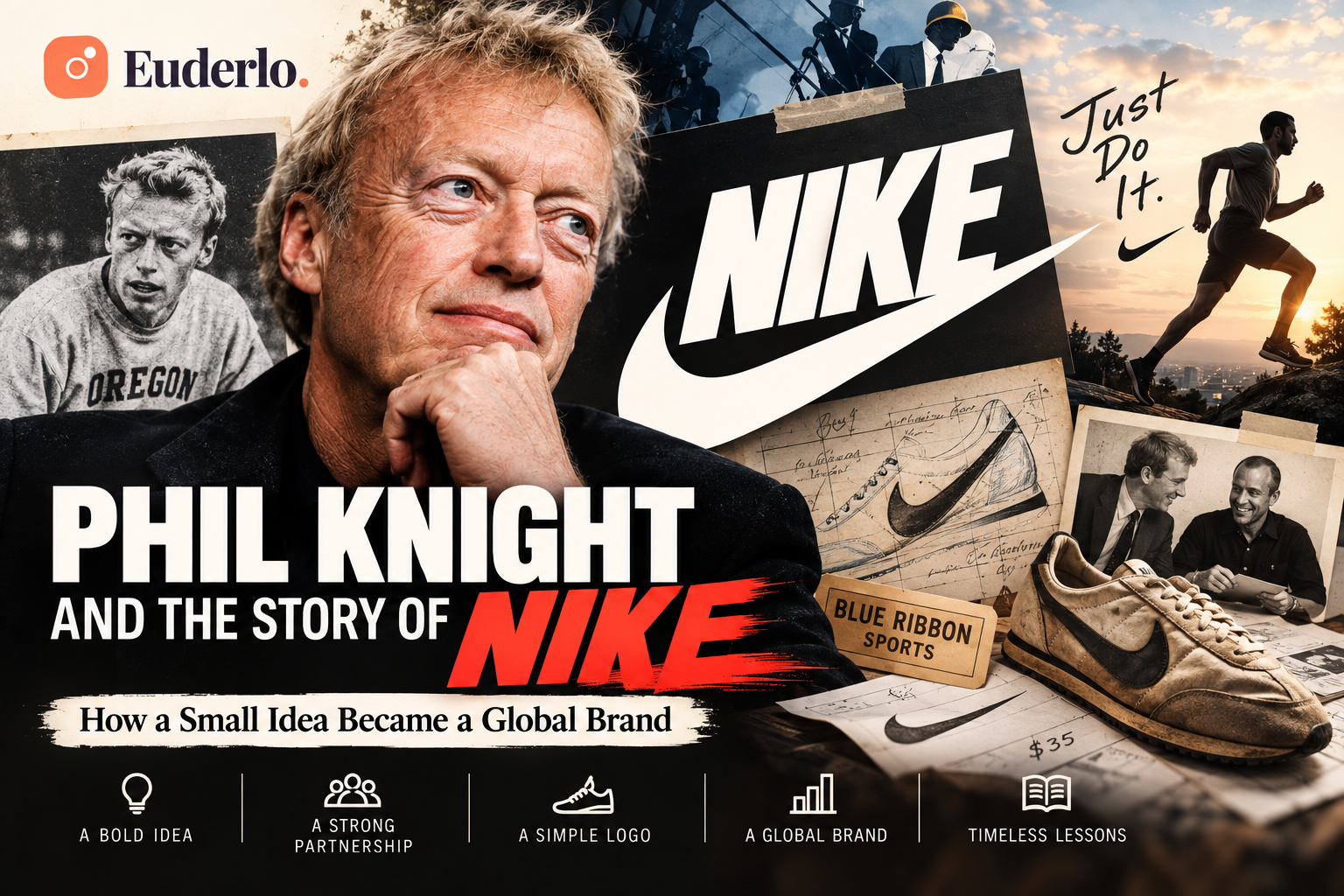
Phil Knight did not start Nike with a giant office, a large team, millions of dollars or a revolutionary piece of technology. He started with an idea. While studying at Stanford Graduate School of Business, Knight explored the possibility of importing high-quality, inexpensive running shoes from Japan and selling them in the United States. At the time, the idea probably looked much smaller than the company it eventually became. There was no reason to believe that a business selling running shoes could grow into one of the most recognisable brands on the planet. Knight's own memoir, Shoe Dog, describes the early years as a period filled with uncertainty, financial pressure, competitors, doubters and constant risk. Stanford's overview of the book explains that Knight began with a simple mission to import Japanese running shoes and initially sold them from the trunk of his Plymouth Valiant. Stanford's overview of Shoe Dog. The interesting part of this story is therefore not simply that Phil Knight founded Nike. It is that he had no way of knowing what the idea would eventually become. He was testing a possibility. That is where many meaningful businesses begin: not with certainty, but with a question that seems worth answering.
Phil Knight's Stanford Business Idea
The original idea was connected to a changing sports environment and Knight's own experience as a runner. He understood that running shoes could be more than ordinary footwear. Athletes cared about weight, comfort, traction and performance, and Knight believed Japanese manufacturers had an opportunity to produce competitive shoes at attractive prices. At Stanford, he developed the concept as a business-school assignment, but the idea remained with him after the assignment ended. This is an important part of entrepreneurship that often gets overlooked. Sometimes an idea becomes meaningful because it refuses to disappear. You think about it after the meeting is over. You continue considering it after the project ends. You imagine how it might work in the real world. Knight eventually decided to test the idea instead of leaving it on paper. Stanford's account of Knight's career describes how the business concept grew out of his Stanford experience and his interest in running. Phil Knight's Stanford entrepreneurship story
The Handshake That Created Blue Ribbon Sports
The company that became Nike was originally called Blue Ribbon Sports. On January 25, 1964, Phil Knight and his former track coach Bill Bowerman met for lunch in Portland, Oregon, to discuss a potential business partnership. They shook hands and agreed to work together. Nike's own archive describes that meeting as the beginning of Blue Ribbon Sports. The handshake that started Blue Ribbon Sports. The partnership worked because Knight and Bowerman did not bring exactly the same abilities to the table. Knight was interested in business, distribution and the commercial opportunity, while Bowerman was deeply interested in athletes and footwear. That difference would eventually become one of the company's biggest strengths. Knight could think about how to get shoes into the market, while Bowerman could think about how to make those shoes better. It is a useful lesson for anyone building something today. The best co-founder is not necessarily someone who thinks exactly like you. Sometimes the strongest partnership is between people who share the same destination but bring different skills to the journey.
The First 300 Pairs of Shoes
In April 1964, approximately 300 pairs of shoes arrived at the Knight family home in Portland. Knight placed the boxes in the basement laundry room, which became the company's first office. Nike's own archive now documents this humble beginning in detail. Nike's history of the company's first office. It is difficult to connect that basement with the enormous Nike campus that exists today, but the contrast is precisely what makes the story powerful. The company had no global headquarters. There was no enormous advertising budget. There was no worldwide retail network. There were boxes of shoes in a family basement and an entrepreneur trying to figure out how to sell them. Knight's first challenge was not to become Nike. It was to move those 300 pairs of shoes from inventory into the hands of customers. That difference between the immediate problem and the eventual ambition is one of the most important lessons in the entire story.
Selling Shoes From the Trunk of a Car
Knight loaded shoes into his Plymouth Valiant and drove around Portland trying to sell them directly to runners. Nike's historical account says that he travelled to high schools around Portland and sold shoes directly to athletes. Stanford also describes the early company as a business that sold sneakers from the trunk of a car. Stanford's account of Phil Knight's early years. Today, that sounds almost unbelievably small. But there was an advantage hidden inside that simplicity. Knight was close to the people buying the product. He could see what they liked. He could hear their complaints. He could discover what mattered to runners. He could learn what made someone hesitate before buying. Every sale gave him money, but every conversation also gave him information. In the early stages of a company, that information can be more valuable than sophisticated infrastructure.
The First Customers Were Also Teachers
A customer is not simply someone who gives you money. In the early stages of a business, a customer can also become a teacher. When Knight sold shoes directly to runners, he could learn from their reactions. Which shoes felt comfortable? Which ones performed well? What did athletes dislike? What were they willing to pay? What did they compare the product against? These questions helped turn a theoretical business idea into a real business. The same principle applies to modern entrepreneurs, writers and creators. You can spend months studying analytics, keywords and competitors, but eventually you need real people to interact with your work. A reader who tells you that an article changed their thinking is giving you information. A customer who says your product is difficult to use is giving you information. A visitor who leaves your website immediately is also giving you information. The skill is learning how to listen.
Bill Bowerman Saw the Shoe Differently
Bill Bowerman brought another dimension to the company. He was a coach, athlete mentor and experimenter who wanted to understand how footwear could improve athletic performance. Nike's account of Bowerman's work describes how he began experimenting with running shoes long before Nike became a major brand. He deconstructed existing racing shoes, examined their construction and experimented with different materials and designs. Bill Bowerman's footwear innovation story. His philosophy was simple: the shoe had to be light, comfortable and capable of going the distance. That mindset was important because it shifted attention from merely selling footwear to solving problems for athletes. A product becomes more valuable when it solves a real problem better than the alternatives. Bowerman was constantly asking how the product could improve, and that curiosity became part of Nike's DNA.
The Waffle Iron Experiment
One of the most famous examples of Bowerman's experimentation came from an ordinary household object: a waffle iron. He wondered whether the waffle pattern could help create a better running-shoe sole. According to Nike's historical account, Bowerman experimented with liquid urethane and waffle irons, even ruining a family waffle iron during the process. Nike's history of the Moon Shoe and waffle sole experiment. The resulting idea helped lead to the development of the Waffle sole and the Nike Moon Shoe. What makes this story memorable is not simply the invention itself. It shows how innovation often begins. Bowerman did not wait for perfect circumstances. He saw something ordinary and asked whether it could solve an unusual problem. That is a useful way to think about innovation today. Innovation does not always require creating something completely new from nothing. Sometimes it means looking at something familiar and seeing a different possibility.
When Selling Someone Else's Shoes Wasn't Enough
Blue Ribbon Sports initially depended heavily on Japanese footwear. That business model helped the company get started, but dependence on another company's products also created a limitation. If another company controls the product, it ultimately controls a major part of your future. Knight eventually realised that Blue Ribbon Sports needed its own products and its own identity. Nike's historical archive explains that the company was still operating as Blue Ribbon Sports while developing its own footwear and identity in the early 1970s. Nike's history of the Swoosh and the move toward its own identity .This is a lesson that applies far beyond footwear. A business can begin by reselling products, using another platform or providing a service. But as it grows, the entrepreneur eventually has to ask what the company actually owns. Does it own the customer relationship? Does it own technology? Does it own a process? Does it own intellectual property? Does it own a brand people remember? The stronger the answer, the greater the potential independence.
The Birth of Nike
The name Nike gave the business a stronger identity. Instead of sounding like a generic sports distributor, the name suggested victory, movement and athletic achievement. But the transition was more than a naming exercise. The company was becoming something different from the business that had started with imported shoes. Nike's own archive explains that in 1971 the company was still operating as Blue Ribbon Sports while introducing products under the Nike identity. Its first Nike football boot retailed for $16.95. Nike's history of the first Nike shoe and brand identity .This period demonstrates how brands evolve. A company does not wake up one morning with a complete identity. It experiments with names, products, logos, messages and customer experiences until the pieces begin to reinforce each other.
The $35 Swoosh
The Swoosh has become one of the most recognisable symbols in the world, but its beginning was remarkably modest. Carolyn Davidson, a graphic design student at Portland State University, created the curved mark while working with Knight. Nike's own archive records that Davidson was paid $35 for the original design. Nike's official history of the $35 Swoosh. Knight reportedly was not immediately enthusiastic about it, but the company used the design because it suggested movement and worked on the shoe. The significance of the story is not simply that a $35 design became incredibly valuable. The deeper lesson is that the value of a creative asset often comes from the system surrounding it. The Swoosh became powerful because Nike repeatedly attached it to products, athletes, advertisements, victories and cultural moments. A symbol accumulates meaning through repeated exposure.
A Logo Is Not a Brand
This is an important distinction for anyone building a company. A logo can be created in a day. A brand cannot. A brand is created through repeated experiences. If a company has a beautiful logo but poor products, customers eventually learn the truth. If the website looks professional but the customer service is terrible, the visual identity cannot compensate forever. Nike's Swoosh became meaningful because the company continuously attached it to an evolving story about sport, performance and possibility. This is why branding should not be reduced to colours, fonts and graphics. The deeper question is what people associate with your company after they have interacted with it repeatedly. For Euderlo, that means the brand should be connected with ideas, books, thoughtful essays and practical lessons rather than merely a visual identity. Readers can explore that philosophy through what Euderlo is about.
The Financial Reality Behind the Dream
The inspirational version of entrepreneurship often focuses on ideas and determination while ignoring money. Knight's story does the opposite. Cash flow was a serious issue throughout the company's development. Inventory needed to be purchased before it could be sold. Suppliers needed to be paid. Growth required additional financing. Banks became important. The company had to grow without running out of money. Knight's memoir describes many of the financial pressures and difficult moments behind Nike's growth. Stanford's overview of Shoe Dog and Nike's early financial struggles This is an important lesson because revenue and cash are not the same thing. A company can have strong sales and still face financial pressure. A growing business can need more working capital precisely because it is growing. Entrepreneurship is therefore not simply about creating demand. It is also about surviving long enough to serve that demand.
Growth Creates Different Problems
One of the strange realities of entrepreneurship is that success does not eliminate problems. It changes them. When you have no customers, you worry about finding customers. When you have customers, you worry about delivering the product. When demand grows, you need more inventory. More inventory requires more capital. More employees create management challenges. More markets create operational complexity. More brand recognition creates greater expectations. Nike's history shows this progression clearly. The problems become larger because the organisation becomes larger. The goal is therefore not to build a business that has no problems. That business probably does not exist. The goal is to build the capability to solve increasingly difficult problems.
Product Innovation Became a Competitive Advantage
Once Blue Ribbon Sports moved toward its own products, innovation became even more important. The company could no longer depend simply on distribution. It had to create reasons for customers to choose its shoes. Bowerman's experiments gave the company an early foundation for product innovation. His approach was closely connected to athletes and their experiences. Nike's account of Bill Bowerman's product innovation. That approach created a feedback loop: athletes used the products, their experiences revealed problems, designers experimented with solutions, and new products emerged. This is essentially the same principle modern technology companies call iteration. The terminology changes, but the process remains remarkably similar: build, test, listen, improve and repeat.
The Power of Athlete Feedback
Athletes gave Nike something more valuable than simple publicity. They provided information. A professional or serious athlete could identify weaknesses that an ordinary customer might never notice. They could explain how a shoe behaved during a race, how it felt after repeated use or where the construction created discomfort. That information could then influence product development. This is why being close to the customer can be a competitive advantage. Data can tell you what people bought. Direct interaction can sometimes tell you why. The strongest companies often combine both.
Nike Started Building Athlete Relationships
As Nike developed, athletes became increasingly important to the company's identity. Instead of treating athletes as ordinary customers, Nike increasingly treated them as partners in the development and communication of the brand. This created a powerful connection between product performance and public identity. When a respected athlete wore a Nike shoe, the product became connected with that athlete's performance and personality. The brand was no longer saying only, “This is a running shoe.” It was beginning to say, “This is the kind of world in which serious athletes perform.”
Michael Jordan Changed the Game
The most famous example of this strategy came with Michael Jordan. When Jordan entered the NBA, Nike was already an important running brand, but basketball represented an enormous opportunity. Nike took a significant risk by offering Jordan a contract worth $500,000 a year for five years, according to NBA.com. The deal included a sales threshold that gave Nike an exit option if the shoes did not reach a specified level of sales. The result dramatically exceeded expectations. NBA.com reports that Nike sold approximately $70 million worth of Air Jordans during the first three months and around $126 million in the first year. NBA's history of the Air Jordan breakthrough. The partnership demonstrated what could happen when product, athlete and storytelling became one thing.
Air Jordan Was More Than an Endorsement
The Jordan partnership was not simply a celebrity holding a shoe in an advertisement. Nike helped create an identity around the product. Air Jordan became associated with Jordan's performance, personality and cultural influence. This distinction is important. Traditional endorsement says, “This famous person recommends our product.” A deeper partnership says, “This product belongs to the world represented by this person.” That is far more powerful because the consumer is not merely buying an object. They are buying into an identity. Air Jordan eventually became a major brand in its own right, demonstrating how an athlete relationship could create a new commercial category.
The Business Lesson Behind Michael Jordan
The lesson for entrepreneurs is not that every business needs a celebrity. It is that partnerships work when there is genuine alignment. The right partner already has trust with a particular audience. That partner could be an athlete, creator, expert, author, coach or community leader. What matters is whether the partnership makes sense. If the person represents qualities that naturally connect with the product, the relationship can strengthen credibility. If the connection feels artificial, the audience usually notices.
Nike Started Selling a Feeling
At some point, Nike's business moved beyond the functional purpose of footwear. Running shoes were no longer simply shoes. They could represent discipline, freedom, competition, ambition and personal transformation. Basketball shoes could represent confidence and cultural identity. This was one of the reasons Nike's marketing became so powerful. Instead of explaining only what the product did, Nike increasingly communicated what the product could mean. That is a major distinction in branding. Features explain function. Stories create emotional meaning.
Why People Remember Stories
People often remember stories longer than specifications because stories connect information with emotion and context. A customer might forget the technical details of a shoe but remember an athlete wearing it during an important moment. They might forget the exact materials used but remember how the advertisement made them feel. Nike's advertising increasingly operated at this emotional level. The product remained important, but the story surrounding the product became part of the value.
The Birth of Just Do It
“Just Do It” became one of the most famous advertising phrases in modern history. Nike's own history explains how the phrase became part of the company's advertising identity. Nike's story behind Just Do It The strength of the phrase comes partly from its simplicity. It does not explain the technical specifications of a shoe. It does not tell you what material was used. It does not even tell you which sport to play. It speaks to action. A runner can interpret it as an invitation to train. A basketball player can interpret it as an invitation to compete. Someone trying to change their life can interpret it as a reminder to stop waiting.
The Psychology of Taking Action
The broader idea behind that message is surprisingly relevant to personal development. We often spend too much time preparing to begin. We research the perfect workout before exercising. We search for the perfect business strategy before launching. We read about writing before writing. We plan our future before taking the first practical step. Planning has value, but eventually action has to begin. That idea connects naturally with Euderlo's article on 30 self-improvement habits that actually work, where meaningful change is approached through repeated behaviours rather than dramatic overnight transformations.
The Story Behind Shoe Dog
Phil Knight eventually documented the company's early journey in Shoe Dog. The memoir is valuable because it gives readers Knight's perspective on the people, risks and decisions behind Nike's growth. Stanford describes the book as an inside account of Nike's early years and its evolution from a small startup into an iconic global brand. Stanford's Shoe Dog overview. The book is particularly interesting because it does not present entrepreneurship as a perfectly clean sequence of decisions. There are moments of uncertainty, financial pressure, conflict and fear. That makes the story more human. At the same time, readers should remember that a memoir represents its author's perspective. It is one person's recollection of a complicated history.
The Myth of the Perfect Entrepreneur
Social media has created a strange image of entrepreneurship. We often see successful founders after the success and forget the uncertainty that came before it. We see the company headquarters but not the first rented office. We see the millions in revenue but not the days when the founder worried about paying suppliers. We see the famous logo but not the moment when nobody knew what the symbol meant. Knight's story corrects that image. Stanford's discussions with Knight have repeatedly highlighted the uncertainty and difficult periods surrounding the company's development. Phil Knight's reflections on Nike's never-give-up attitude. Building something meaningful is often less glamorous while you are actually doing it.
Persistence Does Not Mean Doing the Same Thing Forever
There is an important difference between persistence and stubbornness. Persistence means continuing to work toward a meaningful objective while remaining willing to change your approach. Nike changed repeatedly. It moved from distribution toward original products. It developed new footwear. It built relationships with athletes. It expanded into new categories. It transformed its marketing. It adapted its distribution. The destination was not always perfectly defined, but the company kept learning. This is a useful lesson for entrepreneurs and for anyone trying to change their life. You can remain committed to your larger goal while changing the strategy you use to reach it.
The Importance of Distribution
Knight's early work also demonstrates why distribution matters. A great product sitting in a warehouse is not a successful business. Somebody has to bring it to customers. Knight learned distribution by doing it himself. He carried shoes in his car, attended sporting events and developed relationships with athletes and stores. This gave him practical knowledge that could not have been gained from a classroom alone. Today distribution looks different. A business can reach customers through search engines, social media, email, marketplaces, apps and websites. But the fundamental question remains unchanged: how will the product reach the person who needs it?
Building a Connected Business
As Nike grew, its competitive advantage became less about one particular shoe and more about the entire system around the shoe. Product innovation supported athlete relationships. Athlete relationships supported marketing. Marketing strengthened brand identity. Brand identity supported demand. Demand strengthened distribution. Distribution generated revenue. Revenue supported more innovation. This is how a business becomes difficult to copy. A competitor might reproduce one product feature, but copying the entire network of relationships and capabilities is much harder.
Nike's Brand Became Bigger Than Its Product
The Swoosh became a symbol of speed, sport and possibility because Nike continuously attached meaning to it. Nike's own archive now describes the Swoosh as far more than the original stripe created for a single shoe. Nike's history of how the Swoosh became a global symbol This illustrates a fundamental branding principle: meaning compounds. One advertisement does not create a brand. One athlete does not create a brand. One product does not create a brand. But thousands of consistent experiences can eventually create an association that exists in people's minds even when the company is not speaking.
Nike's Current Scale
Nike's modern financial numbers show how far the company travelled from those first 300 pairs of shoes. For fiscal 2026, Nike reported full-year revenue of approximately $46.4 billion. Nike Brand revenue was approximately $45.2 billion, while Nike Brand wholesale revenue reached about $27.5 billion and Nike Direct revenue was approximately $17.7 billion. Nike also reported that Nike Brand Digital revenue declined 12 percent during the fiscal year. Nike's fiscal 2026 financial results These figures are useful because they remind us that the Nike story is not simply an old success story. Even at enormous scale, the company has to respond to changing consumers, channels, markets and competitive pressures. Becoming famous does not remove the need to adapt.
Success Creates New Responsibilities
The bigger a company becomes, the more complicated its decisions become. A small startup can change direction quickly. A global company has millions of customers, thousands of employees, enormous supply chains and a reputation that has taken decades to build. This creates a different type of challenge. The company has to preserve the strengths that made it successful while finding new ways to remain relevant. This is one reason studying only the beginning of a company can be misleading. The origin story tells us how the business started. The later years tell us whether it can keep learning.
What Phil Knight Teaches Entrepreneurs
The most useful lesson from Knight's story is not simply “work hard.” Hard work without direction can waste years. The deeper lesson is to move from ideas to evidence. Build something. Put it in front of people. Listen to what they say. Watch what they do. Improve the product. Test again. Knight's early shoes created evidence. Each sale and conversation helped the business understand what to do next. That process is still relevant today whether you are building an ecommerce store, a software product, a blog, a service business or a personal brand.
Start Smaller Than Your Ambition
Starting small does not mean thinking small. Knight began with a limited inventory, but the business eventually became enormous. The size of your first step does not need to match the size of your ultimate ambition. You can start with one article while imagining a large publication. You can start with one customer while building a company. You can begin with one product while planning a larger product ecosystem. The important thing is that your first version creates learning. You cannot improve something that exists only in your imagination.
Build Something People Actually Need
Nike's early opportunity existed because athletes wanted better footwear. Bowerman's innovations were connected to actual problems faced by runners. Knight's distribution efforts brought those products closer to customers. The lesson is straightforward: businesses become valuable when they solve problems people care about. Instead of asking only, “What can I sell?” ask, “What problem can I solve better?” The second question often leads to a stronger business.
Stay Close to Your Customer
Large organisations can become distant from the people using their products. Layers of management, reports and data can separate decision-makers from customers. Knight's earliest business had the opposite problem: he was almost too close to customers because he was personally selling the shoes. But that proximity was valuable. It helped the company learn quickly. Even today, founders should regularly talk to customers. Read reviews. Answer questions. Watch how people use the product. Pay attention to complaints instead of treating them as annoyances. A complaint can reveal a product opportunity.
Build a Brand Around Meaning
Nike's strongest advantage was not simply that it sold shoes. It built meaning around those shoes. Performance, competition, movement, ambition and achievement became part of the company's identity. If you are building your own business, you can ask the same question: what should people associate with this company? What should they feel when they encounter it? What promise are you repeatedly making? Branding becomes powerful when the answer is visible in the actual customer experience.
The Lesson of Carolyn Davidson
Carolyn Davidson's story reminds us not to underestimate small creative contributions. She created a symbol for a young company that was still trying to establish itself. She could not know that the design would eventually be seen by billions of people. That does not mean every small project will become globally significant. It means that the importance of your work is not always obvious at the moment you create it. A small design can matter. A small article can matter. A small product improvement can matter. A small conversation can change the direction of a project.
The Lesson of Bill Bowerman
Bowerman teaches curiosity. He did not accept existing footwear as the final answer. He examined it, took it apart and experimented. His work shows that innovation begins with questions. Why does this work this way? What if we changed this? Can this material do something different? Can this problem be solved more simply? That mindset is useful in every field. You do not need to call yourself an innovator to practise curiosity. You only need to remain willing to ask whether there is a better way.
The Lesson of Michael Jordan
Michael Jordan teaches the importance of alignment. Nike did not simply find a famous athlete. It found an athlete whose identity could reinforce the company's ambitions in basketball. The relationship created a new commercial category. For smaller businesses, the same principle can apply. Find people whose reputation naturally connects with your product. A partnership becomes more powerful when the audience can immediately understand why the two sides belong together.
The Lesson of Just Do It
The deeper lesson behind “Just Do It” is not that planning does not matter. Planning matters. Research matters. Strategy matters. But eventually, action has to begin. If you are writing a book, write the first page. If you are building a website, publish the first useful article. If you want to start a business, talk to the first potential customer. If you want to change your life, choose one behaviour that you can begin today. Euderlo's article How to Build a Better Life From Scratch explores this broader idea of rebuilding through practical action rather than waiting for perfect circumstances.
Small Habits Create Large Changes
Nike's growth can also be understood through the idea of compounding. One customer becomes several. One product improvement becomes another. One athlete relationship leads to another. One successful campaign creates more brand recognition. The same principle applies to individuals. One good day does not transform your life, but repeated good decisions can gradually change its direction. This is why small habits matter. Euderlo's self-improvement habits guide explores the same principle from a personal-development perspective.
The Difference Between an Idea and a Business
Almost everyone has ideas. Very few ideas become businesses because a business requires exposure to reality. Reality is messy. Customers disagree with you. Competitors copy you. Products fail. Costs increase. Suppliers create problems. Marketing does not always work. Your original assumptions turn out to be wrong. That messiness is not necessarily a sign that the business is broken. It is often where learning occurs. Knight's early years were full of uncertainty because the company was being tested by the real world rather than protected inside a classroom.
Build, Learn, Improve, Repeat
If the entire Nike story had to be reduced to a practical process, it might look like this: build something small, put it in front of real people, listen carefully, improve it, create trust, develop a meaningful identity, build relationships and repeat the process for a long time. None of these steps sounds revolutionary. That is exactly why they are useful. Extraordinary outcomes often come from ordinary actions performed consistently for years.
Failure Can Become Information
A product that fails to sell tells you something. A customer complaint tells you something. A partnership that does not work tells you something. A marketing campaign that performs badly tells you something. Failure becomes dangerous when you refuse to learn from it. Nike's history contains setbacks and uncertainty, but the company kept evolving. That does not mean every decision was correct. It means the organisation survived long enough to learn from incorrect decisions.
The Founder Cannot Build Everything Alone
Phil Knight is central to Nike's origin story, but Nike was never simply the achievement of one individual. Bill Bowerman influenced product innovation. Carolyn Davidson created the original Swoosh. Athletes provided feedback and cultural credibility. Employees built operations. Designers developed products. Marketers created campaigns. Executives managed growth. Partners helped the company expand. This is important because entrepreneurship is often presented as a story of one genius. In reality, strong organisations become larger than their founders because many people contribute different capabilities.
The Importance of Timing
Nike's rise also happened alongside major changes in American sports and culture. Running became increasingly popular. Television expanded the visibility of athletes. Professional sports grew commercially. Fitness culture expanded. Athlete personalities became increasingly influential. Nike did not control all of those changes, but it positioned itself to benefit from them and helped shape some of the resulting culture. Entrepreneurs should therefore pay attention not only to what customers want today but also to how the environment around them is changing.
Why Nike's Story Still Matters
The reason Phil Knight's story remains relevant decades later is that the underlying human problems have not changed very much. People still have ideas they are afraid to test. Entrepreneurs still worry about money. Founders still struggle with uncertainty. Creators still compare their first attempts with someone else's finished work. People still wait for confidence before acting. Technology changes quickly, but these human patterns remain remarkably stable. That is why a story that began with running shoes in the 1960s can still offer useful lessons to someone building a company or changing their career today.
What Euderlo Can Learn From Nike
For Euderlo, there is an interesting connection. Euderlo is built around books, essays, ideas and practical lessons designed to help readers think clearly and grow deliberately. The Nike story fits because it demonstrates how an idea can become more meaningful as it is developed, tested and connected with people. A website is not built simply by publishing pages. A publication becomes valuable when readers trust its perspective. A book is not valuable simply because it contains words. It becomes valuable when those words change how someone thinks. You can explore more of Euderlo's long-form thinking through its essays and ideas.
Your Beginning Does Not Need to Look Impressive
The early Nike story should also change how we think about beginnings. The first office was a basement laundry room. The first inventory was only a few hundred pairs of shoes. Knight personally carried products in his car. The first Swoosh cost $35. None of these things looked like the future of a global sports company. That is normal. Beginnings usually look ordinary because the future has not yet been built. We judge them with information that was unavailable at the time.
Start Before You Can See the Whole Road
Knight could not see Nike's future when he sold those first shoes. Bowerman could not know where the waffle experiment would lead. Davidson could not know what the Swoosh would eventually represent. Jordan could not know how large the partnership would become. Each person operated with incomplete information. That is how real decisions work. We often want certainty before action, but certainty usually comes after action. You act, learn, adjust and gradually gain a clearer understanding of what is possible.
The Power of Compounding
The deepest lesson from Nike may be the power of compounding. One product improvement leads to a better product. A better product creates customer trust. Customer trust supports sales. Sales provide resources for more innovation. Innovation attracts athletes. Athletes strengthen the brand. A stronger brand attracts more customers. The cycle reinforces itself. This is why large companies can eventually appear almost impossible to compete with. They are not necessarily built around one magical advantage. They are built around many advantages that reinforce one another.
Build Something That Can Outgrow You
A founder eventually has to create something larger than their own personal effort. If every customer requires the founder's personal involvement, the business cannot scale indefinitely. Nike eventually developed systems, teams, products, distribution networks and brand assets that could operate far beyond Knight's individual work. This is an important lesson for entrepreneurs. Your goal should not simply be to work harder. At some point, you need to create systems that allow other people and processes to multiply your effort.
The Final Lesson From Phil Knight
Phil Knight's story is ultimately not a story about shoes. It is a story about what happens when someone takes an uncertain idea seriously enough to test it. The first shipment was small. The first office was humble. The first sales were personal. The first products were imperfect. The first logo was inexpensive. The company experienced financial pressure and uncertainty. Yet each stage created the possibility for the next. Blue Ribbon Sports became Nike. A distributor became a product company. A product company became a brand. A brand became a cultural force. An athlete partnership became a global business. And a simple symbol became one of the most recognisable marks in the world. Nike's current financial scale is extraordinary, with fiscal 2026 revenue of $46.4 billion, but the most useful part of the story remains the beginning. We often want to understand how successful people reached the destination, but the more useful question may be what they did when they could not see the destination clearly. Knight had an idea. He found a partner. He sold shoes. He listened. He experimented. He built relationships. He changed when necessary. He kept moving. The next step became visible only after the previous one had been taken. That is the part of the Nike story that belongs to all of us. You do not need to know exactly how your entire future will unfold before you begin. You need an idea worth testing, the courage to expose it to reality, the humility to learn from what happens and the patience to allow small improvements to compound. A global sports brand can begin with 300 pairs of shoes in a basement. A business can begin with one customer. A book can begin with one paragraph. A website can begin with one useful article. A career can begin with one skill. A different life can begin with one decision. The beginning may look small, but small does not mean insignificant. Sometimes it simply means that the story has not had enough time to become visible.
Phil Knight & Nike — Key Milestones
| Year | Milestone | Why It Mattered |
|---|---|---|
| 1962 | Phil Knight completes his MBA at Stanford | His business idea about Japanese running shoes begins taking shape. |
| 1964 | Knight and Bill Bowerman establish Blue Ribbon Sports | This became the foundation of what would eventually become Nike. |
| 1964 | First shipment of around 300 pairs of shoes arrives | The business moves from an idea into a real operation. |
| 1964–1967 | Knight sells shoes directly to athletes and runners | Direct selling helps him understand customers and build early demand. |
| 1967 | First Blue Ribbon Sports retail store opens | The company begins moving beyond selling shoes directly from a car. |
| Early 1970s | Bowerman experiments with new sole designs | Product innovation becomes increasingly important to the company's identity. |
| 1971 | Nike name and identity begin appearing on the company's own products | The business starts developing an identity separate from its original distribution model. |
| 1971 | Carolyn Davidson designs the Swoosh | The simple symbol eventually becomes one of the world's most recognisable logos. |
| 1972 | Nike's first major footwear products enter the market | The company increasingly becomes a footwear brand rather than simply a distributor. |
| 1970s | Athlete relationships become central to Nike's strategy | Athletes help connect product performance with brand identity. |
| 1984 | Nike signs Michael Jordan | The partnership opens a new chapter in basketball footwear and athlete marketing. |
| 1985 | Air Jordan launches | The product becomes a major commercial and cultural success. |
| 1988 | “Just Do It” campaign begins | Nike's marketing becomes strongly associated with action, ambition and personal achievement. |
| 1990s onward | Nike expands globally across footwear, apparel and sports categories | The company develops into a global sports and lifestyle brand. |
| 2026 | Nike reports approximately $46.4 billion in fiscal-year revenue | The scale demonstrates how far the company has grown from its early Blue Ribbon Sports beginnings. |
| Stage | What Happened | Key Lesson |
|---|---|---|
| Idea | Knight imagined importing Japanese running shoes | Good businesses often begin with a problem or opportunity worth testing. |
| Partnership | Knight joined forces with Bill Bowerman | Different strengths can create a stronger business partnership. |
| First Inventory | Around 300 pairs of shoes arrived | Start with what you can realistically manage. |
| Direct Selling | Knight sold shoes from his car | Early customers can become your best source of information. |
| Product Innovation | Bowerman experimented with footwear | Better products are built through observation and experimentation. |
| Brand Creation | Blue Ribbon Sports developed the Nike identity | Businesses eventually need something distinctive they can own. |
| Visual Identity | Carolyn Davidson created the Swoosh | A simple symbol can gain meaning through consistent use. |
| Athlete Partnerships | Nike worked closely with athletes | The right partnerships can strengthen trust and credibility. |
| Cultural Marketing | Nike developed powerful campaigns | Strong brands often sell meaning as well as products. |
| Global Expansion | Nike expanded across markets and categories | Long-term growth requires systems, adaptation and continued learning. |
| Lesson | What It Means |
|---|---|
| Start before everything is perfect | Your first version does not need to look like the final version. |
| Stay close to customers | Real customers can reveal problems that research alone may miss. |
| Build strong partnerships | Find people whose skills complement your own. |
| Keep improving the product | Innovation becomes meaningful when it solves real problems. |
| Build a memorable identity | A brand becomes powerful through repeated experiences. |
| Adapt without losing your purpose | Persistence means learning and changing, not blindly repeating the same strategy. |
| Give small efforts time to compound | Major results often come from thousands of ordinary decisions repeated consistently. |
| Then | Today |
|---|---|
| Small shoe distributor | Global sportswear company |
| Blue Ribbon Sports | Nike |
| Around 300 pairs of shoes in the beginning | Tens of billions of dollars in annual revenue |
| Shoes sold directly from a car | Global retail, digital and wholesale distribution |
| Small team | Large international organisation |
| Limited product range | Footwear, apparel and multiple sports categories |
| Little brand recognition | One of the world's most recognisable sports brands |
| Direct conversations with runners | Global customer communities and digital channels |
| Small financial resources | Global-scale financial and operational resources |
| Experimental beginnings | Decades of accumulated brand and product knowledge |
| Decision | What Knight Did | Long-Term Importance |
|---|---|---|
| Followed the Japanese-shoe idea | Tested his Stanford business concept in the real world | Turned an academic idea into a business |
| Partnered with Bowerman | Combined business knowledge with athletic expertise | Created complementary strengths |
| Sold directly to athletes | Took shoes personally to customers | Developed customer understanding |
| Continued despite financial pressure | Found ways to keep the business operating | Allowed the company time to grow |
| Moved toward its own products | Reduced dependence on outside brands | Created greater control over the business |
| Developed Nike as a distinct identity | Built a separate brand | Created long-term brand equity |
| Invested in athlete relationships | Connected products with athletes | Strengthened credibility and cultural relevance |
| Took the Michael Jordan opportunity | Made a significant bet on a young basketball star | Helped transform Nike's basketball business |
| Built emotional marketing | Communicated ideas beyond product features | Made Nike culturally recognisable |
| Continued adapting | Changed products, channels and strategies | Helped the company remain relevant over decades |
| Element | Nike's Approach | Lesson for Entrepreneurs |
|---|---|---|
| Product | Focus on athletic performance | Solve a real customer problem |
| Innovation | Continuous experimentation | Keep improving instead of becoming comfortable |
| Athletes | Long-term relationships | Build credibility through trusted people |
| Logo | Simple and memorable Swoosh | Make your identity easy to recognise |
| Storytelling | Focus on ambition and action | Give customers a reason to care |
| Marketing | Emotional rather than purely functional | Sell meaning alongside features |
| Community | Connection with sports and athletes | Build belonging around your brand |
| Distribution | Multiple ways to reach customers | Make it easy for people to access your product |
| Partnerships | Strong athlete and cultural collaborations | Find people who naturally fit your brand |
| Consistency | Repeated visual and emotional messaging | Build recognition over time |
| Contribution | What It Meant |
|---|---|
| Athlete-focused thinking | Products were developed around real athletic needs |
| Footwear experimentation | Existing designs were questioned and modified |
| Waffle sole experimentation | Demonstrated unconventional product development |
| Coaching experience | Gave Nike direct understanding of runners |
| Product testing | Athletes could provide practical feedback |
| Focus on performance | Helped establish Nike's innovation culture |
| Curiosity | Encouraged asking whether something could be done differently |
| Partnership with Knight | Combined product knowledge with business and distribution |
| Stage | Main Challenge | How the Company Responded |
|---|---|---|
| Initial idea | Would customers want Japanese running shoes? | Tested the market |
| First inventory | How to sell the shoes? | Knight sold directly to athletes |
| Customer growth | How to reach more people? | Expanded distribution |
| Product limitations | Dependence on outside manufacturers | Developed its own footwear |
| Brand identity | Need for recognition | Created Nike and the Swoosh |
| Product competition | Need for differentiation | Invested in innovation |
| Athletic credibility | Need to connect with serious athletes | Developed athlete relationships |
| Basketball opportunity | Competition in a new category | Partnered with Michael Jordan |
| Cultural growth | Need to become more than a shoe company | Built emotional storytelling |
| Global scale | Greater complexity | Developed broader systems and distribution |
| Phase | What Nike Was Selling | What Customers Were Buying |
|---|---|---|
| Early Blue Ribbon Sports | Running shoes | Athletic footwear |
| Early Nike | Performance footwear | Better athletic performance |
| Athlete partnerships | Athlete-associated products | Credibility and inspiration |
| Air Jordan era | Basketball footwear | Athlete identity and culture |
| “Just Do It” era | Sports products | Motivation and action |
| Global brand era | Footwear, apparel and experiences | Lifestyle and identity |
| Modern Nike | Connected products and brand experiences | A broader relationship with sport and culture |
| Nike Lesson | Practical Application Today |
|---|---|
| Start small | Launch a manageable first version |
| Talk to customers | Ask what people actually need |
| Don't fear imperfect beginnings | Improve after launching |
| Find complementary partners | Work with people who have different strengths |
| Protect cash flow | Understand costs before aggressively scaling |
| Own something valuable | Build your product, brand, technology or audience |
| Create differentiation | Give customers a reason to choose you |
| Build trust slowly | Deliver consistently |
| Use storytelling | Explain why your work matters |
| Keep experimenting | Test new approaches instead of assuming you know everything |
| Adapt | Change strategy when evidence changes |
| Think long term | Give good work time to compound |
| Figure | What It Represents |
|---|---|
| 1964 | Year Blue Ribbon Sports was founded |
| 300 | Approximate number of shoes in the early shipment |
| $35 | Original payment recorded for Carolyn Davidson's Swoosh design |
| $500,000/year | Reported annual value of Nike's original Michael Jordan contract |
| $70 million | Approximate Air Jordan sales during its first three months |
| $126 million | Approximate Air Jordan first-year sales |
| $46.4 billion | Nike's reported fiscal 2026 revenue |
| $45.2 billion | Nike Brand fiscal 2026 revenue |
| $27.5 billion | Nike Brand fiscal 2026 wholesale revenue |
| $17.7 billion | Nike Direct fiscal 2026 revenue |
| Step | Question | Nike's Answer |
|---|---|---|
| 1. Idea | What opportunity exists? | Japanese running shoes could compete in America |
| 2. Validation | Will people buy it? | Knight sold shoes directly to runners |
| 3. Partnership | Who can strengthen the idea? | Bill Bowerman |
| 4. Product | How can it become better? | Bowerman experimented with footwear |
| 5. Ownership | What can we control ourselves? | Develop Nike products |
| 6. Identity | How should people remember us? | Nike name and Swoosh |
| 7. Credibility | Who can demonstrate the product? | Athletes |
| 8. Expansion | Where else can the brand grow? | Basketball and other sports |
| 9. Culture | What should the brand represent? | Performance, ambition and action |
| 10. Scale | How can it grow beyond the founders? | Build products, teams, systems and distribution |
| Factor | Nike's Approach |
|---|---|
| Customer understanding | Stayed connected to athletes |
| Product development | Focused heavily on experimentation |
| Brand identity | Created a distinctive name and symbol |
| Athlete marketing | Built long-term relationships |
| Storytelling | Connected products with human ambition |
| Partnerships | Used complementary talent |
| Distribution | Built multiple routes to customers |
| Adaptation | Continued changing as markets evolved |
| Emotional connection | Made sport part of the brand's identity |
| Long-term thinking | Allowed advantages to compound |